Licence: Public Domain Mark
Credit: The works of John Hunter / edited by James F. Palmer. Source: Wellcome Collection.
Provider: This material has been provided by the Royal College of Physicians of Edinburgh. The original may be consulted at the Royal College of Physicians of Edinburgh.
299/678 page 269
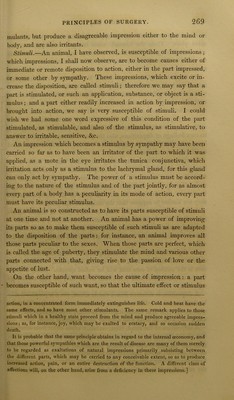
![mulants, but produce a disagreeable impression either to the mind or body, and are also irritants. Stimuli.—An animal, I have observed, is susceptible of impressions; which impressions, I shall now observe, are to become causes either of immediate or remote disposition to action, either in the part impressed, or some other by sympathy. These impressions, which excite or in- crease the disposition, are called stimuli; therefore we may say that a part is stimulated, or such an application, substance, or object is a sti- mulus ; and a part either readily increased in action by impression, or brought into action, we say is very susceptible of stimuli. I could wish we had some one word expressive of this condition of the part stimulated, as stimulable, and also of the stimulus, as stimulative, to answer to irritable, sensitive, &c. An impression which becomes a stimulus by sympathy may have been carried so far as to have been an irritator of the part to which it was applied, as a mote in the eye irritates the tunica conjunctiva, which irritation acts only as a stimulus to the lachrymal gland, for this gland can only act by sympathy. The power of a stimulus must be accord- ing to the nature of the stimulus and of the part jointly, for as almost every part of a body has a peculiarity in its mode of action, every part must have its peculiar stimulus. An animal is so constructed as to have its parts susceptible of stimuli at one time and not at another. An animal has a power of improving its parts so as to make them susceptible of such stimuli as are adapted to the disposition of the parts: for instance, an animal improves all those parts peculiar to the sexes. When those parts are perfect, which is called the age of puberty, they stimulate the mind and various other parts connected with that, giving rise to the passion of love or the appetite of lust. On the other hand, want becomes the cause of impression: a part becomes susceptible of such want, so that the ultimate effect or stimulus action, in a concentrated form immediately extinguishes life. Cold and heat have the same effects, and so have most other stimulants. The same remark applies to those stimuli which in a healthy state proceed from the mind and produce agreeable impres- sions; as, for instance, joy, which may be exalted to ecstacy, and so occasion sudden death. It is probable that the same principle obtains in regard to the internal ceconomy, and that those powerful sympathies which are the result of disease arc many of them merely to be regarded as exaltations of natural impressions primarily subsisting between the different parts, which may be carried to any conceivable extent, so as to produce increased action, pain, or an entire destruction of the function. A different class of affections will, on the other hand, arise from a deficiency in these impressions.]](https://iiif.wellcomecollection.org/image/b21996623_0001_0299.jp2/full/800%2C/0/default.jpg)