Licence: Public Domain Mark
Credit: The works of John Hunter / edited by James F. Palmer. Source: Wellcome Collection.
Provider: This material has been provided by the Royal College of Physicians of Edinburgh. The original may be consulted at the Royal College of Physicians of Edinburgh.
330/678 (page 300)
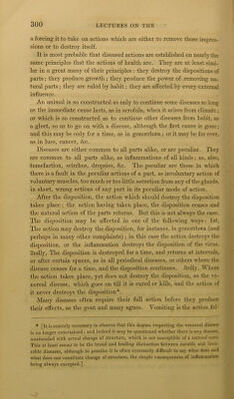
![a forcing it to take on actions which are either to remove those impres- sions or to destroy itself. It is most probable that diseased actions are established on nearly the same principles that the actions of health are. They are at least simi- lar in a great many of their principles : they destroy the dispositions of parts; they produce growth ; they produce the power of removing na- tural parts; they are ruled by habit; they are affected by every external influence. An animal is so constructed as only to continue some diseases so long as the immediate cause lasts, as in scrofula, when it arises from climate ; or which is so constructed as to continue other diseases from habit, as a gleet, so as to go on with a disease, although the first cause is gone; and this may be only for a time, as in gonorrhoea; or it may be for ever, as in lues, cancer, &c. Diseases are either common to all parts alike, or are peculiar. They are common to all parts alike, as inflammations of all kinds ; as, also, tumefaction, scirrhus, dropsies, <kc. The peculiar are those in which there is a fault in the peculiar actions of a part, as involuntary action of voluntary muscles, too much or too little secretion from any of the glands, in short, wrong actions of any part in its peculiar mode of action. After the disposition, the action which should destroy the disposition takes place; the action having taken place, the disposition ceases and the natural action of the parts returns. But this is not always the case. The disposition may be affected in one of the following ways: 1st, The action may destroy the disposition, for instance, in gonorrhoea (and perhaps in many other complaints) ; in this case the action destroys the disposition, or the inflammation destroys the disposition of the virus. 2ndly,- The disposition is destroyed for a time, and returns at intervals, or after certain spaces, as in all periodical diseases, or others where the disease ceases for a time, and the disposition continues. 3rdly, Where the action takes place, yet does not destroy the disposition, as the ve- nereal disease, which goes on till it is cured or kills, and the action of it never destroys the disposition*. Many diseases often require their full action before they produce their effects, as the gout and many agues. Vomiting is the action fol- * [It is scarcely necessary to observe that this dogma respecting the venereal disease is no longer entertained ; and indeed it may be questioned whether there is any disease, unattended with actual change of structure, which is not susceptible of a natural cure. This at least seems to be the broad and leading distinction between curable and incu- rable diseases, although in practice it is often extremely difficult to say what does and what does not constitute change of structure, the simple consequences of inflammation being always excepted.]](https://iiif.wellcomecollection.org/image/b21996623_0001_0330.jp2/full/800%2C/0/default.jpg)