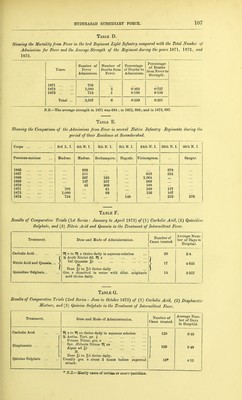
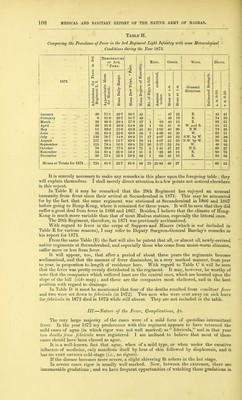
Medical and sanitary reports of the native army of Madras for the year 1873 : framed on the weekly an annual returns, on the reports of regimental medical officers, and on the inspection reports of deputy surgeons-general of the Indian Medical Department.
- Date:
- 1875
Licence: Public Domain Mark
Credit: Medical and sanitary reports of the native army of Madras for the year 1873 : framed on the weekly an annual returns, on the reports of regimental medical officers, and on the inspection reports of deputy surgeons-general of the Indian Medical Department. Source: Wellcome Collection.
Provider: This material has been provided by Royal College of Physicians, London. The original may be consulted at Royal College of Physicians, London.
109/216 (page 103)
![Duty and exercises.—Ordinary garrison duties, drills, parades, guards. The duties do Dnty and not seem to have exercised any injurious effect upon the health of the troops. exercises. Average number of nights per week in bed was only two while it was our tour for Resident's escort duty, which comes for one week in every four. It was about the same during the annual course of musketry, as the companies engaged in musketry are not employed on guard duties. At other periods the average number of nights in bed is five. Drill.—There are daily drills (excepting Thursdays and Saturdays) from 6 to 7-30 a.m., DrilL and in the afternoon from 4 to 6 p.m. Parades are usually held three times a week. I do not think these duties exercised any unfavorable influence upon the health of the troops. During the course of musketry men and officers were out often till noon in the hot season. I wrote to the Commandant on the subject; but, as the course of musketry was then nearly finished, the Major-General Commanding Hyderabad Subsidiary Force decided that it should be completed. Several of the officers suffered in health from it. No other recommendations were considered necessary. Exercises.—The regimental gymnasium is made use of by the recruits with evident Exercises, benefits. During the past year a soldiers' garden has been made, and it affords healthy relaxation and agreeable employment to a large number. A plot in the garden is allotted to each company. We have also started a cricket club, and many of the Burghers and Sepoys enjoy the game. Condition of lock-up rooms and prison cells.—The sanitary condition of the lock-up Condition of rooms and prison cells has been satisfactory. No defects injurious to the health of the'°°'^-'^P'i' 1 , . • and prison prisoners nave come to my notice. p^j],' Vaccination.—The state of vaccination in the corps has been satisfactory. Vaccination. No case of small-pox occurred during the year. There has been no occasion for vaccination. Vaccination was altogether stopped for a few months owing to the epidemic of fever. Diseases.—The only disease which prevailed in an epidemic form was intermittent fever. Diseases. It appears to have been similar in character to that which visited the regiment so severely during the two previous years. I consider it to be caused partly by the effect of this climate on the men after their long period of residence on the coast, partly by bad sanitary conditions in the lines (especially drainage), and partly by the bad site of the lines both with regard to the natural and artificial features of their neighbourhood. A special report upon this fever has. been separately submitted; it is therein discussed at some length. I shall, therefore, refrain from any further remarks in this place. As the subject of fever has been considered in a separate report, I shall here confine my observations to some other points connected with the medical history of this regiment during the past year. There has been a considerable loss to the service from filaria medi- nensis, there having been 25 admissions into hospital for this troublesome parasite during 1873. Not a single case of dracunculus occurred in the regiment during the first year of its stay at Secunderabad; (it arrived in February 1871.) The first case was admitted into hospital on the 16th of April 1872, and the total number of admissions for that year was 23. This fact is in accordance with the recorded observation -that the period of latency of the parasite, i e., the period from arrival in a district where it is endemic until its presence becomes obvious, is at least one year. In the present instance exactly fourteen months elapsed from the time the regiment arrived at Secunderabad until the occurrence of the first case of guinea-worm. During the year 1872 the direct loss to the service in this corps from guinea-worm was equivalent to one man constantly sick for 388 days. In 1873 it was equal to one man constantly sick for 667 days. In the former year the average time in hospital for each admission (23) was 169 days ; in 1873 (25 admissions) it was 26 7 days. Besides the direct loss to the service from guinea-worm there must be a very consider- able indirect loss owing to the effects of the prolonged suppuration which is often unavoidable, or the injury done to joints or muscles by inflammatory deposits, and, in consequence, the frequent necessity for granting a lengthened period of convalescent leave to its victims. I have not been able to trace the occurrence of guinea-worm in the regiment to the use^ of any particular well, nor does it appear to affect specially any one class of the men. It is prevalent amongst the civil population in the neighbourhood. During the past year in few cases did the worm present elsewhere than in the lower extremities. One worm was removed from the nates, another from the scrotum, and one was extracted through the tip of the middle finger. These, however, were not the most remarkable cases. One which occurred lately is, I believe, quite singular. In that case a red-coloredj filaria was extracted in the usual manner from the sole of a man's foot. It was about 12 inches in length and not more than half the usual diameter. Unfortunately it was accidentally broken by the patient himself, and a portion was lost. I was unable, for want of leisure, to examine it microscopically for some days after its extraction; then I found multitudes of what I take to be altered blood corpuscles in the expressed fluid, which is of a pale red color. However I am not a suffi- ciently-experienced microscopist to trust my own unconfined observation ; and, therefore, for the present, this subject must be left in abeyance. The worm is preserved in glycerine, and I shall take an early opportunity of having it examined by an experienced observer.](https://iiif.wellcomecollection.org/image/b24749266_0111.jp2/full/800%2C/0/default.jpg)