Medical and sanitary reports of the native army of Madras for the year 1873 : framed on the weekly an annual returns, on the reports of regimental medical officers, and on the inspection reports of deputy surgeons-general of the Indian Medical Department.
- Date:
- 1875
Licence: Public Domain Mark
Credit: Medical and sanitary reports of the native army of Madras for the year 1873 : framed on the weekly an annual returns, on the reports of regimental medical officers, and on the inspection reports of deputy surgeons-general of the Indian Medical Department. Source: Wellcome Collection.
Provider: This material has been provided by Royal College of Physicians, London. The original may be consulted at Royal College of Physicians, London.
36/216 (page 30)
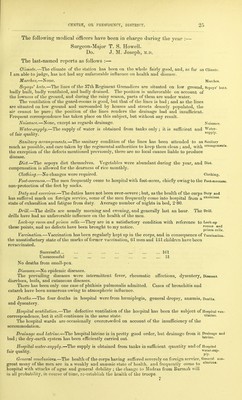
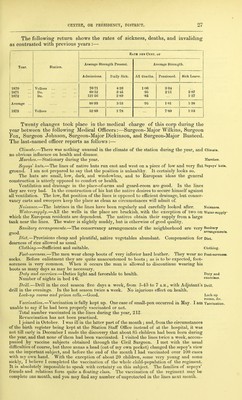
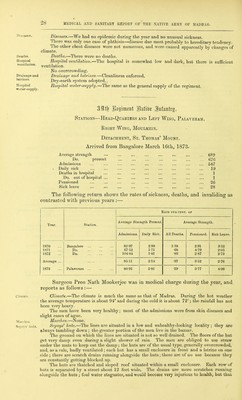
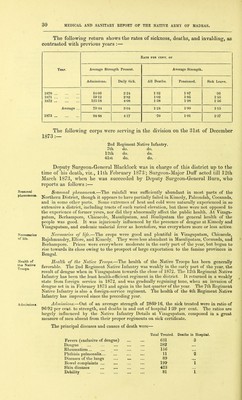
![Seasonal phenomena- Necessaries of life. Health of the Native Troops. Admissions. The following return shows the rates of sickness, deaths, and invalding, as contrasted with previous years :— Year. Rate per cent, op Average Strength Present. Average Strength. Admissions. Daily Sick. All Deaths. Pensioned. Sick Leave. 1870 5403 2-24 1-32 1-87 -36 1871 59-12 2-82 1-02 1-85 1-55 1872 12518 4-08 1-38 1-98 1-56 1873 Average ... 79-44 3-04 1-24 1-90 1-15 94-88 4-17 -70 1-91 2-37 The following corps were serving in the division on the 31st of December 1873 :— 2nd Regiment Native Infantry. 7th do. do. 12t]i do. do. 41st do. do. Deputy Surgeon-General Blacklock was in charge of this district up to the time of his death, viz., 11th February 1873; Sargeon-Major DuflF acted till 12th March 1873, when he was succeeded by Deputy Surgeon-General Burn, who reports as follows :— Seasonal phenomena.—The rainfall was sufficiently abundant in most parts of the Northern District, though it appears to have partially failed in Kimedy, Palcondah, Cocanada, and in some other parts. Some extremes of heat and cold were naturally experienced in so extensive a district, including tracts of such varied elevation, but these were not opposed to the experience of former years, nor did they abnormally affect the public health. At Vizaga- patam, Berhampore, Chicacole, Masulipatam, and Bimlipatam the general health of the people was good. It was injuriously influenced by the presence of dengue at Kimedy and Vizagapatam, and endemic malarial fever as heretofore, was everywhere more or less active. Necpssaries of life.—The crops were good and plentiful in Vizagapatam, Chicacole, Rajahmundry, Ellore, and Kimedy. They were less abundant in Masulipatam, Cocanada, and Berhampore. Prices were everywhere moderate in the early part of the year, but began to rise towards its close owing to the prospect of large exportation to the famine provinces in Bengal. Health of the Native Troops.—The health of the Native Troops has been generally favorable. The 2nd Regiment Native Infantry was weakly in the early part of the year, the result of dengue when in Vizagapatam towards the close of 1872. The 12th Regiment Native Infantry has been the least health-efficient regiment in the district. It returned in a weakly state from foreign service in 1872, and was gradually regaining tone, whea an invasion of dengue set in in February 1873 and again in the last quarter of the year. The 7th Regiment Native Infantry is also a foreign-service regiment. The health of the 4th Regiment Native Infantry has improved since the preceding year. Admissions.—Out of an average strength of 2860*16, the sick treated were in ratio of 96'92 per cent, to strength, and deaths in and out of hospital 1'39 per cent. The ratios are largely influenced by the Native Infantry Details at Vizagapatam, composed in a great measure of men absent from their proper regiments on sick certificate. The principal diseases and causes of death were— Fevers (exclusive of dengue) Dengue Rheumatism... Phthisis pulmonalis Diseases of the lungs Bowel complaints ... Skin diseases Debility Total Treated. 631 382 166 11 89 199 423 81 Deaths in Hospital. 3](https://iiif.wellcomecollection.org/image/b24749266_0038.jp2/full/800%2C/0/default.jpg)