Medical and sanitary reports of the native army of Madras for the year 1873 : framed on the weekly an annual returns, on the reports of regimental medical officers, and on the inspection reports of deputy surgeons-general of the Indian Medical Department.
- Date:
- 1875
Licence: Public Domain Mark
Credit: Medical and sanitary reports of the native army of Madras for the year 1873 : framed on the weekly an annual returns, on the reports of regimental medical officers, and on the inspection reports of deputy surgeons-general of the Indian Medical Department. Source: Wellcome Collection.
Provider: This material has been provided by Royal College of Physicians, London. The original may be consulted at Royal College of Physicians, London.
38/216 (page 32)
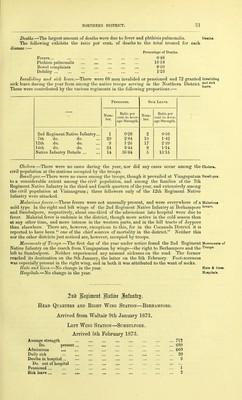
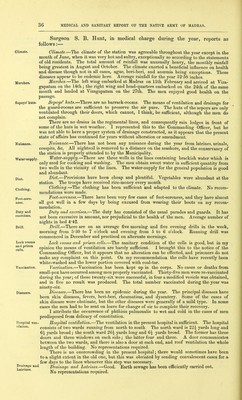
![The following return sliows the rates of sickness, deaths, and invaliding as contrasted with previous years :— Eate per cent. OF Year. Station. Average Strength Present. Average Strength. Admissions. Daily Sick. All Deaths. Pensioned. Sick Leave. 1870 1871 1872 Waltair ... Do Do 66-38 69-56 165-89 2- 42 3- 64 4- 20 1-42 1-21 •87 1-70 3-04 1^48 1-16 Average 100-61 3-42 1-83 1-58 •88 1873 Berhampore » 95-79 2-90 •28 •14 •28 Nuisance. The following medical officers were in charge during the year:— Surgeon Hazlett. Surgeon-Major Beach. The last-named reports as follows :— Climate. Climate.—The climate of tie year has not presented any very unusual variations. The total rainfall^ some 30 inches^ though not below the average of the two former years^ is below that of a good year. The first three months of the year were cool and agreeable with after- showers. Towards the middle of April the hot weather commenced with strong southerly winds. The heat continued excessive up to the end of June, when the south-west monsoon set in. The extremes of temperature ranged from 106° in the shade on the 1st June to 61° on the 30th December. The above considerations have not had any unfavorable influence on health and disease, Marches. Marckes.'—This wing (the right) with the head-quarters marched from Waltair on the 23rd December 1872, and arrived here on the 9th January 1873. No remarks called for. Sepoys' huts, Sepoys' huts.—The individual huts of the lines in which the troops and their families reside are, as a rule, fairly drained and ventilated. The surface drainage is susceptible of improvement; this has been suggested, and will shortly be carried out, as also the house sewage. Nuisance.—In the early part of the year the medical ofiicer of the regiment reported on the insanitary condition of a plot of waste ground to the north of the lines, and the nuisance was removed; also see reply to question No. 5 above. Hospital Hospital vmter-sufply.—The water-supply has been suflScient and of average quality, ■water-supply. Q^^^ained from several wells and tanks in the vicinity of the lines. In the absence of any record of analysis, I am not prepared to say how far the infiltration of the subsoil with sewage may have influenced its purity. Sanitary ar- Sanitary arrangements.—The sanitation of the lines has generally been satisfactory, rangements. ^^^^^ J ]jnow, there are no local causes of disease requiring removal if we except the causes of venereal infection. Diet.—Provisions have been plentiful, and the market rates ruled moderate. Vege- tables, both European and Native, are abundant during the cold season. Native vegetables are less plentiful during the hot season and commencement of the rains. The troops have received compensation. Glothinrj.—The clothing of the men has been suflicient and adapted to the climate. No changes have been recommended. Foot-soreness.—There has been a considerable amount of foot-soreness, though not perhaps above the average, due mainly to wearing boots without socks. The boots are hard, roughly made, and not often a perfect fit; small particles of sand and gravel get in, and, with the natural friction, are a source of irritation, which soon raises a blister. Duty and exercises.— The duty of the men has consisted in the usual exercises, drills, route-marches, and guards pertaining to a native corps, and, though quite up to regulation, have not been excessive, or exercised any prejudicial influence on the general health. Number of nights in bed 4^. drill was omitted during the hot weather. The morning drills commence before sunrise, lasting about 1^ hour; the evening drills not so long. These duties have had no unfavorable influence on health, nor have any recommendations been made. Diet. Clothing. Foot-sore- ness. Duty and ex ercises.](https://iiif.wellcomecollection.org/image/b24749266_0040.jp2/full/800%2C/0/default.jpg)