Licence: Public Domain Mark
Credit: Ethnology / By A. H Keane. Source: Wellcome Collection.
Provider: This material has been provided by the Royal College of Physicians of Edinburgh. The original may be consulted at the Royal College of Physicians of Edinburgh.
18/484
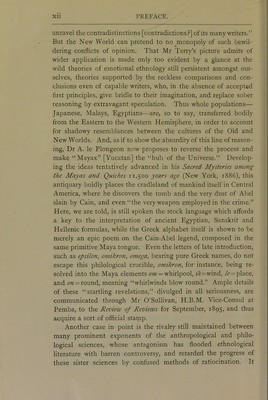
![unravel the contradistinctions [contradictions?] of its many writers.” But the New World can pretend to no monopoly of such bewil- dering conflicts of opinion. That Mr Terry’s picture admits of wider application is made only too evident by a glance at the wild theories of emotional ethnology still persistent amongst our- selves, theories supported by the reckless comparisons and con- clusions even of capable writers, who, in the absence of accepted first principles, give bridle to their imagination, and replace sober reasoning by extravagant speculation. Thus whole populations— Japanese, Malays, Egyptians—are, so to say, transferred bodily from the Eastern to the Western Hemisphere, in order to account for shadowy resemblances between the cultures of the Old and New Worlds. And, as if to show the absurdity of this line of reason- ing, Dr A. le Plongeon now proposes to reverse the process and make “Mayax” [Yucatan] the “hub of the Universe.” Develop- ing the ideas tentatively advanced in his Sacred Mysteries among the Mayas and Quiches 11,500 years ago (New York, 1886), this antiquary boldly places the cradleland of mankind itself in Central America, where he discovers the tomb and the very dust of Abel slain by Cain, and even “the very weapon employed in the crime.” Here, we are told, is still spoken the stock language which affords a key to the interpretation of ancient Egyptian, Sanskrit and Hellenic formulas, while the Greek alphabet itself is shown to be merely an epic poem on the Cain-Abel legend, composed in the same primitive Maya tongue. Even the letters of late introduction, such as epsilon, omikroti, omega, bearing pure Greek names, do not escape this philological crucible, omikron, for instance, being re- solved into the Maya elements = whirlpool, f/^=wind, /if = place, and on = Tound, meaning “whirlwinds blow round.” Ample details of these “ startling revelations,” divulged in all seriousness, are communicated through Mr O’Sullivan, H.B.M. Vice-Consul at Pemba, to the Review of Reviews for September, 1895, and thus acquire a sort of official stamp. Another case in point is the rivalry still maintained between many prominent exponents of the anthropological and philo- logical sciences, whose antagonism has flooded ethnological literature with barren controversy, and retarded the progress of these sister sciences by confused methods of ratiocination. It](https://iiif.wellcomecollection.org/image/b21728331_0018.jp2/full/800%2C/0/default.jpg)