Royal Commission on the Poor Laws and Relief of Distress. Appendix.
- Royal Commission on the Poor Laws and Relief of Distress 1905-09
- Date:
- 1909-1913
Licence: Public Domain Mark
Credit: Royal Commission on the Poor Laws and Relief of Distress. Appendix. Source: Wellcome Collection.
12/646 page 2
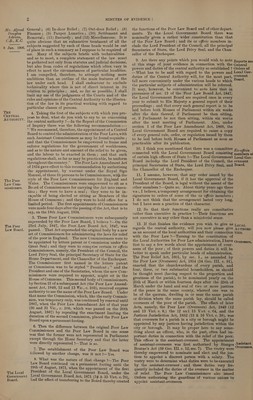
![Douglas Adrian, C.B., K.C. 8 Jan. 1906. THE CENTRAL . AUTHORITY. The Poor Law Com- missioners. The Poor Law Board. The Local Government Board. 2 Finance ; (9) Pauper Lunatics; (10) Settlement and Removal; (11) Bastardy; and (12) Miscellaneous. It is quite obvious that an exhaustive treatment of all the subjects suggested by each of these heads would be out of place in such a summary as I suppose to be required of me. Many of the subjects bristle with technicalities and as to most, a complete statement of the Jaw must be gathered not only from statutes and judicial decisions, but also from codes of regulations which often vary in effect to meet the circumstances of particular localities. I am compelled, therefore, to attempt nothing more ambitious than an outline of the main features of the law under each head. I shall endeavour to exclude technicality where this is not of direct interest in its relation to principles; and, so far as possible, I shall limit my use of the judgments of the Courts and of the rules and opinions of the Central Authority to the illustra- tion of the law in its practical working with regard to particular classes of persons. 4. Taking the first of the subjects with which you pro- pose to deal, what do you wish to say to us concerning the central authority ?—In the Report of the Commission of Inquiry there was the following recommendation :— ** We recommend, therefore, the appointment of a Central Board to contro] the administration of the Poor Laws,with such Assistant Commissioners as may be found requisite ; and that the Commissioners be empowered to frame and enforce regulations for the government of workhouses, and as to the nature and amount of the relief to be given, and the labour to be exacted in them; and that such regulations shall, as far as may be practicable, be uniform throughout the country.’ The Poor Law Amendment Act of 1834 gave effect to this recommendation by authorising the appointment, by warrant under the Royal Sign Manual, of three fit persons to be Commissioners, with the style of the Poor Law Commissioners for England and Wales. The Commissioners were empowered to sit as a Board of Commissioners for carrying the Act into execu- tioa; they were to have a seal; they were to be in- capable of being elected or sitting as Members of the House of Commons ; and they were to hold office for a limited period. The first appointments of Commissioners were made four days after the passing of the Act, that is to say, on the 18th August, 1834. 5. These Poor Law Commissioners were subsequently superseded by the Poor Law Board, I believe ?—On the 23rd July, 1847, the Poor.Law Board Act, 1847, was passed. That Act superseded the original body by a new set of Commissioners for administering the laws for relief of the poor in England. The new Commissioners were to be appointed by letters patent or Commission under the Great Seal; and they were to comprise certain ex officio Commissioners, namely, the President of the Council, the Lord Privy Seal, the principal Secretary of State for the Home Department, and the Chancellor of the Exchequer. The Commissioner first named in the letters patent or Commission was to be styled ‘‘ President ;”? and the President and one of the Secretaries, whom the new Com- missioners were required to appoint, might sit in the House of Commons. Thissecond body of Commissioners, by Section 21 of a subsequent Act (the Poor Law Amend- ment Act, 1849, 12 and 13 Vic., c. 103), received express authority to use the name of the Poor Law Board. Under that name the Commission, which, like the early Commis- sion, was temporary only, was continued by renewal until 1867, when the Poor Law Amendment Act of that year (30 and 31 Vic., c. 106, which was passed on the 20th August, 1867) by repealing the enactment limiting the duration of the second Commission, placed the Poor Law Board upon a permanent footing. 6. Then the difference between the original Poor Law Commissioners and the Poor Law Board in one sense was that the former were not represented in Parliament except through the Home Secretary and that the latter were directly represented ?—That is so. 7. The establishment of the Poor Law Board was followed by another change, was it not ?—Yes. 8. What was the nature of that change ?—The Poor Law Board continued on a permanent footing until the 19th of August, 1871, when the appointment of the first President of the Local Government Board, under the Local Government Board Act, 1871 (34 & 35 Vict. c. 70) had the effect of transferring to the Board thereby created the functions of the Poor Law Board and of other depart- ments. To the Local Government Board there was nominally given a rather wider constitution than that of the Poor Law Board; and its ex officio members in- Secretaries of State, the Lord Privy Seal, and the Chan- cellor of the Exchequer. fall more conveniently under the various heads to which the particular subjects of administration will be referred. It may, however, be convenient to note here that in pursuance of sec. 13 of the Poor Law Board Act, 1847, the Local Government Board are required once in every year to submit to His Majesty a general report of their proceedings ; and that every such general report is to be laid before both Houses of Parliament within six weeks after the date thereof, if Parliament be then sitting, or, if Parliament be not then sitting, within six weeks after the next meeting of Parliament. Also, under section 1 of the Poor Law Amendment Act, 1868, the Local Government Board are required to cause a copy of every general rule, order, or regulation issued by them to be laid before both Houses of Parliament as soon as practicable after its publication. 10. I think you mentioned that there was a committee connected with the Local Government Board consisting the Chancellor of the Exchequer. 11. I assume, however, that any order issued by the Local Government Board, if it has the approval of the President of the Board, is legal without the assent of the other members ?— Quite so. About thirty years ago there wa, I believe, a temporary arrangement for obtaining the signatures to orders of some of the ex officio members ; I do not think that the arrangement lasted very long, but I have seen a practice of that character. 12. So that their functions really are consultative rather than executive in practice ?—Their functions are not executive in any other than a ministerial sense. with the Poor Law ?—Turning to the constitution of first to say a few words about the appointment of over- seers of the poor; of their powers and duties it will be better to speak under particular heads of administration. The Poor Relief Act, 1601, by sec. 1., as amended by the Poor Law (Overseers) Act, 1814 (54 Geo. III. c. 91), enacted that the churchwardens of every parish, and four, three, or two substantial householders, as should be thought meet (having respect to the proportion and greatness of the parish), to be nominated yearly on the 25th of March or within fourteen days after the 25th of March under the hand and seal of two or more justices of the peace in the same county, whereof one was to be of the quorum, dwelling in or near the same parish or division where the same parish lay, should be called overseers of the poor of the parish. The effect. of later Acts, namely, the Poor Law (Overseers) Act, 1849 (12 and 13 Vict. c. 8,) the 12 ani 13 Vict. c. 64, and the Justices Jurisdiction Act, 1852 (15 & 16 Vict. c. 38), was that overseers for a parish in a city or borough might be appointed by any justices having jurisdiction within the city or borough. It may be proper here to say some- thing about an officer, who, in the past, often had im- portant duties in connection with the relief of the poor. This officer is the assistant-overseer. The appointment of assistant-overseers was first authorised by Sturges Bourne’s Act (59 Geo. III. c. 12, sec. 7). The vestry were thereby empowered to nominate and elect and the jus- tices to appoint a discreet person with a salary. The vestry were to determine what duties were to be executed by the assistant-overseer; and these duties very fre- quently included the duties of the overseer in the matter of relief. The Poor Law Commissioners also issued Orders authorising the guardians of various unions to appoint assistant-oversecrs. aids)](https://iiif.wellcomecollection.org/image/b32184335_0012.jp2/full/800%2C/0/default.jpg)