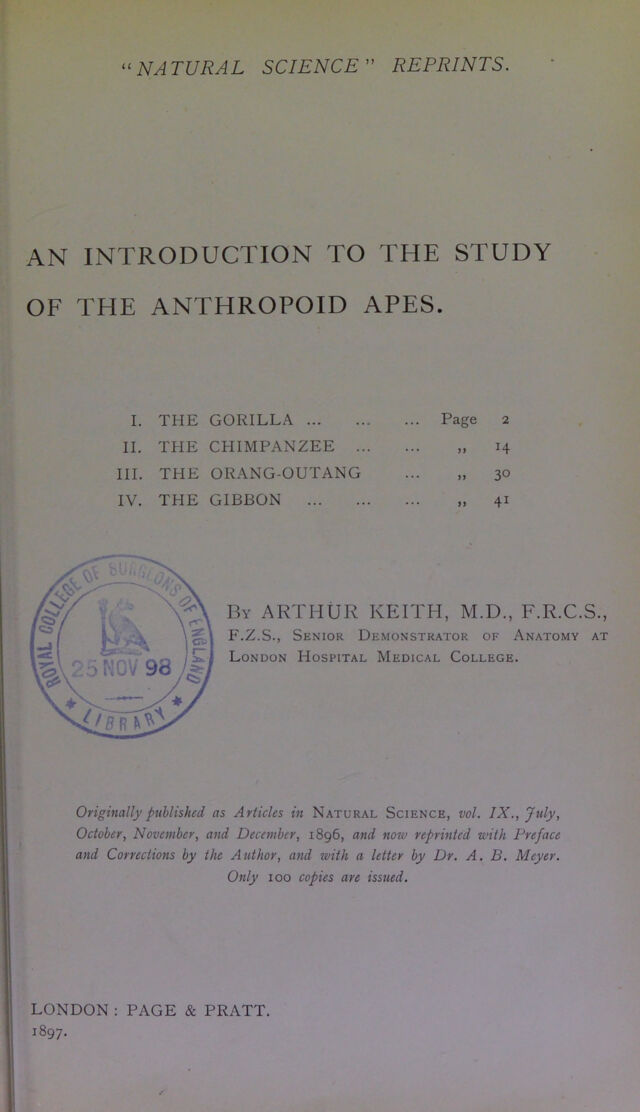
An introduction to the study of the anthropoid apes / by Arthur Keith.
- Arthur Keith
- Date:
- 1897
Licence: Public Domain Mark
Credit: An introduction to the study of the anthropoid apes / by Arthur Keith. Source: Wellcome Collection.
Provider: This material has been provided by The Royal College of Surgeons of England. The original may be consulted at The Royal College of Surgeons of England.
10/52 page 6
![(30) (22), Chapman (13), and Deniker (17). The viscera of the abdomen have never been thoroughly described. The liver has been dealt with by Chudzinski (15), Flower (28), Virchow (84), Deniker (17), Bolau (10), Bischoff (7), and Huxley (496). The alimentary canal has been observed, though only in a cursory manner, by Virchow (84), Deniker (17), Chapman (13), Bischoff (7), Bolau (10), Flower (28), and Hartmann (40). Macalister and Deniker mention the presence of salivary glands (!) But of the pancreas, the supra-renal bodies, the arrangement of the peritoneum and mesenteries, and the sympathetic system of the abdomen, we know practically nothing. [See also 211.] The Respiratory System.—A great deal has been written on the larynx and laryngeal sacs: Ehlers (23), Deniker (17 and 19), Bischoff (7), Duvernoy (22). The function of these sacs is unknown. The lungs are partially described by Ehlers, Bolau, Bischoff, Deniker, and Hartmann. [See also 203.] The Circulatory System.—One would scarcely expect to find any peculiar feature about the heart of the gorilla, and none has been recorded, yet one would expect that the disposition of the pericardium and its relationship to the diaphragm would be different from that found in man. Only Bolau, Deniker, Ehlers, and Bischoff make mention of the heart. Our knowledge of the arteries of the gorilla we owe to Deniker (17) and Eisler (24). This system, especially as regards the veins, requires much more attention. The Lymphatic System and the Ductless Glands.—Of the lymphatic system nothing is known except in a most general way [Eisler, 24.] The spleen has been figured by Bischoff(7) and Deniker; Virchow (84) alludes to it ; so does Bolau. Deniker and Ehlers give a short description of the thyroid; the thymus, supra-renal bodies, pineal and pituitary bodies, the carotid, and coccygeal bodies have never been described. The Genito-Urinary System.—The kidney of the gorilla, like that of the other anthropoids, has only one papilla, and has been described by Deniker (17), Virchow (84), Bolau (10), and Ehlers (23). Its microscopic structure and development require to be investigated. The bladder and its relationship to the pelvis and pelvic fascia have not been noted. The testicle is cursorily described by Ehlers and Chapman, but the prostate and the urethra have not been examined. Duvernoy, Ehlers, Huxley (496), Owen (Proc. Zool. Soc., 1859), and Chapman have described the external genital organs. The repro- ductive system of the female requires examination, although Bischoff (6), Deniker, Bolau, Ehlers, and Hartmann (42) have already made contributions to this subject. Organs of Sense.—These are not likely to show any marked differences from those of man ; yet it would be well to give them the attention they have not yet received. External Characters, Configuration, and Proportions.— Pigeon-holing systematists have devoted most of their attention to](https://iiif.wellcomecollection.org/image/b22335304_0012.jp2/full/800%2C/0/default.jpg)


 No text description is available for this image
 No text description is available for this image
 No text description is available for this image