An introduction to the study of the anthropoid apes / by Arthur Keith.
- Arthur Keith
- Date:
- 1897
Licence: Public Domain Mark
Credit: An introduction to the study of the anthropoid apes / by Arthur Keith. Source: Wellcome Collection.
Provider: This material has been provided by The Royal College of Surgeons of England. The original may be consulted at The Royal College of Surgeons of England.
44/52 page 40
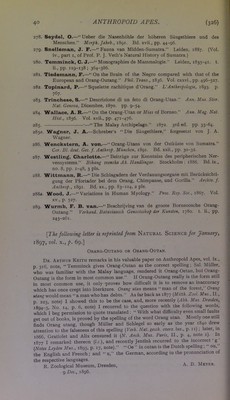
![278. Seydel, O.— Ueber die Nasenhohle der hoheren Saugethiere und des Menschen.” Morph. Jahrb., 1891. Bd. xvii., pp. 44-96. 279. Snelleman, J. P.— Fauna van Midden-Sumatra. Leiden, 1887. (Vol. iv., part i, of Prof. P. J. Veth’s Natural History of Sumatra.) 280. Temminck, C. J.— Monographies de Mammalogie.” Leiden, 1835-41. t. ii„ pp. 119-138; 364-386. 281. Tiedemann, F.—'* On the Brain of the Negro compared with that of the European and Orang-Outang. Phil. Trans., 1836. Vol. cxxvi., pp. 496-527. 282. Topinard, P.— Squelette rachitique d’Orang.” L'Anthropologie, 1893. p. 767. 283. Trinchese, S.— Descrizione di un feto di Orang-Utan.” Ann. Mus. Stor. Nat. Genova, Dicembre, 1870. pp. 9-54. 284. Wallace, A. R.— On the Orang-Utan or Mias of Borneo.” Ann. Mag. Nat. Hist., 1856. Vol. xvii., pp. 471-476. 285. •— The Malay Archipelago. 1872. 3rd ed. pp. 35-64. 285a. Wagner, J. A.—Schreber's Die Saugethiere,” forgesetzt von J. A. Wagner. 286. Wenckstern, A. von.—Orang-Utans von der Ostkiiste von Sumatra.” Cor. Bl. dent. Ges.f. Anthrop. Munchen, 1891. Bd. xxii., pp. 30-32. 287. Westling, Charlotte.— Beitrage zur Kenntniss des peripherischen Ner- vensystems. Bihang svenska Ak. Handlingar. Stockholm: 1886. Bd. ix., no. 8, pp. 1-48, 3 pis. 288. Wittmann, R.— Die Schlagadern der Verdauungsorgane mil Berucksichti- gung der Pfortader bei dem Orang, Chimpanse, und Gorilla.” Archiv.f. Anthrop., 1891. Bd. xx., pp. 83-104, 2 pis. 288a. Wood, J.—Variations in Human Myology.” Proc. Roy. Soc., 1867. Vol. xv., p. 527. 289. Wurmb, F. B. van.— Beschrijving van de groote Borneoosche Orang- Outang.” Verhand. Bataviaasch Genootschap der Kunsten, 1780. t. ii., pp. 245-261. [The following letter is reprinted from Natural Science for January, 1897, vol. x., p. 69.] Orang-Outang or Orang-Outan. Dr. Arthur Keith remarks in his valuable paper on Anthropoid Apes, vol. ix., p. 316, note, Temminck gives Orang-Outan as the correct spelling; Sal. Muller, who was familiar with the Malay language, rendered it Orang-Oetan, but Orang- Outang is the form in most common use.” If Orang-Outang really is the form still in most common use, it only proves how difficult it is to remove an inaccuracy which has once crept into literature. Orang utan means man of the forest,” Orang utang would mean “ a man who has debts.” As far back as 1877 (Mitih. Zool. Mus., II., p. 225, note) I showed this to be the case, and, more recently (Abh. Mus. Dresden, i894-5> No. 14, p. 6, note) I recurred to the question with the following words, which I beg permission to quote translated: With what difficulty even small faults get out of books, is proved by the spelling of the word Orang utan. Mostly one still finds Orang utang, though Muller and Schlegel so early as the year 1840 drew attention to the falseness of this spelling (Verh. Nat.gesch. overz. bez., p. 11) ; later, in 1866, Gratiolet and Alix censured it (N. Arch. Mus. Paris, II., p. 4, note 1). In 1877'I remarked thereon (/.r.), and recently Jentink recurred to the incorrect ‘ g ' (Notes Leyden Mus., 1895, p. 17, note).” Oe ” in outan is the Dutch spelling ; ou,” the English and French; and u,” the German, according to the pronunciation of the respective languages. R. Zoological Museum, Dresden, A- B- Meyer. 9 Dec., 1896.](https://iiif.wellcomecollection.org/image/b22335304_0046.jp2/full/800%2C/0/default.jpg)


 No text description is available for this image
 No text description is available for this image
 No text description is available for this image