A practical treatise on fractures and dislocations / by Frank Hastings Hamilton.
- Frank Hastings Hamilton
- Date:
- 1863
Licence: Public Domain Mark
Credit: A practical treatise on fractures and dislocations / by Frank Hastings Hamilton. Source: Wellcome Collection.
Provider: This material has been provided by the National Library of Medicine (U.S.), through the Medical Heritage Library. The original may be consulted at the National Library of Medicine (U.S.)
77/784
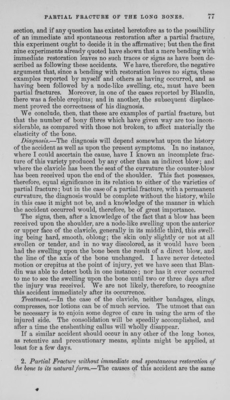
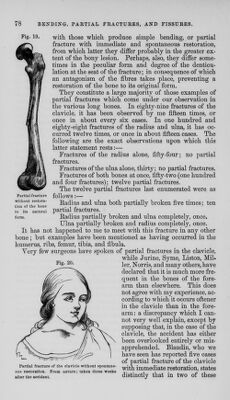
![sectioi], and if any question has existed heretofore as to the possibility of an immediate and spontaneous restoration after a partial fracture, this experiment ought to decide it in the affirmative; but then the first nine experiments already quoted have shown that a mere bending with immediate restoration leaves no such traces or signs as have been de- scribed as following these accidents. We have, therefore, the negative argument that, since a bending with restoration leaves no signs, these examples reported by myself and others as having occurred, and as having been followed by a node-like swelling, etc., must have been partial fractures. Moreover, in one of the cases reported by Blandin, there was a feeble crepitus; and in another, the subsequent displace- ment proved the correctness of his diagnosis. We conclude, then, that these are examples of partial fracture, but that the number of bony fibres which have given way are too incon- siderable, as compared with those not broken, to afi^ect materially the elasticity of the bone. Diagnosis.—The diagnosis will depend somewhat upon the history of the accident as well as upon the present symptoms. In no instance, where I could ascertain the cause, have I known an incomplete frac- ture of this variety produced by any other than an indirect blow; and where the clavicle has been the seat of the curvature the counter-blow has been received upon the end of the shoulder. This fact possesses, therefore, equal significance in its relation to either of the varieties of partial fracture; but in the case of a partial fracture, with a permanent curvature, the diagnosis would be complete without the history, while in this case it might not be, and a knowledge of the manner in which the accident occurred would, therefore, be of great importance. The signs, then, after a knowledge of the fact that a blow has been received upon the shoulder, are a node-like swelling upon the anterior or upper face of the clavicle, generally in its middle third, this swell- ing being hard, smooth, oblong; the skin only slightly or not at all swollen or tender, and in no way discolored, as it would have been had the swelling upon the bone been the result of a direct blow, and the line of the axis of the bone unchanged. I have never detected motion or crepitus at the point of injury, yet we have seen that Blan- din was able to detect both in one instance; nor has it ever occurred to me to see the swelling upon the bone until two or three days after the injury was received. We are not likely, therefore, to recognize this accident immediately after its occurrence. Treatment.—In the case of the clavicle, neither bandages, slings, compresses, nor lotions can be of much service. The utmost that can be necessary is to enjoin some degree of care in using the arm of the injured side. The consolidation will be speedily accomplished, and after a time the ensheathing callus will wholly disappear. If a similar accident should occur in any other of the long bones, as retentive and precautionary means, splints might be applied, at least for a few days. 2. Partial Fracture without immediate and spontaneous restoration of the hone to its natural form.—The causes of this accident are the same](https://iiif.wellcomecollection.org/image/b21125892_0077.jp2/full/800%2C/0/default.jpg)