The blowpipe vade macum : the blowpipe characters of minerals deduced from the original observations of Aquilla Smith ; alphabetically arranged and edited by Samuel Haughton and Robert H. Scott / [Aquilla Smith].
- Aquilla Smith
- Date:
- 1862
Licence: Public Domain Mark
Credit: The blowpipe vade macum : the blowpipe characters of minerals deduced from the original observations of Aquilla Smith ; alphabetically arranged and edited by Samuel Haughton and Robert H. Scott / [Aquilla Smith]. Source: Wellcome Collection.
61/76 page 53
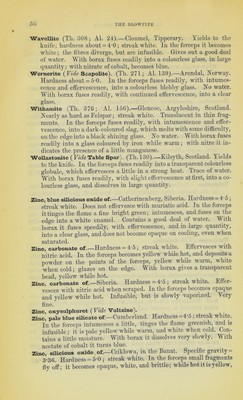
![;53 large quantity, into a glass which becomes opaque when cold, if sa- turated. Sulphate of Liime, compact hydrous.—Hardness less than calcareous spar. In the forceps fuses readily into a white opaque globule, which boils a little if intensely heated. Contains much water. With borax dissolves very readily into a clear glass, which becomes opaque when cold, if a sufficient quantity of the assay be used. Table Spar ( Fic?e Wollastonite). (Th. 129; Al. 152).—Cziklowa, in the Banat, Temeswar. Hoes not effervesce with miu’iatic acid. Yields to the knife. In the forceps fuses, with slight effervescence in the inner flame, into an opaline globule. Contains a little water. With borax fuses slowly into a colourless glass. Hr. Thompson gives the name of WoUastonite to a different mineral {Qu. Stellite). Table Spar (Th. 129; Al. 152).—Hardness about = 3’5. l)oes not ef-. fervesce with nitric acid. In the forceps decrepitates slightly, and fuses readily into a white enamel; in a strong heat it effervesces a little. Ho Mmter. With borax dissolves readily into a transparent colourless glass. Table Spar (Th. 129).—Hoes not effervesce with acid. Hardness about = 4-0. In the forceps it fuses on the edge into a semi-transpa- rent glass, and forms a bead with some difficulty in a prolonged blast. With borax effervesces a little at first, and fuses rather slowly into a colourless glass. Talc (Th. 357; Al. 90).—St. Stephen’s, Cornwall. YTelds easily to the knife. In the forceps fuses readily, with some intumescence and effervescence, into a brownish black scoriaceous bead, feebly magnetic. With borax fuses readily, with effervescence, into a glass coloured deeply by iron. Talc, indurated (Al. 91).—Shetland. Hardness about = 4’0; streak white. ' Sectile in a low degree. In the forceps fuses, with great difficulty, on its thinnest edges. Trace of moisture. With borax emits a few bubbles, tinges it with iron, and dissolves very slowly. [With microcosmic salt, intumesces and dissolves, leaving a siliceous skeleton.—En.] Talc, Venetian (Th. 186).—Tyrol. Flexible, sectile. Yields to the nail. In the forceps exfoliates and fuses on the edge into a white enamel. No water. With borax effervesces much, dissolves spee- dily, and in large quantity, into a clear glass not rendered opaque by flaming. Not soluble in hot nitric acid. Tantalite ( Vide Columbite). (Ph. 272 ; Th. 484).—Connecticut, North America. Hardness about = 5 ■ 25; streak pale reddish-brown. In a good heat it fuses on the edge into an iron-grey glaze ; not attracted by the magnet. No water. With borax fuses very slowly into a glass slightly coloured by iron; if saturated, the bead becomes greyish by flaming, and nearly opaque ; with borax and nitre gives a trace of manganese. With salt of phosphorus dissolves slowly into a glass coloured by iron while warm; does not become red when cold; there- fore does not contain Tungsten.](https://iiif.wellcomecollection.org/image/b24878583_0061.jp2/full/800%2C/0/default.jpg)