The constituents of the leaves of prunus serotina / by Frederick B. Power and Charles W. Moore.
- Frederick Belding Power
- Date:
- [1910?]
Licence: In copyright
Credit: The constituents of the leaves of prunus serotina / by Frederick B. Power and Charles W. Moore. Source: Wellcome Collection.
15/18 page 1111
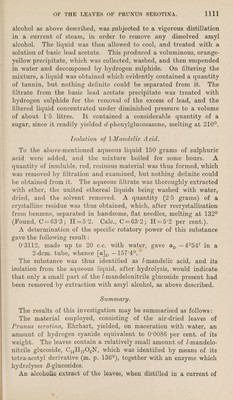
![alcohol as above described, was subjected to a vigorous distillation in a current of steam, in order to remove any dissolved amyl alcohol. The liquid was then allowed to cool, and treated with a solution of basic lead acetate. This produced a voluminous, orange- yellow precipitate, which was collected, washed, and then suspended in water and decomposed by hydrogen sulphide. On filtering the mixture, a liquid was obtained which evidently contained a quantity of tannin, but nothing definite could be separated from it. The filtrate from the basic lead acetate precipitate was treated with hydrogen sulphide for the removal of the excess of lead, and the filtered liquid concentrated under diminished pressure to a volume of about 1'5 litres. It contained a considerable quantity of a sugar, since it readily yielded dZ-phenylglucosazone, melting at 210°. Isolation of VMandelic Acid. To the above-mentioned aqueous liquid 150 grams of sulphuric acid were added, and the mixture boiled for some hours. A quantity of insoluble, red, resinous material was thus formed, which wTas removed by filtration and examined, but nothing definite could be obtained from it. The aqueous filtrate was thoroughly extracted with ether, the united ethereal liquids being washed with -water, dried, and the solvent removed. A quantity (2‘5 grams) of a crystalline residue was thus obtained, which, after recrystallisation from benzene, separated in handsome, flat needles, melting at 132° (Found, C = 63'3; II=:5'2. Calc., C = 63'2; H = 5'2 per cent.). A determination of the specific rotatory power of this substance gave the following result: 0‘3112, made up to 20 c.c. with water, gave aD — 4°54/ in a 2-dcm. tube, whence [a]D —157‘4°. The substance was thus identified as Z-mandelic acid, and its isolation from the aqueous liquid, after hydrolysis, would indicate that only a small part of the Z-mandelonitrile glucoside present had been removed by extraction with amyl alcohol, as above described. Summary. The results of this investigation may be summarised as follows: The material employed, consisting of the air-dried leaves of Prunus serotina, Ehrhart, yielded, on maceration with water, an amount of hydrogen cyanide equivalent to 0’0086 per cent, of its weight. The leaves contain a relatively small amount of Z-mandelo- nitrile glucoside, C14H17OcN, which was identified by means of its tetra-acetyl derivative (m. p. 136°), together with an enzyme which hydrolyses /3-glucosides. An alcoholic extract of the leaves, when distilled in a current of](https://iiif.wellcomecollection.org/image/b30616839_0015.jp2/full/800%2C/0/default.jpg)