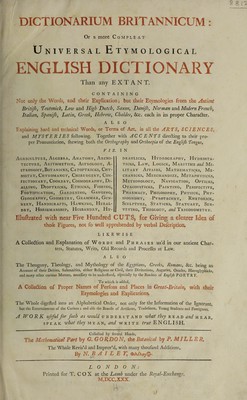
Dictionarium Britannicum: or a more compleat universal etymological English dictionary than any extant ... / Collected by several hands, the mathmatical part by G. Gordon, the botanical by P. Miller. The whole revis'd and improv'd ... by N. Bailey.
- Nathan Bailey
- Date:
- 1730
Licence: Public Domain Mark
Credit: Dictionarium Britannicum: or a more compleat universal etymological English dictionary than any extant ... / Collected by several hands, the mathmatical part by G. Gordon, the botanical by P. Miller. The whole revis'd and improv'd ... by N. Bailey. Source: Wellcome Collection.
11/830
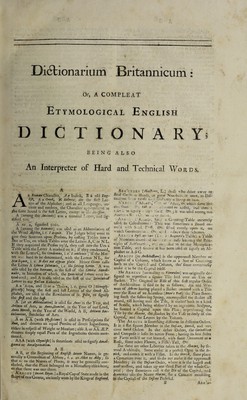
![Dictionarium Britannicum: Or, A COMPLEAT Etymological English DICTIONARY; BEING An Interpreter of Hard A a Roman Chara£ler, A a Italick, 31 a old Eng- I’fi, A a. Greek, X Hebrew, are the firft Let¬ ters of the Alphabet; and in all Languages, an¬ cient and modern, the Character appropriated tc the fame Sound is the firft Letter, except in th< Abajjine. A [among the Ancients] was a numeral Letter, and fig- riified 500. A or a, fignified 5000. . A [among the RomansJ was ufed as an Abbreviation of the Word Abfolvo, i.e. 1 acquit. The Judges being wont to give their Sentence upon Perfons, by calling Tables into a Box or Urn, on which Tables were the Letters A, C or N L. It they acquitted the Perfon try’d, they call into the Urn a Table with the Letter A marked on it; if they condemned, Yvith the Letter C, for Condemno, i. e. I condemn • 'if the Mat¬ ter was hard to be determined, with the Letters N L, for Non Lquet, i. e. It does not appear plain. Hence Cicero calls the Letter A Litera falutaris, i.e. the faving Letter. A was alfo ufed by the Romans, as the fir.fl of the LitterKundi- tialesy in Imitation of which, the Dominical Letters were in¬ troduced; and A is alfo ufed as the firll of the Dominical Letters in our Julian Kalendar. A * Axiftt, and .Qora ’Qui?*, i. e. great O [Hieregly- phicaUy] being the firll and lull Letters of the Greek Al¬ phabet, are ufed in the Revelation of St. John, to Signify the ftrfl and the lajl. A [as an Abbreviation] is ufed for Anno in the Year, and Artium of Arts, as Anno.Domini, in the Year of our Lord, Anno Mundi, in the Year of the World, A B, Artium Bac- ealaureus, Batchelor of Arts. A or A A [with Phyficians] is ufed in Prefcriptions for Ana, and denotes ah equal Portion of divers Ingredients, cither in refpeft of Weight or Meafure ; alfo A or AA.iE.P. denotes fimply equal Parts of the Ingredients therein men¬ tioned. AAA [with Chymifls] is fometimes uled to fignify Amal¬ gam a or Amalgamation. A B A B, at the Beginning of Englifb Saxon Names, is ge¬ nerally a Contraflion of Abbot, i. e. an Abbot or Abhy • fo that as to the Names of Places, it may be generally con- eluded, that the Place belonged to a Monafteryelfe where, or that there was one there. A ba cot [Incert. Etym.] a Royal Cap of State made in the lit <»pe of tv, 0 Crowns, anciently worn by the Kings of England. ALSO and Technical Words. Aba'ctors [Abalheer, L.J thofe v.ho drive away or fleal C*t fo n Herds, or great Numbers at once, m Dif- tinct'On 1) n taofe t.* t ftr.d only a Sheep or two. Abaco T A|J.j.x?- •, * ' of Gr, which lome ‘de¬ rive’’rom 1, Heb r c vated or raifed, and thence t ke it to iigi iry iif' Licit, Qpc.j it was ufed among the Anciem-s fo iO So j or Bu et. Aba. . l Gr.j a Counting-Table anciently ufed in Calculations: this was fometimes a Board co¬ ver d with Said. P'1 ft, &c. fifed evenly upon it, on v/nich Geometric) ai &-c. u: i > draw their Schemes, Abaci s Pyll >ge cut \j. c. i hagoras's Table] a Table ol Numbers coatri :d ioi e r r eafy lea.ning the Prin¬ ciples of Arithmeti- , a* . fo, .fed to be the Multiplica¬ tion Table, and thence it has been uled to fignify an Al¬ phabet or AjBC. Abacus [in ArcbiteBure] is the uppermoft Member or Capital of a Column, v/hich lerves as a Sort of Crowning both to the Cap it; 1 and Column, tho’ fbme erroneoufly make it to be the Capital itfelf. The Abacus [according tc VitruviusJ was originally de- figned to reprefent a fquare Tile laid over an Urn or Basket. The Original or Rife of this firft regular Order of Archi etture is faid to be as follows. An oid Wo¬ man of Athens having placed a Basket covered with a Tile over the Root of an Acanthus [Bear's Foot] the Plant fhoot- ing forth the following Spring, encompafled the B. sket all round, till having met the Tile, it curled back in a kind of Scrolls, which being observ’d by an ingenious Sculptor, he formed a Capital upon this Plan ; representing the I ile by the Abacus, the .Basket by the Vufe or Body of the Capital, and the Leaves by the Volutes. The Abacus is Something different in different Orders. It is a flat Square Member in the Tufcan, Dorick, and an¬ cient Ionick Orders. In the richer Orders, the Corinthian and Compofit it loSes its native Form ; having its four Sides or Faces arch’d or cut inward, with fome Ornament as a Rofe,. fome other Flower, a FiSh’s Tail, &c. But there are other Liberties taken in the Abacus, by Se- veral Architects. Some make it a perfefl Ogee in the Io¬ nick, and crown it with a Fillet. In the Donck, Someplace a Cymatium over it, and fo do not make it the uppermoft Member; in the Tufcan Order, where it is the largeft and moftmaflive, and takes up one third Part of the whole Ca¬ pital ; they Sometimes call it the Die of the Capital, and Scamozzi ules the Name Abacus, for a Concave moulding in the Capital of the Tufcan Pedeftal. Aba'o-](https://iiif.wellcomecollection.org/image/b30449819_0011.jp2/full/800%2C/0/default.jpg)