Dictionarium Britannicum: or a more compleat universal etymological English dictionary than any extant ... / Collected by several hands, the mathmatical part by G. Gordon, the botanical by P. Miller. The whole revis'd and improv'd ... by N. Bailey.
- Nathan Bailey
- Date:
- 1730
Licence: Public Domain Mark
Credit: Dictionarium Britannicum: or a more compleat universal etymological English dictionary than any extant ... / Collected by several hands, the mathmatical part by G. Gordon, the botanical by P. Miller. The whole revis'd and improv'd ... by N. Bailey. Source: Wellcome Collection.
29/830
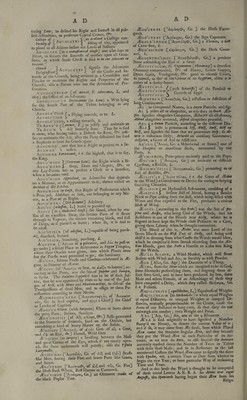
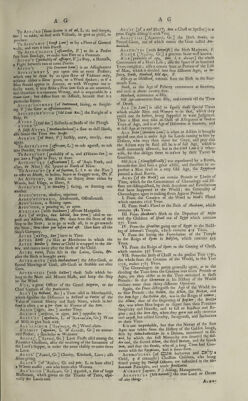
![To Affo'rd [feme derive it of ad, L. at, and boajye, Sax.] to table, or rind with ViGuals, to give or yield, to ^'tVAffo'rest [Forefi Law] to lay a Piece of Ground wifte and turn it into Foreft. To Affranchise [affranthtr, F.] to fet a Perfon free from Bondage, to make him Free or a Freeman. Affra'y [probably of affrayer, F.] a Fray, a Skirmiffi, a Fight between two or more Parties. AffRa'y pin Common Law] is an Aflrightment Affrai'ment $ put uPon one or more Perfons; which may be done by an open fhew of Violence only, without either a Blow given, or a Word fpoken ; as if a Man Ihould appear in Armour, or with Weapons not u- fually worn, it may ftrike a Fear into fuch as are unarmed, and therefore is a common Wrong, and is enquirable in a Court-Leet ; but differs from an Affault, becaufe that is a particular Injury. Affreightment [of Fretemext, hiring, or fraight- in<r F.] the fame as affretamentum. AffreTAMe'ntum [Old Law Rec.] the Freight of a Ship, Ft. A'ffRA jtgc.l Bullocks orBeafts of the Plough. a'ffre Sl A falfe A'ffer [Northumberland] a flow or dull Hone, alfo hence the Term Aver Beafts. Afre'sh [of Frail, F.] frelhly, anew, newly, over again. To AffRi'cate [affricate, LJ to rub againft, to rub into Powder, to crumble. To Affri'ght [probably of a, and pj'ih'can <?<?x.3 to put into a Fright or Fear, to fcare. Affronx'tre [affronitrum] L. of ’Aipp'oc Froth, and rlljov, Gr. Nitre]] the Spume or Froth of Nitre. To Af fro'nt [q. d. ad frontem, L. i. e. to the Face,]] to offer an Abufe, to heGor, brave or fwagger over, &c. F. An Affront, an Abufe, an Injury done either by Words, bad Ufage, or Blows, F. Affro'nte [in Heraldry 3 facing, or fronting one another. Affeo'ntive, abufive, injurious. AffRo'ntiveness, Abufivenefs, Offenfivenefs. Affu'lsion, a fhining upon. Affu'sion, a pouring to, or upon. A'fricans [with Gardeners] African Marigolds. Aft [of aefeJCan, Sax. behind, Sea Term] ufed to ex- prefs any AGion, Motion, &c. done from the Stem of the Ship to the Stem ; as to go or walk aft, is to go towards the Stern ; How cheer you before and aft. How fares all the Ship’s Company. After [xytieji, later in Time. After Birth >a Skin ®r Membrane in which the After Burden $ Feet us or Child is wrapped in the Ma¬ trix, and comes away after the Birth of the Child. After Pains, Pains felt in the Loins, Groin, &c. after the Birth is brought away. After-math [with Husbandmen] the After Grafs, or fecond Mowings of Grafs, alfo Grafs or Stubble cut after Corn. After-sails [with Sailors] thole Sails which be¬ long to the Main and Mizzen Mafts, and keep the Ship to the Wind. A'ga, a great Officer of the Grand Seignior, or the Chief Captain of the Janizaries. Aga'i [in Holland, &c]] a Term ufed in Merchandife, which fignifies the Difference in Holland or Venice of the Value of current Money and Bank Notes, which in Hol¬ land is often 3 or 4 per Cent, in Favour of the Note. Again [agen, Sax.] another Time. Against [ongean, or a’gen, Sax]] oppofite to Agala'xy [agalaxia, L. of’Aj'otAcwjeiet, Gr.J Want of Milk to give Suck with. Aga'li. achum [’A>cc»ox,«v, Gr.]] Wood-aloes. A'ga mi st [agamus, L of alya./a.®', Gr.]] an unmar¬ ried Perfon ; a Batchelor or Widower. Agapai', [fAyzica], Gr.] Love Feafts ufed among the Primitive Chriftians, after the receiving of the Sacrament of the Lord’s-Supper, in order the more clofely to unite them in Love. Agape' [’Aj-awii, Gr.3 Charity, Kindnefs, Love; alfo Alms-giving. Agape't [of 'Aya-Jiv, Gr. and peto, L. to hunt after]] a Whore-mafter ; one who hunts after Womeu. Aga'ricon [’AyciQsxor, Gr.3 Agarick, a fort of large Muihroom, which grows on the Trunks of Trees, efpe- cially the Larch-tree, Ag a'sT [oF a and bhaf^j Sax. a Ghoft or SpeGreQ in a great Fright difrnay’d with bear. AgAsY'LLls [AyctcryAM?, Gr] Herb Ferula, of Fennel-Giant, out of which comes the Gum called Am- moniack. AgaTHi'tes [with Botanlfis] the Herb Marjoram, I. A'gate ['Ax*W, Gr-3 a precious Stone well known. A'g e [probably of apa, Sax. i. e. always3 the whole Continuance of a Man’s Life ; alfo the Space of an hundred Years compleat; alfo a certain State or Portion of the Life of Man, which is divided into four different Ages, as In¬ fancy, Touth, Manhood, Old Age, F. Infancy or Childhood, extends from the Birth to the four¬ teenth Year. Touth, or the Age of Puberty commences at fourteen, and ends at about twenty-five. Manhood, terminates at fifty. Old Age commences from fifty, and extends till the Time of Death. Age [in Law] is ufed to fignify thofe fpecial Times which enable Men and Women to do that, which they could not do before, being fuppofed to want Judgment! Thus a Man may take an Oath of Allegiance at twelve Years of Age, and is at Age of Difcretion at fourteen) and at full Age at twenty-one. Ag e Frier [Common Law] is when an AGion is brought againft one that is under Age for Lands coming to him by Defcent, who may then move the Court, and pray that the AGion may be ftaid till he is of full Age, which is moft commonly allowed; but in the Civil Law it. is other- wife, for that obliges them to anfwer by their Tutors 5r Guardians. _ Old Ag E [Hieroglyphically] was reprefented by a Raven, becaufe that Bird lives a great while, and therefore to re- prefent a Man dead in a very Old Age, the Egyptians painted a dead Raven. , Ages [of the World] are certain Periods or Limits of Time, which for the Convenience of Chronology and Hi- ftorv are diftinguiflied, by thole Accidents and Revolutions^ that have happened in the World; the Generality of Chronologers agree in malting feven Ages or Periods. I. From the Creation of the Word to Noah’s Flood which contains 1656 Years. II. From Noah’s Flood to the Birth of Abraham, which contains 382 Years. III. From Abraham’s Birth to the Departure of MofeS and the Children of Ifrael out of Egypt which contains 550 Years. IV. From the Jfraelites going out of Egypt to the Build¬ ing of Solomons Temple, which contains 479 Years. °V. From the laying the Foundation of the Temple to the Reign of Cyrus in Babylon, which contains 493 Years. . VI. From the Reign of Cyrus to the Coming of Chnlr, which contains 538 Years. VII. From the Birth of Chrift to the prefent Year 1730, the whole from the Creation of the VS orld, to this Year 1731, makes 5783 Years. The Chronologers do pretty generally agree, as to the dividing the Time from the Creation into feven Periods or Ao-es yet they differ as to the Time contained in thefe Periods: fo that Chevereau in his Hiftory of the World reckons more than thirty different Opinions. A fain the Poets diftinguifh the Age of the V\ orld in¬ to four Periods : the Golden, the Silver, the Brazen, and the Iron Age ; the Golden Age, was in the Reign of Saturn ; the Silver, that of the Beginning of Jupiter ; the BraZert Age was when Men began to depart from their Primitive Simplicity and Honefty, and to fall to Injuftice and Ra¬ pine • and the Iron Age, when they grew not only covetous and unjuft, but added Cruelty, Savagenefs, and Barbarities to their Vices. , r , /> It is not improbable, but that this Notion of the four Ages was taken from the Hiftory of the Golden Image, feen by Nebuchadnezzar in a Dream, mentioned in Da¬ niel by which the firft Monarchy was denoted the Co/- den one, the fecond Silver, the third Brazen, and the fourth Iron, and that the Greeks, who of a long Time had Com¬ merce with the Egyptians, had it from them. » Agemo'glans [of barbarous and DR7JJ A Child, q. d. untaught3 Chriftian Children, who being feized young by Turkijb Officers, are ltiftiuGed m the Ma¬ hometan Principles, and made Janizaries. A'gencY [agence, F3 AGmg, Management, Agenfri'da [Old Records] the true Lord or Owii« of any thing* '](https://iiif.wellcomecollection.org/image/b30449819_0029.jp2/full/800%2C/0/default.jpg)




 No text description is available for this image
 No text description is available for this image
 No text description is available for this image