Surgical enquiries : including the Hastings essay on shock, the treatment of surgical inflammations, and numerous clinical lectures / by Furneaux Jordan.
- Date:
- [1880]
Licence: Public Domain Mark
Credit: Surgical enquiries : including the Hastings essay on shock, the treatment of surgical inflammations, and numerous clinical lectures / by Furneaux Jordan. Source: Wellcome Collection.
Provider: This material has been provided by the Royal College of Physicians of Edinburgh. The original may be consulted at the Royal College of Physicians of Edinburgh.
33/374 (page 17)
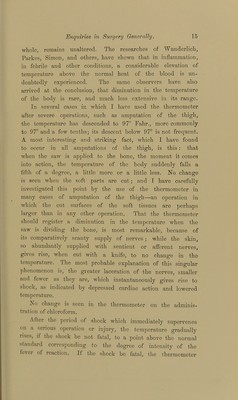
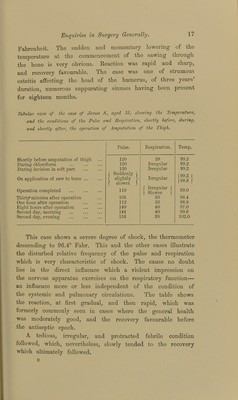
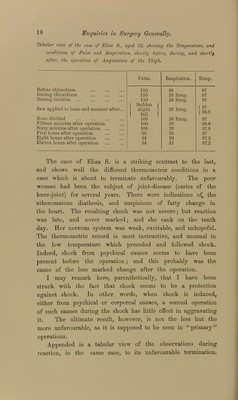
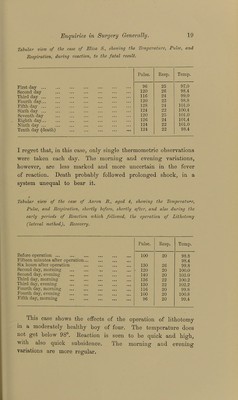
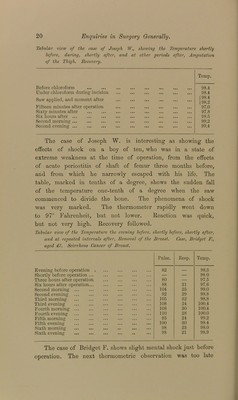
![Fahrenheit. The sudden and momentary lowering of the temperature at the commencement of the sawing through the hone is very obvious. Reaction was rapid and sharp, and recovery favourable. The case was one of strumous osteitis affecting the head of the humerus, of three years5 duration, numerous suppurating sinuses having been present for eighteen months. Tabular view of the case of James S., aged 35, showing the Temperature, and the conditions of the Pulse and Respiration, shortly before, during, and shortly after, the operation of Amputation of the Thigh. Shortly before amputation of thigh During chloroform During incision in soft part On application of saw to bone ... Operation completed Thirty minutes after operation One hour after operation Eight horns after operation Second day, morning Second day, evening Pulse. Respiration. Temp. 120 28 99.2 120 Irregular 99.2 120 Irregular 99.2 [ Suddenly ] 4 slightly t Irregular f 99.2 ) (98.8 } ( slower j 110 f Irregular ) ( Slower j 99.0 105 30 96.4 112 36 96.8 140 40 97.0 144 40 99.6 156 3S 102.0 This case shows a severe degree of shock, the thermometer descending to 96.4° Fahr. This and the other cases illustrate the disturbed relative frequency of the pulse and respiration which is very characteristic of shock. The cause no doubt lies in the direct influence which a violent impression on the nervous apparatus exercises on the respiratory function— an influence more or less independent of the condition of the systemic and pulmonary circulations. The table shows the reaction, at first gradual, and then rapid, which was formerly commonly seen in cases where the general health was moderately good, and the recovery favourable before the antiseptic epoch. A tedious, irregular, and protracted febrile condition followed, which, nevertheless, slowly tended to the recovery which ultimately followed. B](https://iiif.wellcomecollection.org/image/b21979376_0033.jp2/full/800%2C/0/default.jpg)