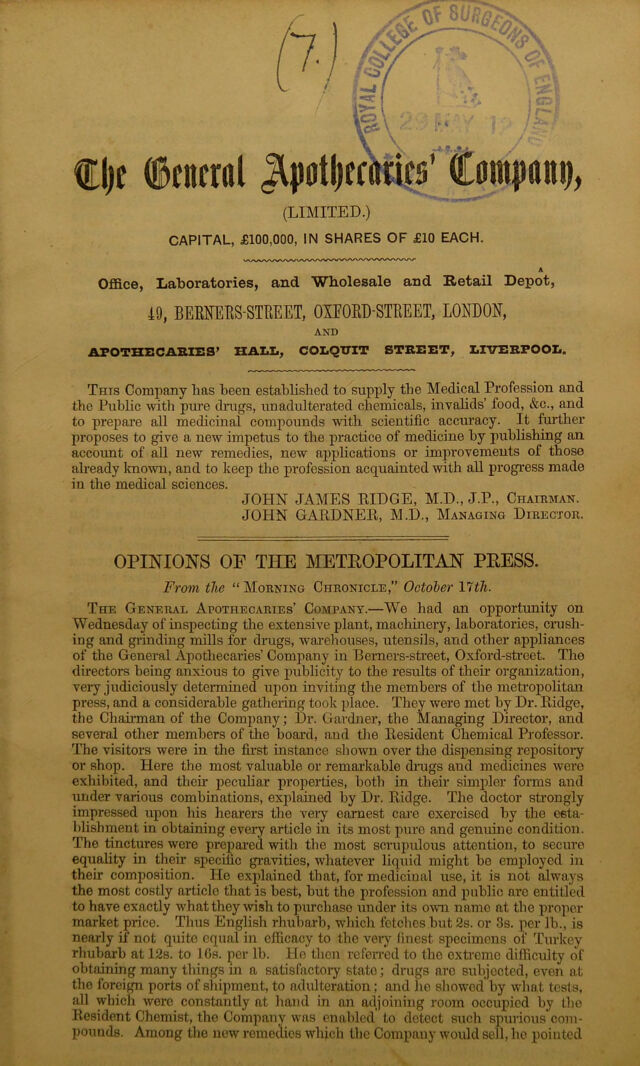
The General Apothecaries Company, (limited).
- General Apothecaries Company (London, England)
- Date:
- [1856]
Licence: Public Domain Mark
Credit: The General Apothecaries Company, (limited). Source: Wellcome Collection.
Provider: This material has been provided by The Royal College of Surgeons of England. The original may be consulted at The Royal College of Surgeons of England.
11/20 page 9
![of the extensive at!alterations of drugs and medicinal preparations. The Lancet, he believed, was the first to call attention to the adulteration of (h-ugs, hut the press generally had taken the subject up, and the movement had resulted in a mass of infonnation, proving the prevalence of a system of gi-oss imposition and fraud, fraught with much evil to the public. A Com- mittee of the House of Commons, too, had issued a report on the subject. He was told that the adidteration of drugs in London was as nothing com- ])ared to the adulterations which took place in the provinces; where 50 per cent, was applied in London, 75 or 90 per cent, was not uncommon in the coimtry. At Wolverhampton, a dealer had advertised to supply any pow- dered dnig at 20s. a cwt., while they all knew that some drugs could not be supplied at 20s. a pound. He sent some to America, and it was found not to contain any of the article which it professed to represent. He was not prepared to say that the druggists generally, either in London or the coun- try, wdbngly or knowingly adulterated their drugs. He did not believe that they did, but they, from ignorance, sold drugs which did not contain what they were stated to contain, and the public suflered in consequence. Medi- cal men not having leisiu’e to examine what they j)urchased, were them- selves deceived, and were obliged to judge of things by their operation rather than by their composition; and thus the art of healing was made rather a matter of chance, than, as it should be, a matter of mathematical certainty. The profession was much indebted to the Apothecaries’ Comj)any; but their prices were high, and they scarcely supplied two per cent, of the practitioners. This Company proposed to prepare and sell medicines without adulteration or substitution; to follow the orders of the coUeges in all pre- parations ; to keep the profession au fait in aU discoveries both at home and abroad respecting the cm’e of diseases; and to put new life and vigour into the science of medicine. Da. Gakdner and several other medical men also addressed the Company; and the proceedings which from the commencement afforded general satisfac- tion, terminated in a highly agreeable manner. From the “ Eailway Eecoed,” October 18th. The General Arothecaries’ Company, (Limited).— It is bad enough to be deceived in the quality of our daily food—oim daily bread; but it is adding insult to injury, if, when we apply to a medical man for a remedy for any evh consequences which we may exi^erience, to be deceived a second time in the remedy as well as the disease! Yet if we place faith in the rep- resentations of the ‘^Lancet,’’ and the evidence given before a Committee of the House of Commons, this is the imfortunate condition to which we ai-e reduced; poisoned by our butcher, our baker, o\ir grocer, our brewer, and the whole host of ti’aders who minister to the daily wants of a civihzed com nuinity, and then doomed to be poisoned by accident or design, by a class of professional men to whom we, in our confiding simplicity, lly for relief, and in the hope of ciu-e! Verily, hiunanity is made a jiretty shuttlecock of! tossed about between the baker and the chemist! The fact of the adultera- tion of food has been proved over and over again ; and no doubt can be en- tertained that the ginatest irregularity in the supply of drugs prevails when the^ really are pure, and that they are of unequal strength in various shops, whilst all kinds of deteriorated materia medica are administered by ill-quali- fied and careless practitionei-s, who are more interested in the profit to bo made, than careful of the liealth of their patients. J ust imagine a case of tincture of opium. It will bo found of its normal strength at one shop, only two-thirds at {mother, and only one-luilf or one-third tlio strength at others; whilst powder of oi)ium, prescribed in gi-c{it emergencies, may bo scarcely operative in three grain doses at one shop, and deadly poison at {mother ! The list might bo multiplied ad infinitum. The cbem'ists and druggists of the kingdom, moreover, liavo no certificates of qualilication. -loiios, the ticket-of-leave man, may set up a chemist’s shop to morrow in any part](https://iiif.wellcomecollection.org/image/b22435001_0011.jp2/full/800%2C/0/default.jpg)