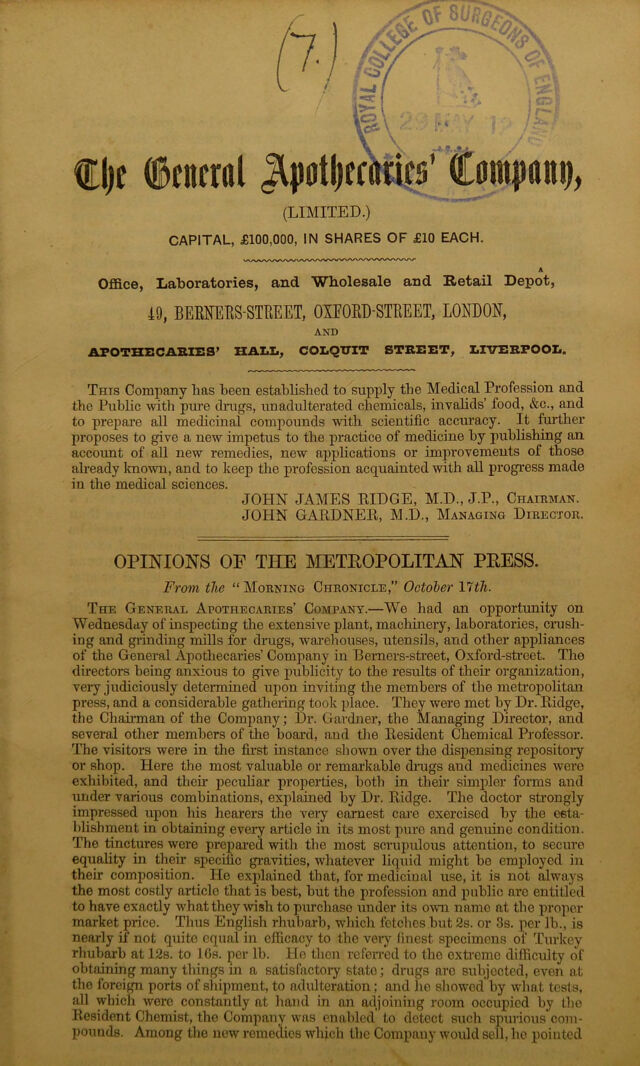
The General Apothecaries Company, (limited).
- General Apothecaries Company (London, England)
- Date:
- [1856]
Licence: Public Domain Mark
Credit: The General Apothecaries Company, (limited). Source: Wellcome Collection.
Provider: This material has been provided by The Royal College of Surgeons of England. The original may be consulted at The Royal College of Surgeons of England.
6/20 page 4
![that the time was ripe for such a Company as tliis—not a mere tradiufj coni' pauy, seeking a good'pi’ofit—but a scientific company, whose object was to supply a want which the Apothecaries’ Company could not supply. ’J'bo Pharmaceutical Society was expected to be a protection to the punlic, but any person might purchase a chemist’s shop and supply the public witli drugs, and make up prescriptions without any knowledge whatever of che- mistry—without knowing prussic acid from rhubarb (hear). There was no- thing to hinder any person from taking one of the dniggist’s shops in Ox- ford-street, and poisoning her Ma-jesty’s subjects without let or hindrance. The Pharmaceutical Society admitted into its body any person paying £] a year, and was chiefly occupied in producing cheap substitutes for the prepa- rations ordered by the licensed colleges; and those who did not pay .£1 a year were not pharmaceutical chemists (hear, hear). The present Company proposed to prepare and sell medicines without adulteration or substitution, and follow the order of the Colleges in all prepai-ations; to advance the art of healing by improving the powers and preparation of medicines; to intro- duce new remedies; to keep the profession au fait in all discoveries, both abroad and at home, respecting the means of curing diseases, and to put new life and vigour into the science of medicine. It woifld be, therefore, a scien- tific as well as a trading company. Everything inferior or wortliless would be rejected. Every prescription would be prepared exactly as the prescriber intends; and tlie public might implicitly rely on eveiything sold or prepared at the establishment. At the present moment prescrii^tions could not be made up in the same way at two shops. They varied considerably. That evil would now be remedied to a considerable extent (hear, hear). The Com- pany did not intend to manufactiu’e eveiything used for medicinal purposes. They did not propose to manufacture sulphuric acid or sulphate of magnesia, and articles of that description, wliich required an outlay of some £100,000 in the shape of capital; but they could obtain those articles from the best sources, and examine them carefully and test their qualities, and if they were not what they ought to be, care would be taken to improve them (heai-, hear.) The Company had endeavoured to select those houses which were most cele- brated for the purity of their articles, and the most eminent houses were anxious to deal with the Company (hear). The Company was a great fact, and there could be no doubt that the public and the profession would be able to get every article used in medicine pure and unadulterated (heai’, heai’). The Company had already put into the hands of 15,000 practitioners a pam- plilet, containing a descriptive catalogue of all the more recently intreduced remedies, and explaining the manner of employing them: and proposes to supply tills kind of information to the profession, throughout the empire, pe- riodically. It intended to establish branches in all the considerable towns, supplying them from the central laboratories, so that a prescription iviatten in London may have the same ingredients if made up in the country, now almost an impossibility, since the strength of preparations varies in every shop. Branches would be established in various parts of London, in the great centres of circles. A branch was opened in Liverpool a few days ago, and similar branches would shortly be opened in Manchester, Birmingham, and other important towns, and would be governed by local directors. The profession would thus be able to obtain genuine drugs and chemicals in all parts of the kingdom. It was most important that medicines should be of imiform strength. One of the most important drugs used by the profession was laudanum. It was used more extensively than any other cfrug, except calomel. But it could not be obtained of the same strength at any two shops in Oxfoi’d street. The same might be said of quinine and other articles, which could never be obtained of uniform strength or purity. !Many persons considered sarsaparilla wholly worthless as a Tiiodicine. Prohably they had never had the drug at all, or they had had it after its virtues had been ex- tracted by fraudulent traders. With regard to the sale of poisons, nothing poisoTious was sold by the Company, except to the order of medical men. or two respectable persoiis, who enter their names and addresses in a book, and](https://iiif.wellcomecollection.org/image/b22435001_0006.jp2/full/800%2C/0/default.jpg)