Some derivatives of 4 (or 5)- methylglyoxaline / by Arthur James Ewins.
- Ewins, Arthur James.
- Date:
- [1911?]
Licence: Public Domain Mark
Credit: Some derivatives of 4 (or 5)- methylglyoxaline / by Arthur James Ewins. Source: Wellcome Collection.
5/12 page 2054
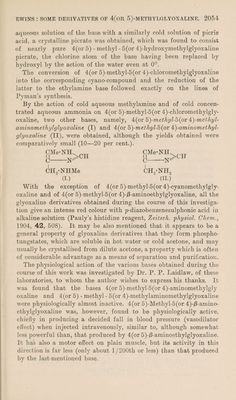
![aqueous solution of the base with a similarly cold solution of picric acid, a crystalline picrate was obtained, which was found to consist of nearly pure 4(or 5) - methyl - 5(or 4)-liydroxymethylglyoxaline picrate, the chlorino atom of the base having been replaced by hydroxyl by the action of the water even at 0°. The conversion of 4(or 5)-methyl-5(or 4)-chloromethylglyoxaline into the corresponding cyano-compound and the reduction of the latter to the ethylamine base followed exactly on the lines of Pyman’s synthesis. By the action of cold aqueous methylamine and of cold concen¬ trated aqueous ammonia on 4(or 5)-methyl-5(or 4)-chloromethylgly- oxaline, two other bases, namely, 4:{ov b)-methyl-b{ov ^-methyl- amino methyl ghj ox aline (I) and 4(or b)-meth]/l-b(ov ^)-aminomethyl- glyoxaline (II), were obtained, although the yields obtained were comparatively small (10—20 per cent.). CMe-NH C-N^CI1 CHVNHMe (I.) CMe-NH C- ch.,-nh2 (II.) With the exception of 4(or 5)-methyl-5(or 4)-cyanomethylgly- oxaline and of 4(or 5)-methyl-5(or 4)-/3-aminoethylglyoxaline, all the glyoxaline derivatives obtained during the course of this investiga¬ tion give an intense red colour with ^-diazobenzenesulphonic acid in alkaline solution (Pauly’s histidine reagent, Zeitsch. physiol. Chem., 1904, 42, 508). It may be also mentioned that it appears to be a general property of glyoxaline derivatives that they form phospho- tungstates, which are soluble in hot water or cold acetone, and may usually be crystallised from dilute acetone, a property which is often of considerable advantage as a means of separation and purification. The physiological action of the various bases obtained during the course of this work was investigated by Dr. P. P. Laidlaw, of these laboratories, to whom the author wishes to express his thanks. It was found that the bases 4(or 5)-methyl-5(or 4)-aminomethylgly oxaline and 4(or 5) - methyl - 5(or 4)-inethylaminomethylglyoxaline were physiologically almost inactive. 4(or 5)-Methyl-5(or 4)-/3-amino- ethylglyoxaline was, however, found to be physiologically active, chiefly in producing a decided fall in blood pressure (vasodilator effect) when injected intravenously, similar to, although somewhat less powerful than, that produced by 4(or 5)-/3-aminoethylglyoxaline. It has also a motor effect on plain muscle, but its activity in this direction is far less (only about 1/200tli or less) than that produced by the last-mentioned base.](https://iiif.wellcomecollection.org/image/b30618162_0005.jp2/full/800%2C/0/default.jpg)


 No text description is available for this image
 No text description is available for this image
 No text description is available for this image