Knight's cyclopædia of the industry of all nations, 1851 / [edited by George Dodd].
- Date:
- [1851]
Licence: Public Domain Mark
Credit: Knight's cyclopædia of the industry of all nations, 1851 / [edited by George Dodd]. Source: Wellcome Collection.
984/1000
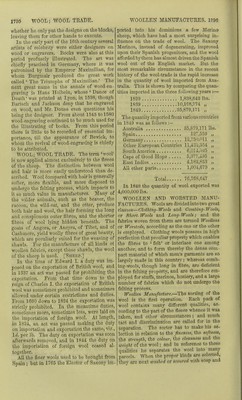
![whether he only put the designs on the hlocks, leaving them for other hands to execute. In the early part of the 16th century several artists of celebrity were either designers on wood or engravers. Books were also at this period profusely illustrated. The art was chiefly practised in Germany, where it was pati-onised by the Emperor Maximilian, for whom Burgmair produced the great work called ' The Triumphs of Maximilian. The next great name in the annals of wood-en- graving is Hans Holbein, whose ' Dance of Death' was printed at Lyon, in 1538, though Bartsch and Jackson deny that he engraved on wood, and Mr. Douse even questions his being the designer. Erom about 1545 to 1580 wood-engraving continued to be much used for the illustrating of books. From this period there is httle to be recorded of essential im- portance, till the appearance of Bewick, to whom the revival of wood-engraving is chiefly to be attribilted. WOOL; WOOL TRADE. The term 'wool' IS now applied almost exclusively to the fleece of the sheep. The distinction between wool and hau- is more easily understood than de- scribed. Wool compared with hair is generally softer, more flexible, and more disposed to ■undergo the felting process, which imparts to it so much value in manufactures. Many of the wilder animals, such as the beaver, the racoon, the wild-cat, and the otter, produce both hair and wool, the hair forming the long and conspicuous outer fibres, and the shorter fibres of wool lying hidden beneath. The goats of Angora, or Ancyra, of Tibet, and of Cashmere, yield woolly fibres of great beauty, which are pecuharly suited for the weaving of shawls. For the manufacture of all kinds oi woollen fabrics, except these shawls, the wool of the sheep is used. [Sheep.] In the time of Edward I. a duty was im- posed on the exportation of British wool, and in 1337 an act was passed for proliibiting the exportation. From that time down to the reign of Charles I. the exportation of British wool was sometimes prohibited and sometimes allowed under certain restrictions and duties. From 16G0 do\vn to 1824 the exportation was strictly prohibited. In the meantime duties, sometimes more, sometimes less, were laid on the importation of i^oreign wool. At length, in 1824, an act was passed making the duty on importation and exportation the same, viz.. Id. per lb. The duty on exportation was soon afterwards removed, and in 1844 the duty on the importation of foreign Wool ceased al- together. All the finer wools used to be brought from Spain; but in 1765 the Elector of Saxony im- ported into his dominions a few Lterino sheep, which have had a most surprising in- fluence on the trade of wool. The Saxony Merinos, instead of degenerating, improved upon their Spanish progenitors, and the wool afforded by them has almost driven the Spanish wool out of the Enghsh market. But the most remarkable circumstance in the recent history of the wool-trade is the rapid increase in the quantity of wool imported from Aus- tralia. This is shown by comparing the quan- tities imported in the three following years :— 1829 1,838,642 lbs. 1839 10,128,774 „ 1849 35,879,171 „ The quantity imported from various countries in 1849 was as follows :— Austraha 35,879,171 lbs. Spain 127,559 „ Germany 12,750.011 „ Other European Countries 11,43^,354 „ South America 6,014^)25 „ Cape of Good Hope ..... 6,377,495 „ East Indies 4,182,853 „ All other parts 1,004,679 „ Total 76,768,647 In 1848 the quantity of wool exported was 4,000,000 lbs. WOOLLEN AND WORSTED MANU- FACTURES. Wools are dividedinto two great classes—Olothiug-Wools and Combing-Wools, or Short-Wools and Long-Wools; and the fabrics woven from them are termed Woollens or Worsteds, according as the one or the other is employed. Clothing wools possess in high perfection that peculiar property which enables the fibres to ' felt' or interlace one among another, and to form thereby the dense com- pact material of which men's garments are so largely made in this country ; whereas comb- ing-wools, though long in fibre, are deficient in the felting propertj', and are therefore em- ployed for stuffs, merinos, hosiery, and a large number of fabrics which do not undergo the felting process. Woollen Manufacture.—ThQ sorting of tiie wool is the first operation. Each pack of wool contains many different qualities, ac- cording to the part of the fleece whence it was taken, and other circumstances; and much tact and discrimination are called for in the separation. The sorter has to make his se- lection in relation to the ftnchess, the softness, the strength, the colour, the cleanness and the tveight of the wool; and in reference to these qualities he separates the wool into many parcels. When the proper lands are selected, they are next washed or scoured with soap and](https://iiif.wellcomecollection.org/image/b21495348_0984.jp2/full/800%2C/0/default.jpg)