Economic botany [of the Himálayan district / by Edwin T. Atkinson].
- Edwin Felix Thomas Atkinson
- Date:
- [1882?]
Licence: Public Domain Mark
Credit: Economic botany [of the Himálayan district / by Edwin T. Atkinson]. Source: Wellcome Collection.
10/228 page 674
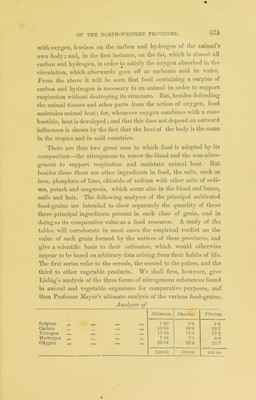
![maize, and sugarcane, which enter so largely into the food-resources not only of this country but of every country in the universe. To the LeguminoscB belong peas, beans, lentils, and gram. The gourds and cultivated vegetables are eaten more as a relish or to eke out a scanty supply of food-grain than as a sole food resource, and then only at certain seasons when their abundance and cheapness render them a favourite. The same may be said of fruits, culti- vated and wild, and of the wild plants collected for food. There are three forms of nitrogenous substances common to both Analysis of the food- animal and vegetable organizations distin- gi'aius, gTiished by the names albumen, fibrine, and caseine; and it has been found that, when introduced into a living organism, each of these is capable of being converted into the other.* The principal ingredients of the blood of animals is found to be fibrine and albumen, and these substances contain, besides the carbon, hydro- gen, and oxygen found in farinaceous products, such as the cereals, nitrogen, sulphur, and phosphorus, which abound in the pulses. These elements are also found in all parts of the animal organism except water and fat. It follows, therefore, that nutritious food must possess both albuminous and nitrogenous ingredients. The former are composed of carbon, hydrogen, and oxygen; the hydrogen and oxygen being in proportion to form water, thus leaving the carbon wholly unoxidised; or if we suppose the oxygen to be divided between the carbon and hydrogen, a surplus of carbon and hydrogen that is unoxidised remains. We are now speaking of what takes place after the food has been taken into the body and there submit- ted to assimilation. From the moment an animal is born until it dies oxygen is taken into its body through the skin and lungs, and given out again by the same channels in the form of compounds of carbon and hydrogen, or, in other words, as the vapour of water and carbonic acid. The latter is derived from the food eaten; for, when an animal is unable to take food, so long as it lives, it continues to inspire oxygen and give out compounds of carbon and hydrogen, which it obtains from the waste of the tissueso f its own body. In fact death ensues from the action of the inspired oxygon, on account of its ])Owerfnl affinity for carbon and hydrogen. AVhen the animal has no longer superfluous carbon and hydrogen capable of combining ‘ Based on the researches of Professor Mayer.](https://iiif.wellcomecollection.org/image/b28119253_0010.jp2/full/800%2C/0/default.jpg)




 No text description is available for this image
 No text description is available for this image
 No text description is available for this image