State Board of Health of Massachusetts : a brief history of its organization and its work, 1869-1912 : material compiled mainly from the reports of the Board.
- Massachusetts Department of Public Health
- Date:
- 1912
Licence: Public Domain Mark
Credit: State Board of Health of Massachusetts : a brief history of its organization and its work, 1869-1912 : material compiled mainly from the reports of the Board. Source: Wellcome Collection.
Provider: This material has been provided by the Augustus C. Long Health Sciences Library at Columbia University and Columbia University Libraries/Information Services, through the Medical Heritage Library. The original may be consulted at the the Augustus C. Long Health Sciences Library at Columbia University and Columbia University.
64/110
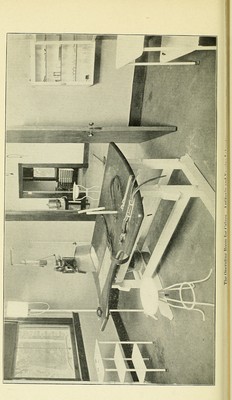
![At the same time another problem was brought forward, which in-' volved the preparation and free distribution of vaccine lymph by the State Board of Health. The importance of some cfirect supervision and control of this prophylactic substance by the State had been felt for a long time, but any supervision of a product made largely outside of the] State and by a number of different parties was impossible. The only solution was the assumption by the State itself of the preparation of the; lymph, as is the practice in nearly all European countries. During the session of 1903 the Legislature finally passed a bill which authorized the State Board of Health to produce and distribute anti- toxin and vaccine lymph. To obtain a suitable site for a State laboratory, free from objection- able surroundings, with sufficient land about it to secure light and air, and not subject to the complaints or the objections of fastidious neigh- bors or sensitive real estate owners, would have been impossible with- out acquiring a large and expensive tract. To overcome this difficulty, the Corporation of Harvard University came to the aid of the State, and agreed to use a portion of the land of the Bussey Institution adjoining the Arnold Arboretum, and build a laboratory in which the preparation of diphtheria antitoxin and animal vaccine could be carried on together. After the passage of the bill au- thorizing the State Board of Health to prepare diphtheria antitoxin and vaccine, Dr. Smith visited a number of vaccine institutes in England, Germany, France and Denmark during the summer of 1903. In the fall of the same year the site for the new building was selected, the plans made and the building begun. On account of the very severe winter of 1903 and 1904, building operations were almost wholly suspeuded until late in March. However, the work progressed uninterruptedly in the spring, and the building was ready for occupation in July. The pro- duction of antitoxin continued without interruption in the old laboratory during the installation of apparatus in the new. The production of vac- cine was begun in Jul}', and late in September the first lot was issued. The building is situated on South Street, about one-quarter of a mile beyond the Forest Hills station of the ~New York, Xew Haven & Hart- ford Bailroad. It faces slightly east of south, and receives an abundance of sunshine, as no shadows from other structures fall upon it. The windows have been constructed amply large to admit plenty of light. The situation is ideal, as the building stands in a park reservation of over 200 acres of land.' The building is nearly square, and has an extension or wing consisting of basement and first floor only. This wing was designed to house the calves after vaccination. The floors are of cement in the basement, of](https://iiif.wellcomecollection.org/image/b21230225_0064.jp2/full/800%2C/0/default.jpg)