Report on the means of deodorizing and utilizing the sewage of towns : addressed to the Rt. Hon. the President of the General Board of Health / by Henry Austin.
- Austin, Henry, 1809 or 1810-1861
- Date:
- 1857
Licence: Public Domain Mark
Credit: Report on the means of deodorizing and utilizing the sewage of towns : addressed to the Rt. Hon. the President of the General Board of Health / by Henry Austin. Source: Wellcome Collection.
121/134 (page 99)
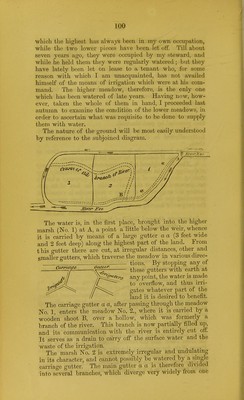
![can be made to mix with watet*. I was surprised to find the quantity of fluid covered by the boghead coke diminish more rapidly than that with which the peat charcoal was mixed, but which had sunk to the bottom. By another experiment I have satisfied myself that the boghead coke actually promotes the evaporation of water, on the top of which it is sprinkled, while it effectually condenses any odorous gases that would otherwise have escaped from the surface. From these premises we may draw the following conclusions :— 1. That boghead coke does possess the power of con- densing odorous gases, to the extent of about one-fourth of that possessed by peat charcoal. 2. That neither boghead coke nor peat charcoal are per- fectly efficient in deodorizing liquids when mixed with them. 3. That boghead coke is as good a filtering medium as peat charcoal, if desired to be used for that purpose. 4. That the boghead coke possesses the valuable property of floating on the surface of a liquid and effectually pre- venting the escape of odorous gases—a property which is not possessed by peat charcoal—while the fact of its pro- moting the evaporation of water would render it valuable in promoting the drying of deposits obtained from sewage for the purpose of forming manures. LlNDSEY BLYTH. Laboratory, General Board of Health, January 31st, 1857. APPENDIX C. Laying out Catch-Meadows. (From the Journal of the Boyal Agricultural Society oj England, vol. xiii part ].) The improved system of guttering, invented by Mr. Bickford, of Crediton, and of which I have made partial use in some water-meadows in the neighbourhood of Exeter appears to me to possess great advantages, both in efficiency and economy, over that usually practised in this neighbour- hood, and seems likely to be of great value if sufficiently made known. The meadows to which I refer are situated on the banks of the Exe, about two miles above Exeter, and lie between the river itself and the stream, which is taken out of it at Pynes Weir, for supplying the city with water. The waste water of this stream returns to the Exe immediately below the meadows, so as completely to surround a space of about thirty acres. This space is divided into three meadows of](https://iiif.wellcomecollection.org/image/b20398177_0121.jp2/full/800%2C/0/default.jpg)