Essays in preventive medicine : infection and disinfection : the health of children, and the period of infection in epidemic diseases / by William Squire.
- Squire, William
- Date:
- 1887
Licence: Public Domain Mark
Credit: Essays in preventive medicine : infection and disinfection : the health of children, and the period of infection in epidemic diseases / by William Squire. Source: Wellcome Collection.
18/144 (page 12)
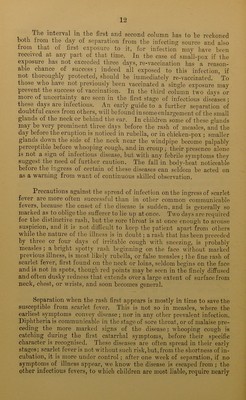
![intsiVcil in th© first and second column has fo he reckoned both fioin the day of separation from the infectinpj source and also fioui that of first exposure to it, for infection may have been received at any part of that time. In the case of small-pox if the exposure has not exceeded three days, re-vaccination has a I’eason- able chance of success; indeed all exposed to this infection, if not thoroughly protected, should be immediately re-vaccinated. To those who have not ])reviously been vaccinated a single exposure may pievent the success of vaccination. In the third column two days or more of uncertainty are seen in the first stage of infectious diseases; these days are infectious. An early guide to a further separation of doubtful cases from others, will be found in some enlargement of the small glands of the neck or behind the ear. In children some of these glands may be very prominent three days before the rash of measles, and the day before the eruption is noticed in rubella, or in chicken-pox ; smaller glands dot\n the side of the neck near the windpipe become palpably perceptible before whooping cough, and in croup; their presence alone is not a sign of infectious disease, but with any febrile symptoms they suggest the need of further caution. The fall in body-heat noticeable before the ingress of certain of these diseases can seldom be acted on as a warning from want of continuous skilled observation. Precautions against the spread of infection on the ingress of scarlet fever are more often successful than in other common communicable fevers, because the onset of the disease is sudden, and is generally so marked as to oblige the sufferer to lie up at once. Two days are required for the distinctive rash, but the sore throat is at once enough to arouse suspicion, and it is not difficult to keep the patient apart from others while the nature of the illness is in doubt; a rash that has been preceded by three or four days of irritable cough with sneezing, is probably measles; a bright spotty rash beginning on the face without marked previous illness, is most likely rubella, or false measles ; the fine rash of scarlet fever, first found on the neck or loins, seldom begins on the face and is not in spots, though red points may be seen in the finely diffused and often dusky redness that extends over a large extent of surface from neck, chest, or wrists, and soon becomes general. {Separation when the rash first appears is mostly in time to save the susceptible from scarlet fever. This is not so in measles, where the earliest symptoms convey disease; nor in any other prevalent infection. Diphtheria is communicable in the stage of sore throat, or of malaise pre- ceding the more marked signs of the disease; whooping cough is catching during the first catarrhal symptoms, before their specific character is recognised. These diseases are often spread in their early stages; scarlet fever is not without such risk,but, from the shortness of in- cubation, it is inore under control; after one week of separation, if no symptoms of illness appear, we know the disease is escaped from ; the other infectious fevers, to M'hich children are most liable, require nearly](https://iiif.wellcomecollection.org/image/b28717806_0018.jp2/full/800%2C/0/default.jpg)