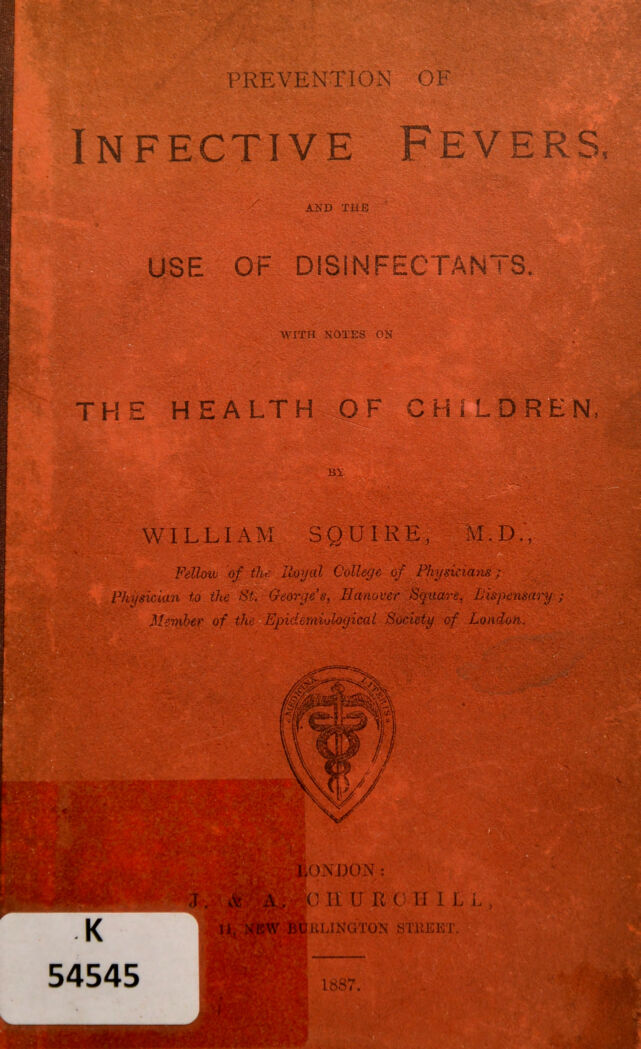
Essays in preventive medicine : infection and disinfection : the health of children, and the period of infection in epidemic diseases / by William Squire.
- Squire, William
- Date:
- 1887
Licence: Public Domain Mark
Credit: Essays in preventive medicine : infection and disinfection : the health of children, and the period of infection in epidemic diseases / by William Squire. Source: Wellcome Collection.
31/144 page 25
![It is not necessary that tliese vapours sliould bo of a strength to kill the germs of disease; if they prevent contamination of, or restore the oxygen to the air they are of service. Many antiseptic or disinfecting agents are not really germicide or absolutely destructive to all infection; some do little more than deodorize; others arrest the septic ])0\ver; some have their use in safely conveying away the agents of disease from the room or house. In this way clothes can be taken to the laundry, but must not mix with others, until they have undergone the requisite boiling for half an hour or more ; this really destroys all infective power.* Very often it would bo possible, in the course of the disease, to remove the patient to a Mell-aired room for a whole day, and thoroughly purify the sick room with sulphur vapour. Spread open the bedding, clothes, playthings, &c,, close the windows, chimney or other apertures, and burn, in the centre of the room, 1 lb. of yellow Sulphur moistened with methylated spirit, with precautions for its safe and complete combustion. After five or six hours the room can be entered and cleansed ready for use again by night. The room occupied by the convalescents during the day can then be similarly fumigated, a pound of sulphur will suffice for this purpose. Either allow half a pound of sulphur for each person occupying the room ora pound per 1000 cubic feet, A larger quantity is needed, and a much longer time of exposure, for full disinfection. Thorough and complete disinfection is only effected by heat; that of boiling water if applied long enough is sufficient. Steam applied under moderate pressure for five minutes destroys the germs of most diseases. Boiling the linen clothes for half an hour with a little soap and soda or common salt disinfects thoroughly, if so managed that the heat reaches to all parts; any stained linen after the use of the strong disinfectant should be steeped and rinsed in cold water to remove the stain before boiling, as by steaming or long boiling the stain is fixed. Woollen clothes require dry heat, as hot water shrinks flannel and woollen textures; felt hats, shoes, and leather goods are spoilt by steam or by wetting, these stand dry heat well ; mattresses should be unpicked before exposure to heat and re-made aBerwards to ensure disinfection. Some degree of safety is obtained by placing articles of this kind before the fire, or in an oven, after they have been cleaned. Any heat over 240 is injurious to these materials, a heat of 250 scorches flannel. After a sick-room is no longer occupied, complete disinfection should be brought about by means of the full use of sulphur fumes, the sulphurous acid liberated by burning sulphur, in sufficient volume, may Ixj relied on to reach and act upon all that is most conveniently left in the room. To effect this, the bed should be uncovered and raised from the frame, the brass or iron work hero and elsewhere, as on * We are uiflebtcfl to Du. James 13. Ku.ssell, of Gla.sgow, for establishing tliis fact on a sufficiently large scale. Du, Ja.mes A. Russell, of Edinburgh, in Quain’s I)ictii/nary of Medicine, gives a very complete article on Disinfection.](https://iiif.wellcomecollection.org/image/b28717806_0031.jp2/full/800%2C/0/default.jpg)


 No text description is available for this image
 No text description is available for this image
 No text description is available for this image