On the curative effect of carbonic acid gas or other forms of carbon in cholera, for different forms of fever, and other diseases / by C.J. Lewis.
- Lewis, C. J. (Charles James), 1875-1937.
- Date:
- 1903
Licence: In copyright
Credit: On the curative effect of carbonic acid gas or other forms of carbon in cholera, for different forms of fever, and other diseases / by C.J. Lewis. Source: Wellcome Collection.
26/56 (page 22)
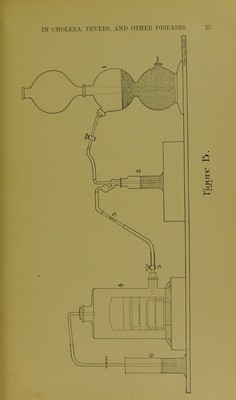
![the work of Kitasato, Watson Cheyne, Hueppe, Giiyon, ami Berklioltz upon this point, as the possible error of desiccation affects \-ery few of inv experiments. It is sufficient to note that this possible fallacy was recognised. ^ ACCOUNT OF RESEARCH. An experimental research was undertaken in the Laboratory of the Pmyal College of Physicians of Edinburgh, with the object of testiim the effects which the different forms of carbon mentioned by Dr Parkin might ha\e upon cultuies of the Spirillum Asiaticie Choleroe, and upon cultures of some other organisms. The forms of carbon which I submitted to investigation were: I. Carbonic Acid Gas. II. Charcoal (both Animal and Vegetable). A few experiments are also included in which I used— III. Naphtha. IV. Creosote. V. Yeast. Naphtha and creosote were tested because they are in use as remedies for cholera, and because Parkin attributes their alleged efficacy to the amount of carbon they contain. Yeast was included on account of its production of carbonic acid gas when grown in suitable media. The organisms with which I conducted the experiments were:— (A) Spirillum Asiaticie Cholerie of Koch. (B) Bacillus Typhosus of Eberth. (C) Bacillus Coli Communis of Escherich. (D) Bacillus Diphtheriai of Klebs-Loffler. The media used, either in the investigation or in subsequent tests, were 1 per cent, peptone broth, 1‘5 per cent, agar, 10 per cent, gelatine, 2 per cent, glucose jelly, milk, and blood-serum. I. Carbonic Acid Gas Experiments. Tlie carbonic anhydride was obtained from the action of dilute hydro- chloric acid upon marble chips in a Kipp’s apparatus (figs. A 1 and B 1). The gas was passed through a saturated solution of sodium carbonate in a wash-bottle (figs. A 2 and B 2), and then through sterilised cotton-wool (figs. A3 and B 3), into the chamber containing the cultivation media. This process was used to jmrify the gas given off in the Kipp apparatus. The chamber used was in one of two forms, either a Novy’s jar or a glass cylinder whicli could be securely sealed. Novy'sjar (fig. A 4) consists of a lower half composed of a cylindrical glass jar with a flat ground-gla.ss rim, upon which fits a similar rim belonging to the u])per half. The u])])or half takes the form of a glass dome surmounted by a neck, into which fits a ground-gla.ss stoi)per. The 8Lo])])Cr and neck arc laterally ])crforatcd, so that ga.sos may ho ptisscd in or out and the ojtcnings appo.sed or otherwise by revedution of the stopijcr.](https://iiif.wellcomecollection.org/image/b28087045_0026.jp2/full/800%2C/0/default.jpg)