Guide to the exhibition of specimens illustrating the modification of the structure of animals in relation to flight.
- National Museum of Ireland, Merrion Street
- Date:
- 1913
Licence: In copyright
Credit: Guide to the exhibition of specimens illustrating the modification of the structure of animals in relation to flight. Source: Wellcome Collection.
Provider: This material has been provided by The Royal College of Surgeons of England. The original may be consulted at The Royal College of Surgeons of England.
66/96 page 54
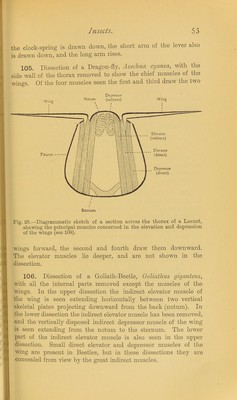
![107. Dissection of a Locust, with the hind thoracic segment (metathorax), together with the second pair of wings and the third pair of legs, separated from the rest of the body, and showing the principal muscles of the wing. See explanatory sketch 108. 108. Diagrammatic sketch of a transverse section through the metathorax of a Locust, showing the four principal muscles of the wings (see fig. 28). CHAEACTEEISTICS OF THE WINGS IN THE DIFFEEENT OEDEES OF INSECTS. Buttekplies and Moths (Lepidopteea). In Lepidopterous Insects both the front and hind wings are developed as organs of flight, and they are invested with closely disposed minute scales which give a fur-like or velvety appearance to the surface. 109. A Hawk-Moth, Pseudosphinx tetrio, after removal of the scales from the wings of the left side. The wing-membrane so prepared is as clear and its venation as distinct as in the wings of Flies and Dragon-flies. 110. An enlarged sketch (x 150) of three scales removed from the same Moth. The scales are flat, with longitudinal striations; they are attached to the surface of the wing by a kind of short stalk, while the free edge of the scale is broad and toothed. See shdes F, G and H under the microscope, and fig. 42. 111-112. Two Olear-wing Hawk-Moths, a British species, Hcmaris [Haemorrhagia) fiiciformis, and a South African form,' Cephonodcs hylas. In Clear-wing Moths the scales of the wings i resemble those of other Moths at the time that the insect emerges from the pupa-case, but they are fugitive, and most of them are shaken off during the first few flights. 113-114. Male and female of a large Butterfly, Troidcsl (Ornithoptera) p>riamus urvUiianus, from the Solomon Isles. Thej male is brightly coloured, while the female is dull. The female isj a slower flier than the male, and has a larger expanse of wing;! this is doubtless related to the fact that the female is weighed] down by the mass of unlaid eggs in the body.](https://iiif.wellcomecollection.org/image/b22470888_0068.jp2/full/800%2C/0/default.jpg)