Materia medica and pharmacy : for the use of medical and pharmaceutical students preparing for examination / by W. Handsel Griffiths ; edited, and in part written, by George F. Duffey.
- Date:
- 1879
Licence: Public Domain Mark
Credit: Materia medica and pharmacy : for the use of medical and pharmaceutical students preparing for examination / by W. Handsel Griffiths ; edited, and in part written, by George F. Duffey. Source: Wellcome Collection.
Provider: This material has been provided by the Royal College of Physicians of Edinburgh. The original may be consulted at the Royal College of Physicians of Edinburgh.
39/340 page 25
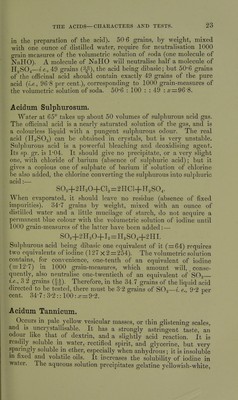
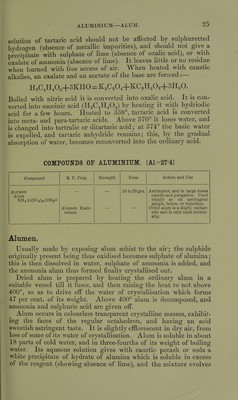
![ALUMINIUM—ALUM. solution of tartaric acid should not be affected by sulphuretted hydrogen (a.bsence of metallic impurities), and should not give a precipUate with sulphate of lime (absence of oxalic acid), or with oxalate of ammonia (absence of lime). It leaves little or no residue when burned Avith free access of air. When heated with caustic alkalies, an oxalate and an acetate of the base are formed:— H2C4HA+3KHO = K2C204+KC2H3024-3H20. Boiled with nitric acid it is converted into oxalic acid. It is con- verted into succinic acid (H2C4H4O4) by heating it with hydriodic acid for a few hours. Heated to 338°, tartaric acid is converted into meta- and para-tartaric acids. Above 370° it loses water, and is changed into tartralic or ditartaric acid; at 374° the basic water is expelled, and tartaric anhydride remains; this, by the gradual absorption of water, becomes reconverted into the ordinary acid. COMPOUNDS OF ALUMINIUM. [Al=27-4] Compound B. P. Prep. Strength Dose Action and Use Alumen Alum NH4A1(S04)2,12H20 Alumen Exsic- catum 10 to 20 grs. Astringent, and in large doses emetic and purgative. Used locally as an astringent gargle, lotion, or injection. Dried alum is a slight eschar- otic aud is only used extern- ally. Alumen. Usually made by exposing alum schist to the air; the sulphide originally present being thus oxidised becomes sulphate of alumina; this is then dissolved in water, sulphate of ammonia is added, and the ammonia alum thus formed finally crystallised out. Dried alum is prepared by heating the ordinary alum in a suitable vessel till it fuses, and then raising the heat to not above 400°, so as to drive off the water of crystallisation which forms 47 per cent, of its weight. Above 400° alum is decomposed, and ammonia and sulphuric acid are given off. Alum occurs in colourless transparent crystalline masses, exhibit- ing the faces of the regular octahedron, and having an acid sweetish astringent taste. It is slightly efflorescent in dry air, from loss of some of its water of crystallisation. Alum is soluble in about 18 parts of cold water, and in three-fourths of its weight of boiling water. Its aqueous solution gives with caustic potash or soda a white precipitate of hydrate of alumina which is soluble in excess of the reagent (showing absence of lime), and the mixture evolves](https://iiif.wellcomecollection.org/image/b21934058_0039.jp2/full/800%2C/0/default.jpg)



 No text description is available for this image
 No text description is available for this image
 No text description is available for this image