Manual of surgical operations : containing the new methods of operating devised by Lisfranc; followed by two synoptic tables of natural and instrumental labours / By J. Coster, M.D. & P. ... The translation and notes by John D. Godman, M.D.
- Coster, Jacques, 1795-1868.
- Date:
- 1825
Licence: Public Domain Mark
Credit: Manual of surgical operations : containing the new methods of operating devised by Lisfranc; followed by two synoptic tables of natural and instrumental labours / By J. Coster, M.D. & P. ... The translation and notes by John D. Godman, M.D. Source: Wellcome Collection.
276/284 (page 270)
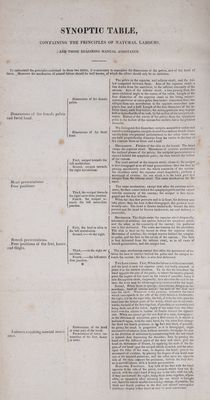
![SYNOPTIC TABLE, CONTAINING THE PRINCIPLES OF NATURAL LABOURS, AND THOSE UEQUIRING MANUAL ASSISTANCE. To uQdcrstQDd the principles contained in these two tables, it is oecessai'y to remember the dimensions of the pelvis, and of the head of fœtus. Moreover the mechanism of natural labour should be well known, of which the others should only be an imitation. Dimensions of the female pelvis. Dimensions the female pelvis and foetal lieatl. Dimensions of tbe fœtal bead. First, occiput towards the left acetabulum. Second, occiput towards the right acetabulum. Head presentations. Four positions. J Third, tbe occiput towards tbe right sacrO'iliac junction. Fourth, tbe occiput to> wards tbe left sacro-iliac junction. Breech presentations. Four positions of the feet, knees and thighs. First, the heel or tibia to the left acetabulum. Second, to the right. Third, to tbe right sa- cro'iliac. Fourth, the left sacro- iliac junction. f Presentation of the head Labours .ciuiring manual assist- I j tremities of the feet, Jmees [ or nates. The pelvis in tbe superior and inferior strait, and the hol- low comprised between them. Axis of the superior strait: a line drawn from the umbilicus, to tbe inferior extremity of the sacrum. Axis of tbe inferior strait, a line passing, from the sacro-vertebral angle to the centre of the vulva. Length of the four diameters of tbe superior strait in the living subject: aDtero.>posterior or sacro-pubic four inches: transverse four; the oblique from one acetabulum to the opposite sacro-iliac sym- physis four and a half. Length of the four diameters of the in- ferior strait, each four inches; the anteru-posterior may acquire half or three-fourths of an inch, by the motion of the coccyx back- wards. Extent of the cavity of the pelvis; from the symphysis pubis to the hollow of the sacrum five inches ; this is the greatest . diameter. f We distinguish five diameters; occipito mental five inches and i even five and a quarter; occipito-frontal four and one'fourth*. Irans- versclyfrom one parietal protuberance to tbe other three and one half: perpendicular diameter from tbe vertex to the base of tbe cranium three or three and a half. Mechanism. Flexion of the chin on the breast. The head clears the superior strait. Movement of rotation prociucedby the inclined planes of the pelvis; tbe occipital protuberance is carried behind the symphisis pubis, the face toward the hollow of the sacrum. The head arrived at the interior strait; clears it; the occiput ] is first disengaged as in all head presentations; then the face by jvassiDg successively over the whole concavity of the sacruni; the shoulders enter the superior strait diagonally; perl'orrn a movement of rotation ; the one which is to tbe back part first escapes from the inferior strait. Tbe same mecharvism for the nates. The same mechanism, except that after the rotatory move- ment, the face comes behind the symphysis pubis and the vertex into (he concavity of the sacrum; the occiput is first disen- gaged and tbe face follows. ^ When the chin first presents and is in front, (be delivery may j take place; then the face is first disengaged; this position isex- ilremely rare. The bead is thrown backwards. Sitould tbe chin present and the bead be thrown backwards, nat irai delivery is impossible. f Mechanism. The thighs enter the superior streit diagonally; movement of rotation; one arrives behind the symphisis pubis; and the other in the concavity of the sacrum: the posterior one is first delivered. The same mechanism ibr the shoulders. • The chin is bent on the breast to clear the superior strait. Movement of rotation; the occiput arrives behind the symphy- sis pubis, and the face in tlie cavity of the sacrum. The face is first delivered from the inferior strait, as ia all cases of breech presentation, and the occiput last. C The same mechanism except that after tbe movement of ro- } tation the face is carried behind the pubis and the occiput to- ( wards the sacrum; the face is also first delivered. [ Two Indications First, When the labour is without accident, and the head is near the superior strait, but badly situated, to place it in tbe natural situation. To do this we introduce tbe hand opposite the side of the pubis, to where tlie head is placed; press the fingers of this band on the vertex if possible; bring it into the superior strait, diagonally; then abandon the rest to na- ture: the lever may be advantageousiysubslltutcdfor the hand. Second, When there is syncope, convulsions, dangerous he- 1 morrhage, want of uterine ar.tion; lay hold of (he feot and I turn the childl Whatever is tbe position, introduce tbe hand j which corresponds to tbe side of tbe child which is backwards; 1 the right, if it be the right side; the left, if it be the left; pass the hand over tbe lateral parts of the trunk, which arc found back- wards; lay bold of the feet together, if possible, orsejiarately and bring them out of the vulva. Apply at the same lime (he other hand over the uterus to incline its fundus toward (be opposite side. When we cannot get but one foot at a time, disengage it. in the direction of adduction, pass a fillet round it, to secure it and search again, with (he same hand, for the other foot: change the (bird and fourth positions, to lljp fii'st and third, if possible, by giving the trunk in proportion as it is disengaged, slight movements of rotation from without inivards; disengage (he arm in the direction of adduction by commencing with the one which is behind, first depressing the shoulder; then by passing the hand over the different parts of the face and chest, give the head its movement of llexion, by applying the ends of the fin- gers uf one hand upon tbe occiput which is raised, and (be other upon the sides of the nose, to depress the head; give it the movement of rotation, by placing tbe fingers of one hand near one of tbe mastoid processes, and the other upon the opposite side of the chin; support the perioeum, deliver tbe face first, as in natural labour, with a breech presentation. Diagonal Positions. Lay hold of the feet with the band opposite to the side of tbe pelvis, towards which they are di- rected, with the right band if they are to the left; with the left, if they are towards the right; bring them down together, if pos- sible, or separately nfier securing the one which is brought out; finish tbe labour as after (be turning; change, if possible, the third and fourth position to the first and second sacro-pubic V positions: employ either hand as may be roost convenient.](https://iiif.wellcomecollection.org/image/b28748529_0276.jp2/full/800%2C/0/default.jpg)