Licence: Public Domain Mark
Credit: The birth of chemistry / by G.F. Rodwell. Source: Wellcome Collection.
83/156 page 67
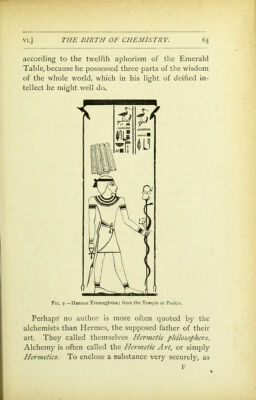
![but here we find them united, or assumed to be united, in one man. Yet more, Borrichius was ap- pointed Court Physician, and Assessor of the Supreme Court of Law. He was the very personification of all learning, if we may judge by the treatment he received from his countrymen. In addition to the work mentioned above, he wrote various treatises on philology, on the quantity of syllables, on the Greek and Latin poets, on medicine, chemistry, and botany. It is strange that a man who, presumably in his capacity of judge, was in the habit of sifting evidence, and of avoiding hasty generalisation, should have endeavoured with much elaborate argument to prove that Hermes Trismegistus was a real personage ; that his Smaragdine table was really found by the wife of Abraham, and that it contained matter of the highest import to mankind. We must imagine that in this matter Borrichius allowed the imaginative faculty due to his poetical temperament to exert an undue in- fluence over his more sober judgment. He is equally at pains to assert the authenticity and antiquity of the various Greek MSS. on alchemy in the libraries of Europe. He specially mentions a MS. by Zozimus of Panapolis, on the art of making gold, in the King’s Library in Paris; and Scaliger tells us that this same MS. was written in the fifth century. M. Ferdinand Hoefer is apparently penetrated by the Borrichian spirit of faith and imagination, and he unhesitatingly accepts the early date attributed to the Paris MS. M. Hoefer traces the rise of Alchemy to the fourth century of our era; it was then known as the “ sacred art” {ars •''^cra] Tkyyr] lepd), and one of the chief F 2](https://iiif.wellcomecollection.org/image/b24866878_0083.jp2/full/800%2C/0/default.jpg)




 No text description is available for this image
 No text description is available for this image
 No text description is available for this image