Elements of pharmacy, materia medica, and therapeutics / by William Whitla.
- William Whitla
- Date:
- 1889
Licence: Public Domain Mark
Credit: Elements of pharmacy, materia medica, and therapeutics / by William Whitla. Source: Wellcome Collection.
31/656 (page 27)
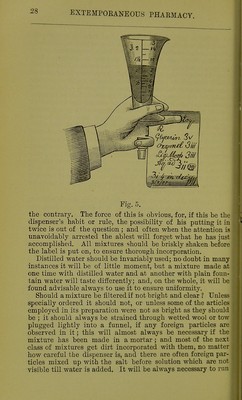
![ithe different medicine bottles required from their different )places and set them down beside him before he begins to .measure, otherwise he may lose his head, or get confused in .travelling from one part of the surgery to another. This practice, however, should be no excuse for bottles being left upon the dispensing counter ; after the mixture is made each should be carefully put back into its proper position; and the 5ame law applies to every operation in Pharmacy, for nothing should be left lying about out of its place: it is in this way Amistakes are often made. It will be noticed that in carrying Jia stock bottle from its shelf, collecting it with others where ]l;:the dispenser is to work, and putting it back after he has ' finished, its label will be certain to be examined at least three times. The skilful compounder will make up a mixture more ■ expeditiously by taking the measure-glass in the left hand, as if about to use it as previously described, and the prescription , between the middle two fingers of the same hand, and, pro- ceeding with his right hand entirely free, walking to and fro he can compound his mixtures as quickly and accurately as if iall were within the reach of his hand—as they should be wrhen ^^possible. This is well shown in the Figure. Care is requisite to prevent the paper being soiled. j_ As regards the order in mixing liquids for a simple mixture, lit is not of so much importance as in making emulsions, and ;often the ingredients can be mixed in the order in which : they are written. It is a good plan to pour the tinctures or rspirituous fluids (as they are measured) into the bottle an which the mixture is to be made, mix them, and then vadd the syrups or essences, and finally fill up with the ; water or infusion ordered ; in this way a better mixture is often made than if the tinctures were each singly added to a .large body of water, when their resinous principles would be tisure to be precipitated. Suppose in a prescription of eight bounces of mixture, containing two ounces of tinctures, one bounce of mucilage, and five ounces of water, if the dispenser ! added the mucilage to the undiluted tinctures, an unsightly imess would be the result; the mucilage should either be added idast or, largely diluted with the water, before adding the litmctures ; but the difficulty about the order of mixin% in- rgredients will be found to be more imaginary than real—a Uittle common sense and experience will soon overcome it. •.Ihere is, however, one rule which is almost universally neg- tt!^' v^ importance :-If there be a very poisonous substance hke Prussic acid, strychnine, aconite, arsenic, cor- .rosive sublimate, &c., ordered in a mixture, it should be put in .the last thmg before corking, unless there be some reason for](https://iiif.wellcomecollection.org/image/b20417731_0031.jp2/full/800%2C/0/default.jpg)