Biographia Britannica literaria; or, biography of literary characters of Great Britain and Ireland. Anglo-Saxon period / arranged in chronological order.
- Thomas Wright
- Date:
- 1842
Licence: Public Domain Mark
Credit: Biographia Britannica literaria; or, biography of literary characters of Great Britain and Ireland. Anglo-Saxon period / arranged in chronological order. Source: Wellcome Collection.
57/582 page 45
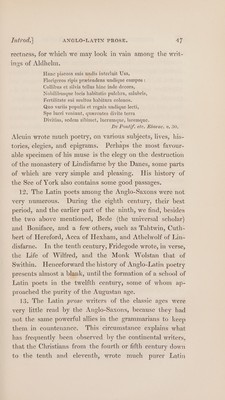
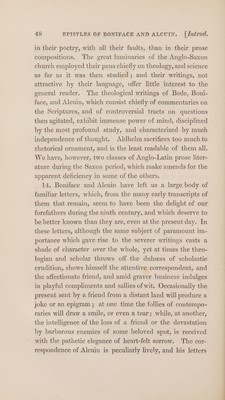
![Te cupiens appel- peregrinus -lare camcenis, O Cori[d]on! Cori[d]on! dulcis amice satis.* 10. Alcuin and Aldhelm were the chief Anglo-Latin poets of this period. Aldhelm possessed all the defects above enumerated. He was a great imitator of the an- cients; he was a celebrated Greek scholar, and he filled his writings with foreign words and clumsy compounds; he was also a lover and composer of Anglo-Saxon verse, and he shows a deeply rooted taste for alliteration and pompous diction; and in addition to these defects we see in his writings generally a bad choice of words, with harsh sentences, and a great deficiency in true delicacy and harmony.t In a word, Aldhelm’s writings, popular as they once were, exhibit a very general want of good taste. For an example of this, we need only cite one of the embellishments of his metrical treatise de Laude Vir- ginum, where he tells the story of St. Scholastica, how, when she had failed by her arguments and persuasions in prevailing on her brother to embrace Christianity, she fell on her knees in prayer by his side; how a fearful storm immediately burst over the house, and how the * Alcuinus ‘‘ Ad Discipulum,’’ Poems, p. 235, in his works. Abbo, in the beginning of the tenth century, inserts que in the middle of a com- pounded word, for the sake of metre, as ocquecidens and imguesulam, for occidensque and insulamque. + William of Malmsbury, himself a good scholar for his age, has left us a curious estimate of Aldhelm’s character, in which he confesses the over- pompous style of the Anglo-Latin writers. ‘‘ Denique Greci involute, Ro- mani splendidé, Angli pompaticé dictare solent. Id in omnibus antiquis chartis est animadvertere, quantum quibusdam verbis abtrusis et ex Greeco petitis delectentur. Moderatius tamen se agit Aldelmus, nec nisi perraro et necessario verba ponit exotica. Allegat Catholicos sensus sermo facundus, et violentissimas assertiones exornat color rhetoricus. Quem si perfecte legeris, et ex acumine Greecum putabis, et ex nitore Romanum jurabis, et ex pompa Anglum intelliges.’’ Vit. Aldelm. p. 339. If this writer alludes to the monastic charters given under the Saxon Kings, they are certainly written in the strangest ‘‘ jargon’? that it is possible to conceive, and Ald- helm is purity itself in comparison with them. Perhaps chartis only means books,](https://iiif.wellcomecollection.org/image/b33096740_0057.jp2/full/800%2C/0/default.jpg)