A direct reading hydrogen-ion meter / by C.G. Pope and F.W. Gowlett.
- Pope, C. G.
- Date:
- [1927?]
Licence: In copyright
Credit: A direct reading hydrogen-ion meter / by C.G. Pope and F.W. Gowlett. Source: Wellcome Collection.
1/8
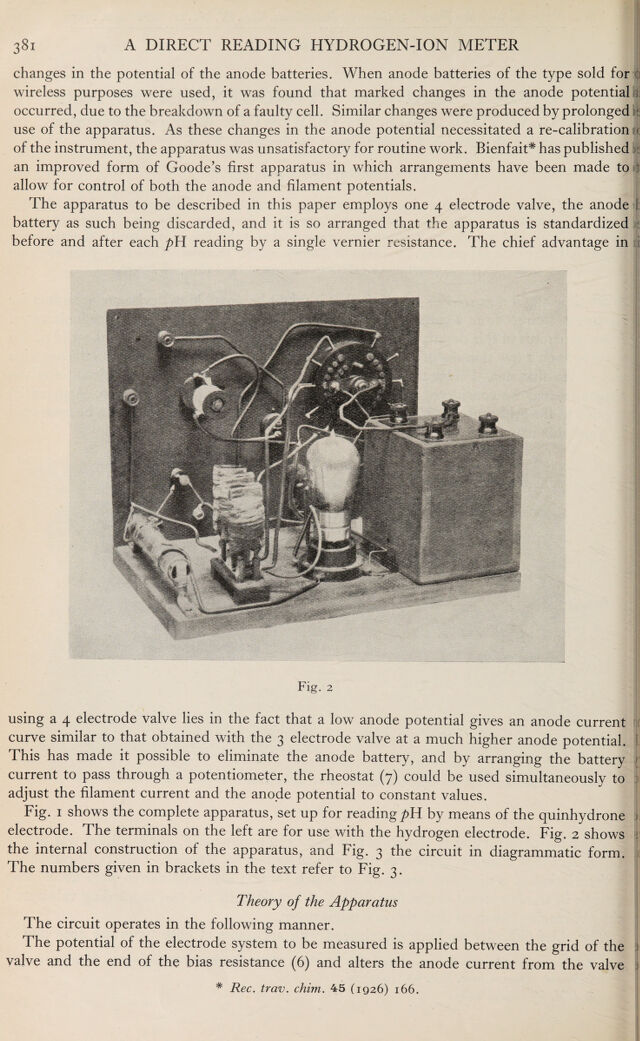
![» Reprinted from the, Journal of Scientific Instruments, Vol. IV, No. 12, September 1927 PRINTED IN GREAT BRITAIN A DIRECT READING HYDROGEN-ION METER.* By C. G. POPE AND F. W. GOWLETT. Wellcome Physiological Research Laboratories, Langley Court, Beckenham, Kent. [MS. received, u)th March, 1927.] ABSTRACT. An apparatus giving direct readings of hydrogen-ion concentration [/>H], for use with the hydrogen electrode and quinhydrone electrode, is described. The use of a potentiometric form of circuit and a 4 electrode thermionic valve makes it possible to standardize the apparatus before and after each^H reading, by means of a single vernier rheostat. Tables are given showing the accuracy with which it is possible to calibrate the instrument for each range. Some time ago it occurred to one of us that it might be possible to devise an apparatus for reading p\A direct from a galvanometer deflection, by using a 3 electrode thermionic valve. In an apparatus of this description the potential to be measured is applied to the grid of the valve in such a way that the grid is always at a negative potential with respect to the negative end of the filament. Under these conditions no current flows in the grid circuit and the apparatus may be considered as a galvanometer of infinitely high resistance. A potential applied to the grid causes a change in the anode current of the valve which can be measured in a suitable manner. Fig. 1 After the construction of the apparatus had been commenced, our attention was drawn to the fact that a similar apparatus had been described by Goodef. LaterJ, he published a description of a modified apparatus in which three 3 electrode valves were used. The change in anode current of the first valve was amplified by the two succeeding valves and the^H reading obtained directly on a milliameter. The chief difficulty we have experienced with apparatus of both types has been due to * The apparatus was demonstrated at a Meeting of the Biochemical Society in June 1926. f Journ. Amer. Chem. Soc. 44 (1922) 26.](https://iiif.wellcomecollection.org/image/b30626705_0001.jp2/full/800%2C/0/default.jpg)


 No text description is available for this image
 No text description is available for this image
 No text description is available for this image