Volume 1
Mind and brain, or, The correlations of consciousness and organisation : systematically investigated and applied to philosophy, mental science and practice / by Thomas Laycock.
- Thomas Laycock
- Date:
- 1869
Licence: Public Domain Mark
Credit: Mind and brain, or, The correlations of consciousness and organisation : systematically investigated and applied to philosophy, mental science and practice / by Thomas Laycock. Source: Wellcome Collection.
Provider: This material has been provided by King’s College London. The original may be consulted at King’s College London.
233/470 page 193
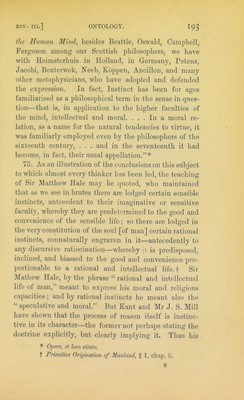
![the Human Mind, besides Beattie, Oswald, Campbell, Ferguson among our Scottish philosophers, we have with Heimsterhuis in Holland, in Germany, Petens, Jacobi, Bouterwek, Neeb, Koppen, Ancillon, and many other metaphysicians, who have adopted and defended the expression. In fact, Instinct has been for ages familiarised as a philosophical term in the sense in ques- tion—that is, in application to the higher faculties of the mind, intellectual and moral. ... In a moral re- lation, as a name for the natural tendencies to virtue, it was familiarly employed even by the philosophers of the sixteenth century, . . . and in the seventeenth it had become, in fact, their usual appellation.* 75. As an illustration of the conclusions on this subject to which almost every thinker has been led, the teaching of Sir Matthew Hale may be quoted, who maintained that as we see in brutes there are lodged certain sensible instincts, antecedent to their imaginative or sensitive faculty, whereby they are predetermined to the good and convenience of the sensible life; so there are lodged in the very constitution of the soul [of man] certain rational instincts, connaturally engraven in it—antecedently to any discursive ratiocination—whereby il is predisposed, inclined, and biassed to the good and convenience pro- portionable to a rational and intellectual lifc.f Sir Mathew Hale, by the phrase rational and intellectual life of man, meant to express his moral and religious capacities; and by rational instincts he meant also the speculative and moral. But Kant and Mr J. S. Mill have shown that the process of reason itself is instinc- tive in its character—the former not perhaps stating the doctrine explicitly, but clearly implying it. Thus his * Opere, et loco citato. t Primitive Origination of Mankind, § 1, chiip. ii. N](https://iiif.wellcomecollection.org/image/b21292462_0001_0233.jp2/full/800%2C/0/default.jpg)
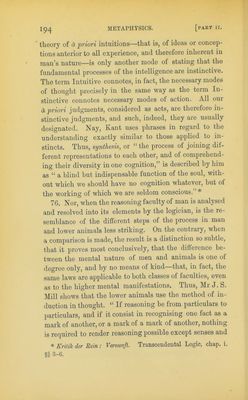
 No text description is available for this image
 No text description is available for this image
 No text description is available for this image