The trial (at large) of James Hill; otherwise James Hind; otherwise, James Actzen: for feloniously, wilfully, and maliciously, setting fire to the rope-house, in His Majesty's dock-yard at Portsmouth. Tried at the Assize, at Winchester, on Thursday, March 6, 1777. Before the honorable Sir William Henry Ashhurst, knt. ... and Sir Beaumont Hotham, knt. ... / Taken in short-hand ... by Joseph Gurney. And published by permission of the judges.
- John the Painter
- Date:
- [1777?]
Licence: Public Domain Mark
Credit: The trial (at large) of James Hill; otherwise James Hind; otherwise, James Actzen: for feloniously, wilfully, and maliciously, setting fire to the rope-house, in His Majesty's dock-yard at Portsmouth. Tried at the Assize, at Winchester, on Thursday, March 6, 1777. Before the honorable Sir William Henry Ashhurst, knt. ... and Sir Beaumont Hotham, knt. ... / Taken in short-hand ... by Joseph Gurney. And published by permission of the judges. Source: Wellcome Collection.
38/42 page 38
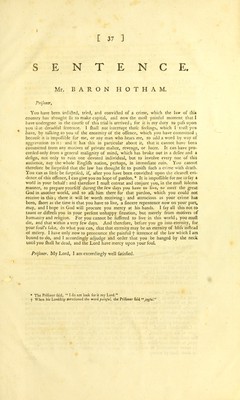
![» I 38 ] • (COP Y.) the voluntary ConfeJJion of James Aitken, commonly called John the City of Winchelter Painter■, now a Prifoner in the County Gaol of Southampton^ and under Sentence of Death, for burning the Bock-yard at Portfmoutb taken this Twenty-eighth Day of March, 1777 ; SAITH, that he was born at Edinburgh, the 28th of September, 1752, his mo- ther now living, as he believes. Curiofity led him to Virginia, in America, at the age of twenty-one, as an adventurer to feek his fortune.—Left America in March, 1775- In October, 1775, by the name of James Bofwell, inlifted a private foldier in the thirty-fecond regiment atGravefend—marched to Chatham next day, from whence he foon deferted •, was not concerned in the fire in Temple-Street, Briftol, nor privy to it. —Broke into Mr. Morgan's warehoufe at Briftol alone ; no perfon concerned with him in that, or any other accident, that enfued in that city.—He intended to fet fire to two houfes in Portfmouth, in order to employ the engines, whilft the fire might fpread in the rope-yard.—Broke into Mr. Morgan's warehoufe at Briftol, in order to burn it, that the engines might be there employed, whilft the (hipping were burning and the quay, for which purpofe, he left a lighted candle burning in the faid warehoufe; and, becaufe that fire did not take effect, he afterwards fct fire to the warehoufe in Quay- lane, by getting over the top of the door.—Mr. Deane told him, when the work was done (meaning burning the Dock-yards at Portfmouth, Woolwich and Briftol har- bour, but not the houfes) he ftiould make his efcape, and come, if poffible, to him at Paris, and he mould be rewarded. As a reward, his own expectations prompted hi\n to hope, that he fhould be preferred to a comnuffion in the American army. When after fetting fire to the rope-yard, he left Portfmouth (to wit) the next night, being Sunday—he reached London, and went to Doctor Bencraft, No. 4, Downing- ftreet, Weftminfter, to whom he had a verbal recommendation from Mr. Deane, who gave him at Paris the Doctor's name in writing, and place of abode ; but the Dc&or would give him no countenance, and therefore did not relate the particulars of the mif- chief he had done to him, but hinted to him, that he would foon fee or hear by the papers of an extraordinary accident that had happened. And he afterwards wrote fuch an account in a letter to him, which he left himfelf at the Doctor's houfe with a perfon who came 10 the door, which for the fake of truth he relates, and without intention of calling any .flur on the q^aracter of an innocent man. That he faw the Doctor the day following in the Salopian coffee-houfe, and told him that he would do all the prejudice he could to this kingdom ; to which the Doctor re- plied, he could not be of opinion with him in that refpect, for that he got his bread in this kingdom, and therefore would not be concerned with him. And feeing that the Doctor did not approve of his conduct, he hoped he would not inform againft him, to which the Doctor faid, he did not like to inform againft any man. When at Paris, he was affifted by Mr. Deane with twelve fix livre pieces; he alked for no more, neither did he receive from him any Bank bill, draft or note whatever. After leaving London (to wit) at High Wycombe, he broke into a houfe, and took away a few linens, confifting of caps, handkerchiefs, but nothing of value. He then went to Oxford, from thence to Abingdon, where he attempted to break into two houfes, filverfmiths or watchmakers, but without effect. From thence he went to Fairford, where he broke into a houfe, and took from thence a number of ftockings and handkerchiefs, and a metal watch, and near fifty lhillings in filver and halfpence : the watch he pledged for fixteen /hillings, in the name of James Hill, at a pawnbrokers in Caftle-ftreet Briftol. After this, without attempting any thing, but having prepared fome of his ingredients, he went from Briftol to Plymouth, with intent to fet fire to the dock-yard there; twice he reached the top of the wall, but the watchmen' being near, he could hear them talk together, efpecially the laft night, therefore he defifted; he never committed, or attempted to commit any robbery, but when he was like to be drove fhort of money. After](https://iiif.wellcomecollection.org/image/b20443821_0038.jp2/full/800%2C/0/default.jpg)




 No text description is available for this image
 No text description is available for this image
 No text description is available for this image