Elements of electricity, magnetism, and electro-magnetism : embracing the late discoveries and improvements : digested into the form of a treatise, being the second part of a course of natural philosophy : compiled for the use of the students of the University at Cambridge, New England / by John Farrar.
- John Farrar
- Date:
- 1826
Licence: Public Domain Mark
Credit: Elements of electricity, magnetism, and electro-magnetism : embracing the late discoveries and improvements : digested into the form of a treatise, being the second part of a course of natural philosophy : compiled for the use of the students of the University at Cambridge, New England / by John Farrar. Source: Wellcome Collection.
Provider: This material has been provided by the Francis A. Countway Library of Medicine, through the Medical Heritage Library. The original may be consulted at the Francis A. Countway Library of Medicine, Harvard Medical School.
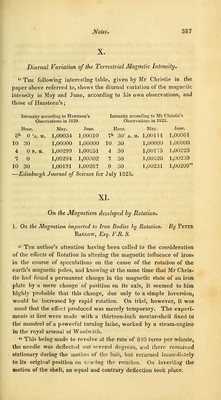
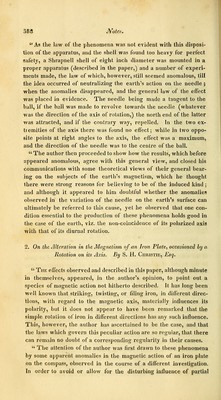
397/428 page 383
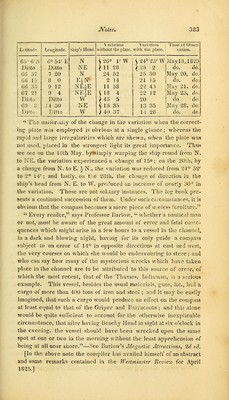
![Latitude. 65- 6'!*^ Ditto 66 57 66 15 66 35 67 21 Ditto 69 8 Ditto Longitude. 6° 54' E Ditto 7 20 8 0 9 12 9 4 Ditto U 30 Ditto Ship's Head. N NE N EiN- NEiE NE|E \V NE W \aihuion Variution . Time ot'Obser- withouttlie plate, with the plate. . vation. 11 24 2 11 18 43 r 28 52 14 58 4 5 W 13 35 40 37 24023'WMaj 18,1823 25 2 do. do. 25 30 May 20, do. 21 15 do. do. 22 43 May 21, do. no 12 May 23, do. 20 do. do. 13 35 May 28, do. 1-i 28 do. do The uniibr.niiy of tlie change in the variation when the correct- ing plate was employed is obvious at a single glance; whereas the rapid ;ind large irregularities which are shewn, when the plate was not used, placed in the strongest light its great importance. Thus we see on the 18th May, by^simply warping the ship round from N. to NE. the variation experienced a change of 15°; on the'20th, by a change from N. to E. g^N., the variation was reduced from 24° 52' to 2^ 14'; and lastly, Oii ti,e 28th, the change of direction in the ship's head from N, E. to W. prot'uced an increase of nearly 30 in the variation. These are not solitary instances. The log book pre- sents a continued succession of them. Under such ciicurnstances, it is obvious that the compass becomes a mere piece of u eless furniture. Every reader, says Professor Barlow, whether a nautical man or not, must be aware of the great amount of error and fatal coii'ic- quences which might arise in a i'ew hours to a vessel in the channel, in a dark and blowing night, having for its only guide a compass subject to an error of 14° in opposite directions at east and west, the very courses on which she would be endeavouring to steer; and who can say how many of the mysterious wrecks which have taken place in the channel are to be attributed to this source of error, of which the most recent, that of the Thames, Indiaman, is a serious example. This vessel, besides the usual materials, guns, &c., had a cargo of more than 400 tons of iron and steel ; and it may be easily imagined, that such a cargo would produce an effect on the compass at least equal to that of the Griper and Barracouta ; and this alone would be quite sufficient to account for the otherwise inexplicable circumstance, that after having Beachy Head in sight at six o'clock in the evening, the vessel should have been wrecked upon the same spot at one or two in the morning without the least apprehension of being at all near shore.—See Barlow's Magnetic Attractions, 2d ed. [In the above note the compiler has availed himself of an abstract and some remarks contained in the Westminster Reviera for April 1825.]](https://iiif.wellcomecollection.org/image/b21051483_0397.jp2/full/800%2C/0/default.jpg)