Physical chemistry for physicians and biologists / by Ernst Cohen ; authorized translation from the German by Martin H. Cohen.
- Ernst Cohen
- Date:
- 1903
Licence: Public Domain Mark
Credit: Physical chemistry for physicians and biologists / by Ernst Cohen ; authorized translation from the German by Martin H. Cohen. Source: Wellcome Collection.
19/360 page 5
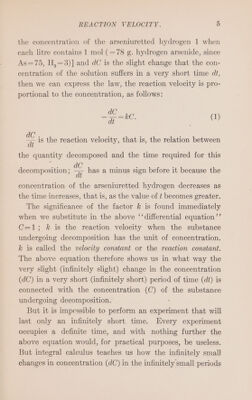
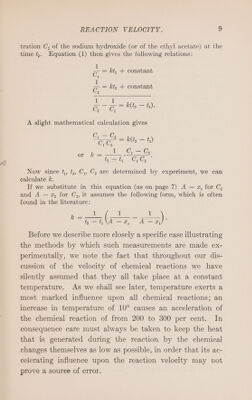
![the concentration of the arseniuretted hydrogen 1 when each litre contains 1 mol (=78 g. hydrogen arsenide, since As=75, H,=3)] and dC is the slight change that the con- centration of the solution suffers in a very short time dt, then we can express the law, the reaction velocity is pro- portional to the concentration, as follows: were (1) a is the reaction velocity, that is, the relation between the quantity decomposed and the time required for this decomposition ; has a minus sign before it because the concentration of the arseniuretted hydrogen decreases as the time increases, that is, as the value of t becomes greater. The significance of the factor k is found immediately when we substitute in the above ‘‘differential equation’’ C=1; k is the reaction velocity when the substance undergoing decomposition has the unit of concentration. k is called the velocity constant or the reaction constant. The above equation therefore shows us in what way the very slight (infinitely slight) change in the concentration (dC) in a very short (infinitely short) period of time (dt) is connected with the concentration (C) of the substance undergoing decomposition.’ But it is impessible to perform an experiment that will last only an infinitely short time. Every experiment occupies a definite time, and with nothing further the above equation would, for practical purposes, be useless. But integral calculus teaches us how the infinitely small] changes in concentration (dC) in the infinitely small periods](https://iiif.wellcomecollection.org/image/b32861631_0019.jp2/full/800%2C/0/default.jpg)