Physical chemistry for physicians and biologists / by Ernst Cohen ; authorized translation from the German by Martin H. Cohen.
- Ernst Cohen
- Date:
- 1903
Licence: Public Domain Mark
Credit: Physical chemistry for physicians and biologists / by Ernst Cohen ; authorized translation from the German by Martin H. Cohen. Source: Wellcome Collection.
337/360 page 323
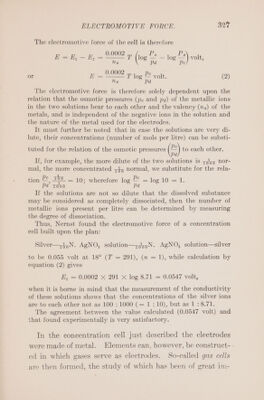
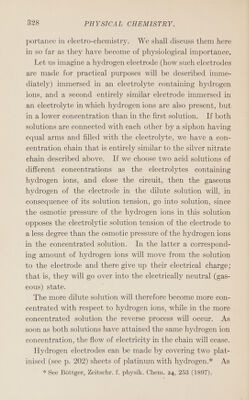
![first differential of time, when the metal comes in contact with the solution no difference in potential arises between the two. Every metal has, at a definite temperature, a definite electrolytic solution tension. If the electrolytic solution tension of different metals is investigated (we cannot here discuss the method by which this can be done), it is found that aluminium, iron, nickel, magnesium, zinc, and cadmium are always negative when brought in contact with solutions of their salts; this means that their electrolytic solution tension is greater than the osmotic pressure of the metallic ions in any solution that can be prepared from their salts. This is attributable to the fact that the solubility of these salts is never so great that the osmotic pressure of the metallic ions in the given solutions equals the very high electrolytic solution tension of the metal. Mercury, copper, gold, and silver are charged positively when immersed in solutions of their salts, since the electro- lytic solution tension of these metals is so low that it is usually less than the osmotic pressure of the metallic ions in solution. Only in exceedingly dilute solutions would it be possible for the osmotic pressure of the metallic ions to be lower than the electrolytic solution tension of these metals, and under these conditions the metal would become negative in the solution.* * We cannot here discuss how the magnitude of electrolytic solu- tion tension is determined. Calculation shows that this pressure is exceedingly high, at room temperature, for such metals as zinc, cadmium, ete., while for gold, silver, etc., it is exceedingly low. Ac- cording to Neumann, for example, [Zeitschr. f. physik. Chem. 14, 193 (1894),] the electrolytic solution tension of zinc in normal solu-](https://iiif.wellcomecollection.org/image/b32861631_0337.jp2/full/800%2C/0/default.jpg)