A report on state public health work based on a survey of State Boards of Health / by Charles V. Chapin.
- Charles V. Chapin
- Date:
- [1915]
Licence: In copyright
Credit: A report on state public health work based on a survey of State Boards of Health / by Charles V. Chapin. Source: Wellcome Collection.
Provider: This material has been provided by London School of Hygiene & Tropical Medicine Library & Archives Service. The original may be consulted at London School of Hygiene & Tropical Medicine Library & Archives Service.
144/238 (page 132)
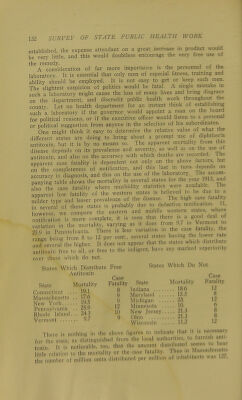
![established the expense attendant on a great increase in product would be very little, and this would doubtless encourage the very free use of the remedy. . i r .t, A consideration of far more importance is the personnel of the laboratory It is essential that only men of especial fitness, training and ability should be employed. It is not easy to get or keep such men. The slightest suspicion of politics would be fatal. A single mistake in such a laboratory might cause the loss of many lives and bring disgrace on the department, and discredit public health work throughout the county. Let no health department for an instant think of establishing such a laboratory if the governor would appoint a man on the board for political reasons, or if the executive officer would listen to a personal or political suggestion from anyone in the selection of his subordinates. One might think it easy to determine the relative value of what the different states are doing to bring about a prompt use of diphtheria antitoxin, but it is by no means so. The apparent mortality from this disease depends on its prevalence and severity, as well as on the use of antitoxin, and also on the accuracy with which deaths are recorded. The apparent case fatality is dependent not only on the above factors, but on the completeness of notification, and this last in turn depends on accuracy in diagnosis, and this on the use of the labora ory. The accom- panying table shows the mortality in several states for the year 1913, and also the case fatality where morbidity statistics were available. The apparent low fatality of the western states is ^el'eved to be due to a milder type and lesser prevalence of the disease. The high case fatality in several of these states is probably due to defective notification. If, however, we compare the eastern and middle western states, where notification is, more complete, it is seen that there ^y^J'^^^J^^^ variation in the mortality, varying as it does from 9.7 m Vermont to 25 9 in Pennsylvania. There is less variation m the case fatality, the range being from 8 to 12 per cent., several states having the lower ra e and several the higher. It does not appear that the states which distribute antitoxin free to all, or free to the indigent, have any marked superiority over those which do not. States Which Distribute Free States Which Do Not Antitoxin ^^^^ Case State Mortality Fatality State Mortality Fatality /- 10 1 8 Indiana lo.o i£ Connecticut .... 19.1 » Maryland 15.3 8 IS:^']^.::.^ 10 New jersey.. 2U 8 Vermont 9.7 9 Ohio^^.^. ... • ^ There is nothing in the above figures to indicate that it is necessary for the state, as distinguished from the local authorities, to furnish anti- toxin It is noticeable, too, that the amount distnbuted seems to bea itrrelation to the mortality or the case fatality. Thus m Massachusetts he number of million units distributed per million of inhabitants was 127,](https://iiif.wellcomecollection.org/image/b21358886_0144.jp2/full/800%2C/0/default.jpg)