Dr. Ballard's report to the local goverment board upon an outbreak of diphtheria in a cottage adjoining the churchyard at Trotterscliffe near Wrotham, Kent.
- Ballard, Edward
- Date:
- 1880
Licence: Public Domain Mark
Credit: Dr. Ballard's report to the local goverment board upon an outbreak of diphtheria in a cottage adjoining the churchyard at Trotterscliffe near Wrotham, Kent. Source: Wellcome Collection.
Provider: This material has been provided by London School of Hygiene & Tropical Medicine Library & Archives Service. The original may be consulted at London School of Hygiene & Tropical Medicine Library & Archives Service.
4/12 page 4
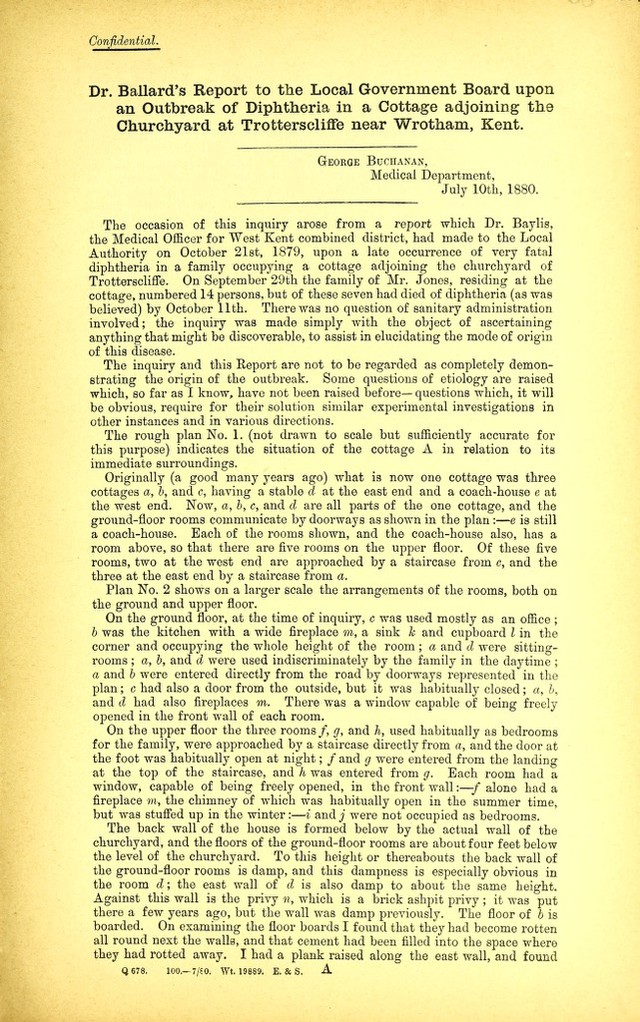
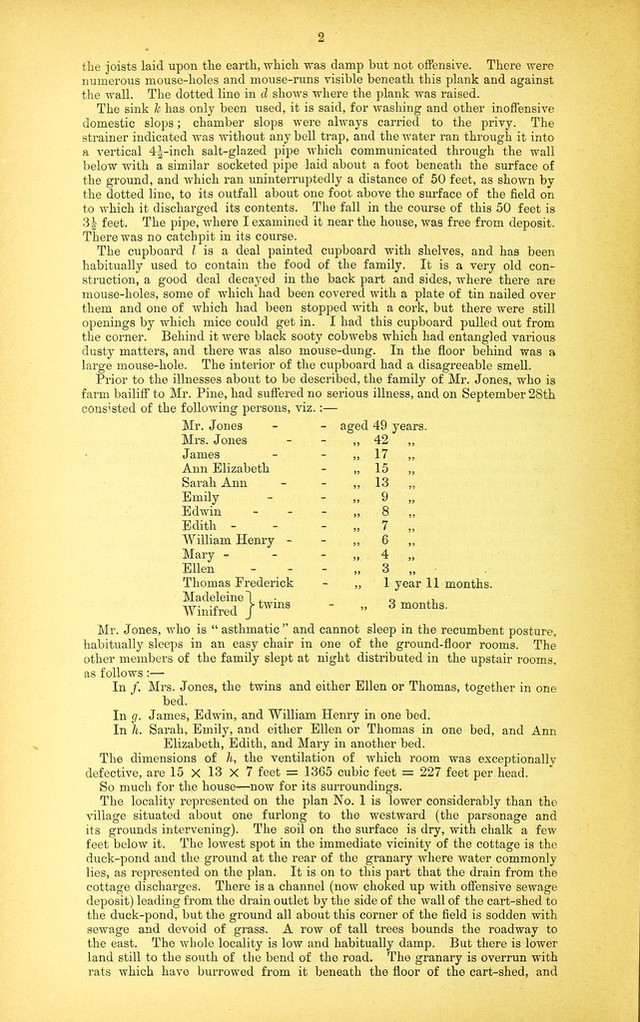
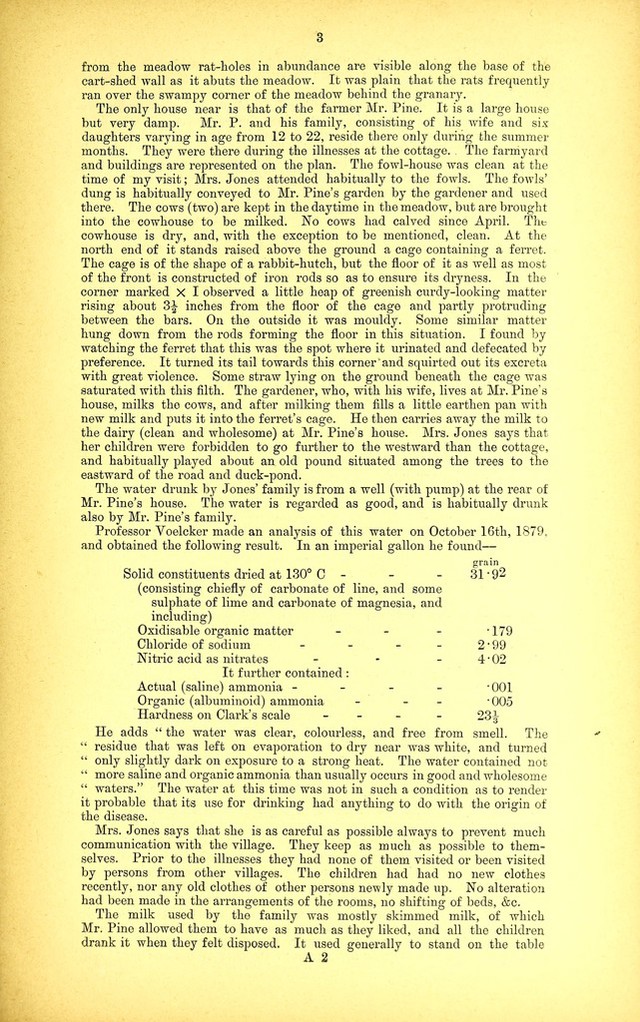
![in d. “ unless people were about,” and then it was commonly put into tbe cupboard with the other food. The infants (twins) were allowed new milk from Mr. Pine’s dairy. In the latter part of August and during September measles was prevalent in the village and among the children attending the parish school. The first cases occurred in a family named Nott, who had in July come from Fairseat, and who had acquired measles by visiting subsequently a family which had the disease in a neighbouring village. The Nott children were absent from school on account of measles on August 11th. It subsequently spread in the village, and there were numerous cases when the Jones family were suffering from measles. All who were attacked are said to have had more or less severe coryza, and many of them a slight amount of sore throat; but inquiring in the village I only heard of one case that required any special domestic treatment on this account. The cases, with only one or two exceptions, had no medical attendance. The sore throat in all the cases accompanied the coryza and ceased with the eruption. No sore throat after the measles. Nor did I hear of any remarkable external swellings about the throat, although I inquired; nor did I hear of any cases of sore throat independently of measles. Some cases of measles had no sore throat. Between 3rd and 9th September such of the J ones family as had not had measles formerly were (with the exception of the twins) attacked with it. All had marked coryza; the mother says, “ their noses were dirty, and they looked as if they had been crying,” She says there was no remarkable sore throat. For dates of attack see Table A. School broke up on September 5th, on which day none of the Jones’ children, except Sarah Ann and Emily, were present at the “ breaking up ” school feast. The children who habitually attended school were Sarah Ann, Emily, Edwin, Edith, William, Henry, and Mary. The first child attacked with sore throat was Emily. She had no medical attendance. For some days prior to Sunday, September 14th, she had been employed in the harvest field making “ bands.” Other village children were there also. She may have taken cold. She carried her dinner with her to the field, but had her other meals at home. She had no communication with other villages, nor with persons from other villages. On September XMh, while in the field, she felt ill, and came home in the evening with her throat sore. She continued ill with the sore throat for about a fortnight, but did not keep her bed; she came downstairs and mingled with the other children. After the death of the twins she, with Sarah Ann, went to stay at the Rectory. The mother says that at one time there was a good deal of discharge from her throat. But there was no eruption at any time on her skin. When Dr. Prall first visited the family on September 29th she was, he says, looking ill and her eyes were sunken, the throat was congested, but no membrane was observable. She was recovering. On September 28th (Sunday) the mother says that Mary was flushed and evidently not well in the evening. She lolled and lay about. The twins had been fretful and crying unusually ever since the 27th, and she thought she would that Sunday night put a mustard poultice on their chests. Having made more poultice than she wanted, she put one also upon Mary [perhaps this may have been on account of the “ croupy ” symptoms she had had after measles]. At about 2 a.m. on 29th, Mary awoke with croupy breathing and “ convul- sions.” She was “ black in the face ” with dilated nostrils. Dr. Prall was sent for and came. He says he could perceive no membrane on the throat, and there was no eruption on the skin. She died about 6 p.m. on 29th. [This case, standing alone, might have been regarded therefore as a case of “ croup.”] On September 29th, when Dr. Prall saw Mary, he also saw the twins. He says that a reddish serum was running from their noses. He examined their throats. On that of Madeleine there was some thin diphtheritic membrane. Winifred’s throat was red, but there was no membrane. Dr. Baylis saw Winifred on October 3rd, and could see no membrane. Madeline died on October 2nd, and Winifred on 3rd October. Both died apparently from “ asthenia.” On September 80th Dr. Prall saw Thomas Frederick. He says he had at that time an eruption on his skin distinct and dark coloured, both on face and trunk, but no coryza. He recognized it as the eruption of “ Rubeola notha,”](https://iiif.wellcomecollection.org/image/b24997225_0006.jp2/full/800%2C/0/default.jpg)