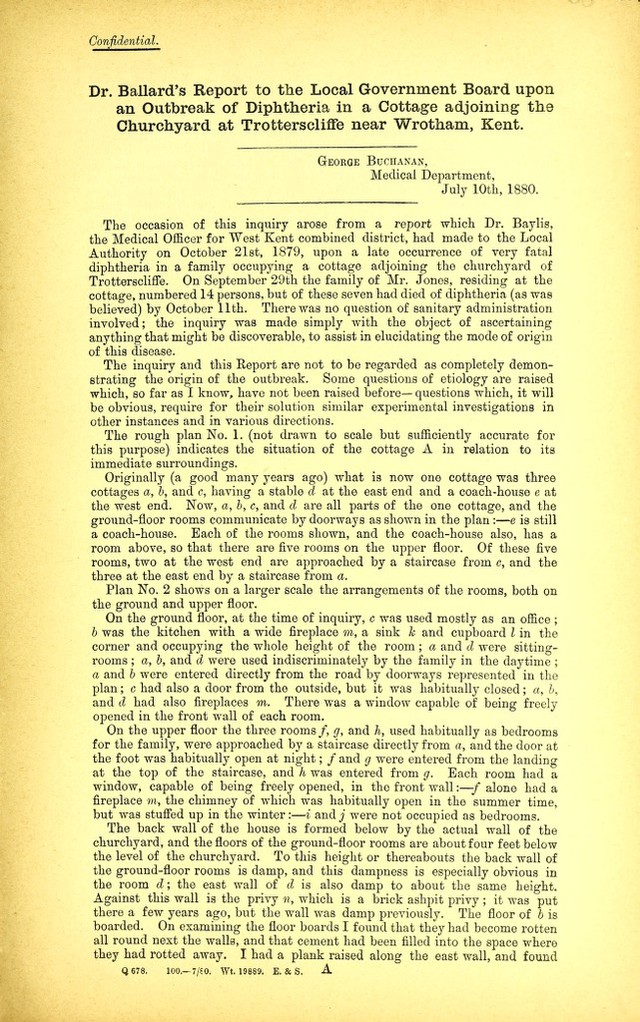
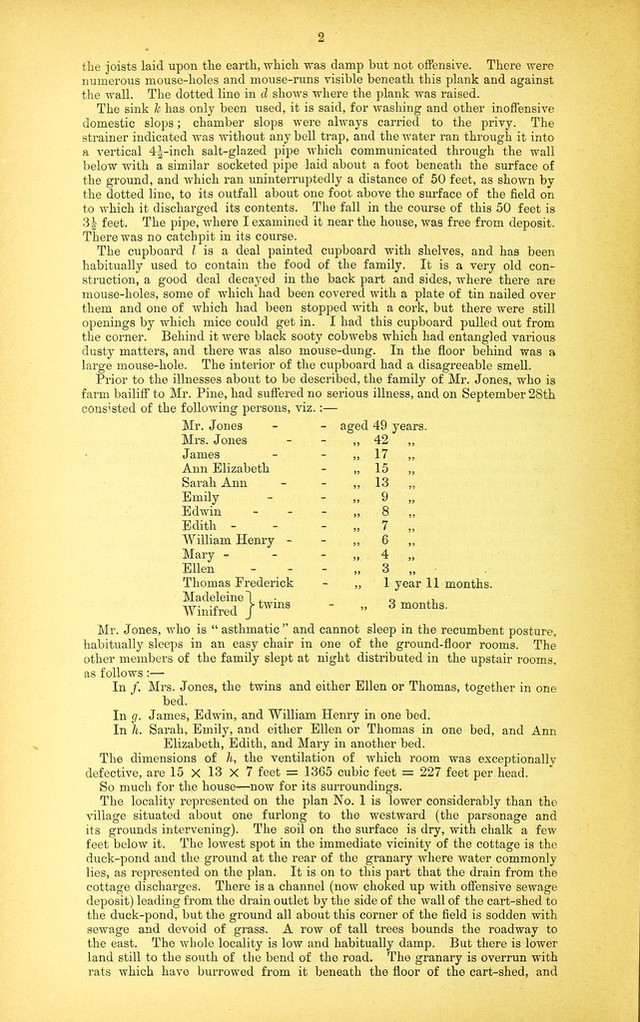
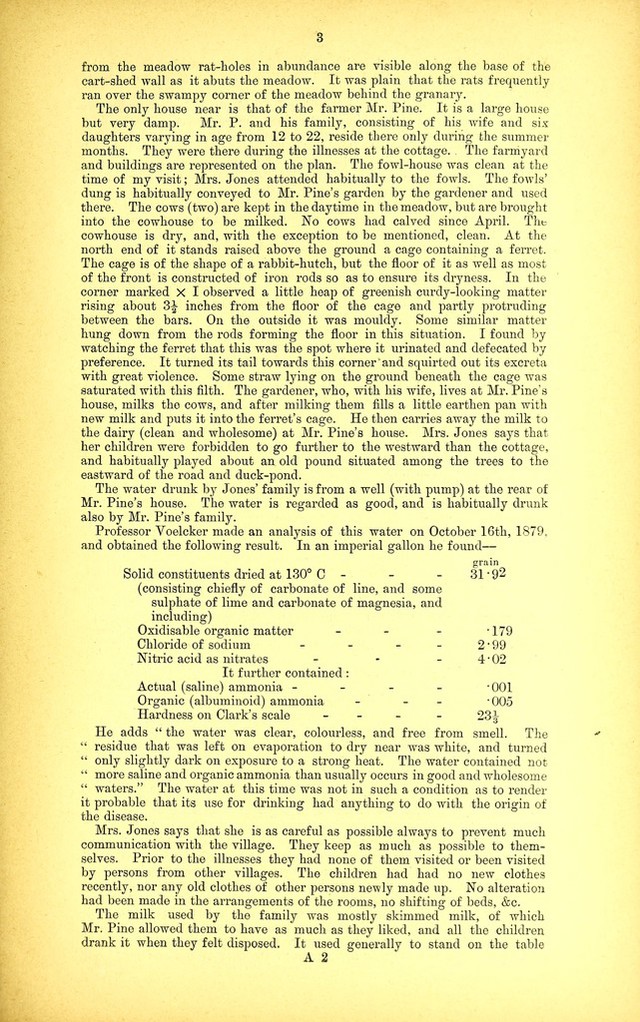
Dr. Ballard's report to the local goverment board upon an outbreak of diphtheria in a cottage adjoining the churchyard at Trotterscliffe near Wrotham, Kent.
- Ballard, Edward
- Date:
- 1880
Licence: Public Domain Mark
Credit: Dr. Ballard's report to the local goverment board upon an outbreak of diphtheria in a cottage adjoining the churchyard at Trotterscliffe near Wrotham, Kent. Source: Wellcome Collection.
Provider: This material has been provided by London School of Hygiene & Tropical Medicine Library & Archives Service. The original may be consulted at London School of Hygiene & Tropical Medicine Library & Archives Service.
5/12 page 5
![with which disease he says he is very familiar. There was, he says, deep ulceration of the throat, and the glands about the jaw were enlarged. He saw him again for the last time on October 1st. There was then no membrane on the throat, and his respiration was not croupy. He then advised the parents to send for Dr. Pope, the parochial medical officer, and ceased his own attendance. Dr. Pope says he first saw this child, with Edith, Ann Elizabeth, and James, on October 5th; there was no eruption on any of them, but on all the diphtheritic membrane was obvious, covering both the tonsils and the uvula. Thomas Frederick died on October 6th. On October 5th Dr. Pope saw the sick children Ann Elizabeth, James, Edith and William Henry for the first time, and says they all had diphtheritic membrane, so that they were probably ill before that day. He says that on James there were only a few patches of membrane, but that all were cases of diphtheria. They died (with the exception of James, who recovered) on the days mentioned in the Table. In the absence of any infection traceable by strict inquiry from outside, it would appear probable that Emily’s case at least had a local origin, either in the harvest field or in the house. The other cases might have received infection from her or from one another. As regards Ann Elizabeth, the mother and Dr. Pope both say that four days before her death she was apparently convalescing, and Dr. Pope’s son saw her eating her breakfast and a chop with some appetite. It appears from the mother’s statement that towards the end of the meal she was suddenly seized with “ convulsions ” and croupy breathing, pallor, and faintness This was on Tuesday, October 7th. She says that such fits occurred at short intervals daily until she died. She vomited also soon after taking any food, so that at last she was fed by means of beef-tea enemata. After coming out of any of these so-called “ fits ” her face used to flush. Dr. Pope’s certificate was “ Diphtheria, 16 days. Thrombosis, 4 days,” There had been no burial in churchyard for seven months before the out- break at Jones’ family. I learn from Dr. Baylis, the Medical Officer of Health, that, so far as he is able to learn, the family of Mr. Pine suffered from no form of illness whatever, and that sore throat has not prevailed at all in the parish since the fatal illnesses in Mr. Jones’ family. For some time past there has been growing up in my mind a notion that possibly, in those instances of apparently spontaneous origin of diphtheria which are often met with, the specific contagion of the disease may have been derived in some way from the lower animals, and especially from animals which are regarded as domestic vermin, such as rats, mice, blackbeetles, &c., about which and about the diseases of which there is scant knowledge or no knowledge at all. I therefore brought away with me for further investigation the following matters:—1. A sample of water from the duck-pond. 2. Some of the drainage mud that lay in the channel behind the granary and cart-shed. 3. Mouse-dung found entangled in cobwebs behind the cupboard 1. 4. Por- tions of old sooty cobweb from behind the cupboard 1. 5. Some of the ferret’s dung. These things were collected on the 4th, 5th, and 6th of ISTovember, and on November 11th, I handed them over to Dr. Klein for experiment. His reports of his experiments with these several matters are appended :—= Dr. Klein’s Beport on Experiments upon Babbits made with Substances from Trotterscliffe. November 15, 1879. I have examined all the samples left with me, and have not found in them anything of a special character, as far as the microscopic examination goes. I have inoculated rabbits with those different materials and have obtained striking results, at any rate for the present. Of the material inoculated I produced with the drain-matter [the mud from the channel behind the cart shed] and the mouse’s dung in two rabbits (one a piece) death in conse- quence of a disorder quite similar to that resulting from inoculating rabbits witti diphtheritic matter. With the pond water and cobweb I have not obtained any result.](https://iiif.wellcomecollection.org/image/b24997225_0007.jp2/full/800%2C/0/default.jpg)