An elementary text-book of biology, comprising vegetable and animal morphology and physiology / by J.R. Ainsworth Davis.
- James Richard Ainsworth-Davis
- Date:
- 1893
Licence: Public Domain Mark
Credit: An elementary text-book of biology, comprising vegetable and animal morphology and physiology / by J.R. Ainsworth Davis. Source: Wellcome Collection.
24/460 (page 8)
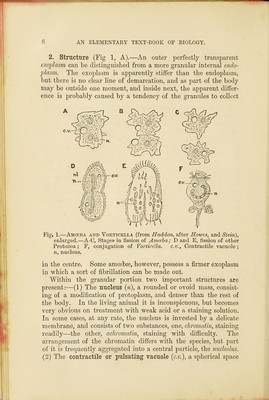
![2. Structure (Fig 1, A).—An outer perfectly transparent exo]plasm can be distinguished from a more granular internal endo- plasm. The exoplasm is apparently stiffer than the endoplasm, but there is no clear line of demarcation, and as part of the body may be outside one moment, and inside next, the apparent differ- ence is probably caused by a tendency of the granules to collect Fig. 1.—Amceba and Vorticella (from Haddon, after Howes, and Stein), enlarged.—A-0, Stages in fission of Amoeba; D and E, fission of other Protozoa; F, conjugation of Vorticella. c.v.. Contractile vacuole; n, nucleus. in the centre. Some amoebae, however, possess a firmer exoplasm in which a sort of fibrillation can be made out. Within the granular portion two important structures are present:—(1) The nucleus {n), a rounded or ovoid mass, consist- ing of a modification of protoplasm, and denser than the rest of the body. In the living animal it is inconspicuous, but becomes very obvious on treatment with weak acid or a staining solution. In some cases, at any rate, the nucleus is invested by a delicate membrane, and consists of two substances, one, chromatin, staining readily—the other, achromatin, staining with difficulty. The arrangement of the chromatin differs with the species, but part of it is frequently aggregated into a central particle, the nucleolus. (2) The contractile or pulsating vacuole {c.v.), a spherical space](https://iiif.wellcomecollection.org/image/b28121570_0024.jp2/full/800%2C/0/default.jpg)