Licence: In copyright
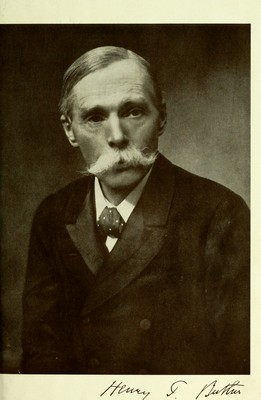
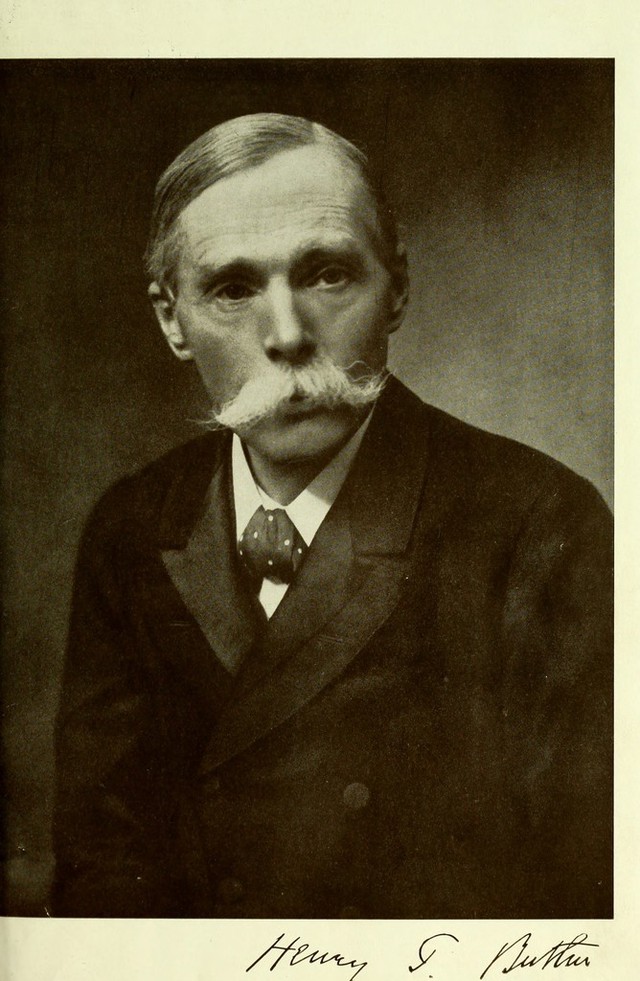
Credit: Sir Henry Trentham Butlin, Bart. ... : obituary. Source: Wellcome Collection.
Provider: This material has been provided by The Royal College of Surgeons of England. The original may be consulted at The Royal College of Surgeons of England.
5/14 page 277
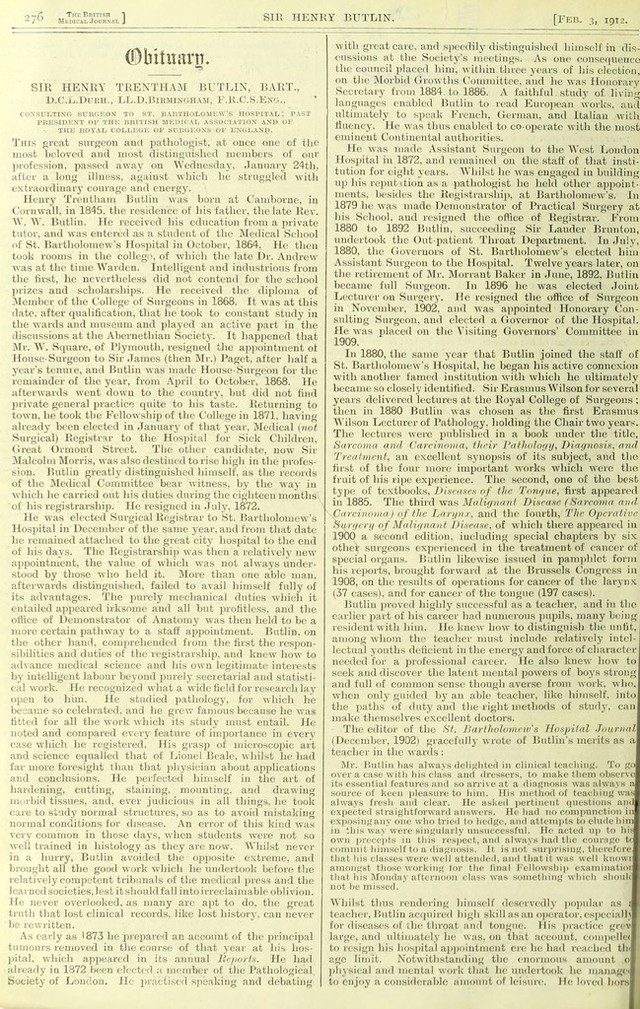
![exercise, and lie made many tours in Europe, visiting remote but highly-interesting places in Spain and Italy little known to the tourist. He took deep interest in Italian pictorial and architectural work, and studied the writings of Vasari and other art critics of the Benaissmee. All members of the Association know what services Sir Henry Butlin rendered to us. At the Worcester Meeting in 1882 he was Vice-President of the Section of Pathology and Bacteriology. In 1889, at the Leeds Meeting, he filled the office of President of the Section of Laryngology. In his address he dwelt on the future position of laryngology. He noted how the specialist had taken into his domain the whole of the mouth, and even the outside of the neck. The lectmer doubted if the laryngologist would retain his hold over such advanced outworks as the neck, but added that if he should lose them it mattered little, as he could well afford to do without them. At the Portsmouth Meeting in 1899, as President of the Section of Surgery, Butlin turned attention in his address to certain questions associated with military surgery which more directly affect the civilian. He deplored the fact that of late years the use of firearms in civil life had increased alarmingly, an evil which has not decreased. At the Exeter Meeting in 1907 Butlin delivered the Address in Surgery, an exceptionally fine and important oration, “ On the Contagion of Cancer in Human Beings: Auto- inoculation,” which appeared, finely illustrated, in our columns. As a literary souvenir it is, however, eclipsed by Butlin’s more recent Hunterian Lectures delivered at the College last autumn. Another fine public-spirited address, still familiar to all our members, was delivered by Butlin, as President of the Association, at the London Meeting in 1910, the subject being “ The Evolution of the Association and its Work.” Space forbids us to say more of it beyond reminding our readers that it well deserves rcperusal, being a clear review of the Association's work prex>ared and made xmblic by a great authority—a kind of review beyond the j)owers of the most conscientious, industrious, and learned official or literary historian. We must remember that whilst compiling and considering our “ evolution ” Butlin was discharging the arduous duties of another Presidency, that of the Royal College of Surgeons. As to his more purely official services to the Associa- tion, we must add that he was Treasurer from 1891 to 1895, having been unanimously re-elected to that highly responsible office at the Newcastle Meeting in 1893. He modestly stated on that occasion that doubtless there were men more fitted to be Treasurer than he, but that no one could be found who had more at heart the interests and prosfierity of the Association. His fitness and his zeal, already at that date so evident, were amx)ly i^roved by his subsequent labours in the cause of the Association. At a meeting of the Abernethian Society in January, 1901, Butlin related to the students of St. Bartholomew’s Hos- pital the history, character, and aims of our Association, testifying to the great services rendered to it by Mr. Ernest Hart and Mr. Francis Fowke. During those years, when he worked so hard for us, for his hosiiital, and for the College of Surgeons, he had acquired a lucrative x^iacticc, yet he never flagged at scientific work. He became President of the Laryngological Society, hexu'cpared four communications whicli appeared iu the Medico-Chir}!njical Transaciions, a,m\ was elected Vice-President of the Royal Medical and Chirurgical Society in 1904. When it was converted, after fusion with a mmiber of otlicr institutions of its class, into the Royal Society of Medicine he was jilaced on its General Council. The Pathological Society, so closely identified with Butlin’s early scientific work, he served actively almost to the year of its amalgamation. He held the chair in 1895-7, and the date of his Presidency was most fortunate. The Patho- logical Society of London was founded by Dr. Bentley and otlicis after a learned association bearing the same name bad been established in Dublin, in 1839, and another Pathological Society set uj) in Reading in 1841. On Octofx'.r 20th, 1846, the London Society held its first meeting, jiiid on October 20tli, 1896, it fell very ha))[)ily to the lot of Butlin, as President, to deliver an address on its jubilee, a in’odigious efff)i't on his part when wc; bear in mind tlia.t lie was at that date at the height of his active service, j)rivatn and public, as an o))erating surgeon, indeed, Ids faculty of collecting material for addresses— always a mentally and ]3bysically irksome task—and of welding them into orations that could not only be listened to but read afterwards iu print with not less i)leasure was X>henomenal. His fluency and his elegance of diction irrigated those wholesale collections of relatively dry facts on which such addresses are necessarily founded, and rendered them both comprehensible and interesting. Butlin devoted much time in his later years not only to the Association as we have already related, but likewise to the College of Surgeons. Having lectured with such great success in earlier years iu the theatre of the College, ho easily found his way into its Council in 1895 and was as easily re-elected in 1903 when he had served the regulation eight years. In 1905 he delivered the Bradshaw Lecture and in 1907 the Hunterian Oration. In 1909 he was elected President of the College, and was re-elected iu 1910 and 1911. There can be no doubt that liis failing health was greatly tried in 1910 when he held the chair iu the Association as w'ell. In 1911 he grew much weaker, but often drove himself to Council and Committee meetings at Lincoln’s Inn in the course of the spring. On June 13th a comiflimeutary banquet was given in his honour by the medical x>rofession on the instigation of the Metrop)olitan Counties Branch of the Association at the Connaught Rooms, and Dr. Lauristou Shaw, who was in the chair, spoke highly of his services, and Butlin was quite bright as in former years when he stood up to make a long yet most pathetic and interesting speech in returning thanks. The hot weather which followed jiroyed most trying. After his re-election in July he went to Switzerland, but the journey there and hack proved quite the reverse of beneficial. In the summer he had received the dentists at the College, and the last x>hotograf)h of him was taken as he stood in the p)orch of the building surrounded by his guests. He showed signs of great debility, and after his return to London the laryngeal affection from which he suffered rendered speaking imiDossible. His two lectures on Unicellula Cancri, the Parasite of Cancer, which, published in the Journal last autumn, gave rise to so much correspondence in our columns, were read from his manuscript by Dr. R. N. Paramore. On November 9th, before their delivery, Butlin resigned the presidencj'. The new President, Mr. Rickman Godlee, and the Council X^assed a unanimous resolution emxfliasizing the courage with which he had performed his presidential duties. It is sad to think that Butlin did not live to enjoy the well- merited titular distinction which he received from King George V on the occasion of that monarch’s coronation, but was forced by ill health to retire within a few months after he became a baronet. After his resignation in November he took to his bed, from which he never rose again. For a time he was greatly distressed by increasing dyspnoea and insomnia, and on January 24th he x^a-ssed peacefully away at noon. “ After life’s fitful fever he sleex^s well.” His remains were cremated on Saturday, January 27th, at Holders Green, only his nearest relatives being xu'esent. A memorial service at St. Andrews, Wells Street, on January 29th, conducted by the Rev. H. A. Camberlege (the vicar), assisted by Prebendary Grose Hodge, was largely attended by members of the xnofession, including the President of the Royal College of Surgeons (Mr. R. j. Godlee), the Vice-Presidents (Mr. Mansell Moullin and Mr. Clinton Dent), the President of the Royal College of Phy- sicians (Sir Thomas Barlow), Sir Douglas Powell, Sir J. F. Goodhart, Sir Lauder Brunton, Sir Anthony Bowfiny, Sir Pearce Gould, Dr. Frederick Roberts, Dr. Samuel West, Mr. Howard Marsh, Mr. Lockwood, Mr. Furnivall, Mr. Clement Lucas, Mr. Golding Bird, Mr. Bilton Pollard, Sir H. Paget-Cooke, Sir J. Tweedy, Sir Frederic Eve, Dr. Dimdas Grant, Dr. Raymond Johnson, Mr. Makins, Sir Frederick Wallis, Sir Watson Cheyne, The Dowager Lady Bi’oadbcnt, Sir John Rose Bradford; Dr. Steeves, repre- senting Sir James Barr (I’resident-elect), Dr. Rayncr (Treasurer), and Mr. Guy Elliston (Financial Secretary and Business Manager), rcx)rescnting the British Medical Asso- ciation ; Sir H. Monis and IMr. J. Y. AV. MacAlister, rc])re- senting the Royal Society of Mcdiciut', Miss Cock, rcxirc- senting the London School of Medicine for AVomeu, In. E. H. Bashford of, the Imperial Cancer Research Fund, and Mr. Smith AVoodward (of the Natural History Museum) ; from the Royal College of Surgeons : Professor](https://iiif.wellcomecollection.org/image/b22418982_0007.jp2/full/800%2C/0/default.jpg)