Bibliothecae Colfanae catalogus. Catalogue of the library in the free grammar-school at Lewisham founded by the Rev. Abraham Colfe in the year 1652 / By William Henry Black.
- Colfe Grammar School (Lewisham, London, England). Library.
- Date:
- 1831
Licence: Public Domain Mark
Credit: Bibliothecae Colfanae catalogus. Catalogue of the library in the free grammar-school at Lewisham founded by the Rev. Abraham Colfe in the year 1652 / By William Henry Black. Source: Wellcome Collection.
51/256
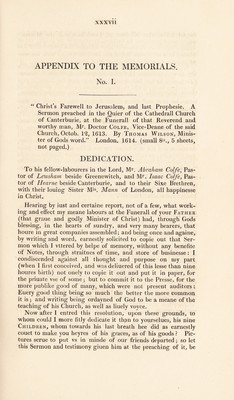
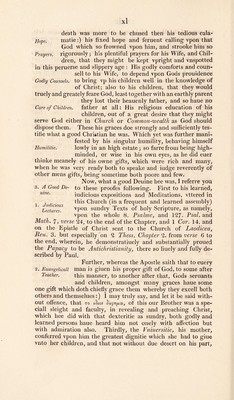
![ble behaviour and peaceable disposition towards all men that had to doe with him; also his humane compassion, pittying and relieuing (as hee could) the miseries of men; his loathnesse either to speake or to doe hurt vnto others, or to suffer any euill to be spoken or done by others: All these doe beare witnesse of him, that hee was a good man. Neither indeede could hee be lesse, if the Poet haue well described a good man, when he thus wrote, Vir bonus est quis? qui consulta legum qui vatresj juraque seruat: For hee submitted himselfe vnto superiour powers, being a diligent observer of good orders, and good lawes, both teaching and practising subiection to lawfull au¬ thority. But unto his morrall goodnes God added 2. A Good Christian, much Christian and spirituall goodnesse. For in time of his prosperitie and health, his vnfayned love to the Saints, (holding all deare vnto him which were deare vnto God,) communicating vnto their necessi- sities, euen for Christs sake ; more particularly, his contributions towards poore Schollers of the Vniuersity, for their maintenance and increase in learning and piety; also his vnblameable and honest conuersation, led according vnto the booke which hee studied, professed, and preached, doe speake for his sound Chris¬ tianity. In time of many and very great affliction [s], Patience. (wherof some were both exceeding sharpe by an¬ guish, and long for the continuance) his wonderfull patience in bearing euils, almost intollerable, without significa¬ tion of the least grudge or discontentment in minde, when the beholders were forced through compassion to turne away their eyes from looking vpon his extremities; yet did hee still indure, not onely with patience, but with eheerfulnesse, the heauy hand of God, kissing (as it were) the rod that smote him, being euen another Job for patience, as he was another Moses for meeke- nes. My selfe inwardly and long acquainted with Meeknesse. him, yet neuer, or uery seldom, did I see him moued vnto anger for any priuate or worldly matter 5 but as that seruant Moises, which was meeke and gentle in his owne causes, shewed himselfe seuere and stout, hot and earnest in Gods quarrell, Exod. 32, 19. So this our brother, otherwise not bee stirred, yet (cum qucestiofuit de veritate) he did declare himselfe very angry against gainsayers, taking more to hart, and being more displeased with the hurt done vnto the truth, than vnto himselfe. Moreover, his constant faith, continuing to trust in Trust. God, euen then when he did more then kill him (for ✓ 1 Read qui consulta pairum, qui leges—from Horace.](https://iiif.wellcomecollection.org/image/b29304556_0051.jp2/full/800%2C/0/default.jpg)




 No text description is available for this image
 No text description is available for this image
 No text description is available for this image