Volume 1
Contemporary classics in the life sciences / edited by James T. Barrett.
- Date:
- ©1986-
Licence: Attribution-NonCommercial 4.0 International (CC BY-NC 4.0)
Credit: Contemporary classics in the life sciences / edited by James T. Barrett. Source: Wellcome Collection.
35/400 (page 13)
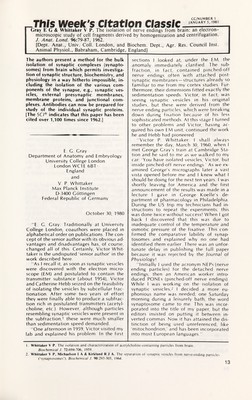
![... . . „ . _ _ CC/NUMBER 1 _Th/s week's Citation Classic Gray E G & Whitlaker V P. The isolation of nerve endings from brain: an electron- microscopic study of cell fragments derived by homogenization and centrifugation. J. Anat. Lond. 96 :79-87, 1962. [Dept. Anat., Univ. Coll. London, and Biochem. Dept., Agr. Res. Council Inst. Animal Physiol., Babraham, Cambridge, England] The authors present a method for the bulk isolation of synaptic complexes (synapto- somes) from brain which permits investiga tion of synaptic structure, biochemistry, and physiology in a way hitherto impossible, in cluding the isolation of the various com ponents of the synapse, e.g., synaptic ves icles, external presynaptic membranes, membrane proteins, and junctional com plexes. Antibodies can now be prepared for study of the individual synaptic proteins. [The SC/® indicates that this paper has been cited over 1,100 times since 1962.] E. G Gray Department of Anatomy and Embryology University College London London WC1 E 6BT- E ngland and V P Whittaker Max Planck Institute D-3400 Göttingen Federal Republic of Germany October 30, 1980 E. G. Gray: Traditionally at University College London, coauthors were placed in alphabetical order on publications The con cept of the senior author with its obvious ad vantages and disadvantages has, of course, changed all of this Certainly, Victor Whit taker is the undisputed 'senior author' in the work described here As I recall it, as soon as synaptic vesicles were discovered with the electron micro scope (EM) and postulated to contain the transmitter substance (about 1954), Victor and Catherine Hebb seized on the feasibility of isolating the vesicles by subcellular frac tionation After some two years of effort they were finally able to produce a subfrac tion rich in postulated transmitters (acetyl choline, etc ) However, although particles resembling synaptic vesicles were present in the subfraction, 1 these were much smaller than sedimentation speed demanded One afternoon in 1959, Victor visited my lab and explained his problem In the first sections I looked at, under the EM, the anomaly immediately clarified The sub- fraction, in fact, contained pinched-off nerve endings often with attached post synaptic membranes —structures already so familiar to me from my cortex studies Fur thermore, their dimensions fitted exactly the sedimentation speeds Victor, in fact, was seeing synaptic vesicles in his original studies, but these were derived from the nerve ending particles, which were breaking down during fixation because of his less sophisticated methods At this stage I turned to other problems and Victor, having ac quired his own EM unit, continued the work he and Hebb had pioneered Victor P Whittaker I shall always remember the day, March 30, 1960, when I met George Gray's train at Cambridge Sta tion and he said to me as we walked to my car: 'You have isolated vesicles, Victor, but inside pinched-off nerve endings ' As we ex amined George's micrographs later a vast vista opened before me and I knew what I should be doing for the next ten years. I was shortly leaving for America and the first announcement of the results was made in a lecture I gave in George Koelle's de partment of pharmacology in Philadelphia During the US trip my technicians had in structions to repeat the experiments: this was done twice without success! When I got back I discovered that this was due to inadequate control of the temperature and osmotic pressure of the fixative This con firmed the comparative lability of synap- tosomes and explained why no one had identified them earlier There was an unfor tunate delay in publishing the full paper because it was rejected by the lournal of Physiology! Initially I used the acronym NEPs (nerve ending particles) for the detached nerve endings; then an American worker intro duced PONEs (pinched-off nerve endings) While I was working on the isolation of synaptic vesicles, 2 I decided a more eu phonious name was needed; one Saturday morning during a leisurely bath, the word synaptosome came to me This was incor porated into the title of my paper, but the editors insisted on putting it between in verted commas Now it has attained the dis tinction of being used unreferenced, like mitochondrion,' and has been incorporated into most European languages. 1. Whittaker V P. The isolation and characterization of acetylcholine-containing particles from brain. Biochemical J. 72:694-706, 1959. 2. Whittaker V P, Michaelson I A & Kirkland R J A. The separation of synaptic vesicles from nerve-ending panicles (synaptosomes'). Biochemical J. 90:293-303, I964. 13](https://iiif.wellcomecollection.org/image/b18031973_vol_1_0036.JP2/full/800%2C/0/default.jpg)