Volume 1
The encyclopaedia of sport and games / edited by the Earl of Suffolk and Berkshire.
- Date:
- 1911
Licence: Attribution-NonCommercial 4.0 International (CC BY-NC 4.0)
Credit: The encyclopaedia of sport and games / edited by the Earl of Suffolk and Berkshire. Source: Wellcome Collection.
41/530 page 27
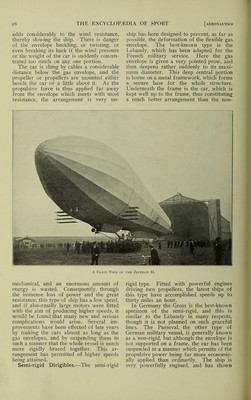
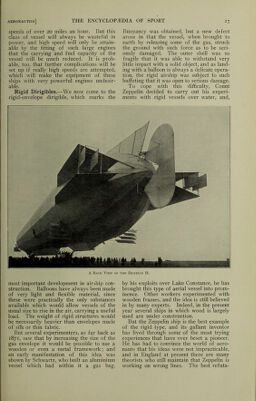
![A Back View of the Zeppelin II. most important development in airship con- struction. Balloons have always been made of very light and flexible material, since these were practically the only substances available which would allow vessels of the usual size to rise in the air, carrying a useful load. The weight of rigid structures would be necessarily heavier than envelopes made of silk or thin fabric. But several experimenters, as far back as 1871, saw that by increasing the size of the gas envelope it would be possible to use a wooden or even a metal framework; and an early manifestation of this idea was shown by Schwartz, who built an aluminium vessel which had within it a gas bag. by his exploits over Lake Constance, he has brought this type of aerial vessel into prom- inence. Other workers experimented with wooden frames, and the idea is still believed in by many experts. Indeed, in the present year several ships in which wood is largely used are under construction. But the Zeppelin ship is the best example of the rigid type, and its gallant inventor has lived through some of the most trying experiences that have ever beset a pioneer. He has had to convince the world of aero- nauts that his ideas were not impracticable, and in England at present there are many theorists who still maintain that Zeppelin is working on wrong lines. The best refuta- AERONAUTICs] THE ENCYCLOPAEDIA OF SPORT speeds of over 20 miles an hour. But this class of vessel will always be wasteful in power, and high speed will only be attain- able by the fitting of such large engines that the carrying and fuel capacity of the vessel will be much reduced. It is prob- able, too, that further complications will be set up if really high speeds are attempted, which will make the equipment of these ships with very powerful engines undesir- able. Rigid Dirigibles.—We now come to the rigid-envelope dirigible, which marks the Buoyancy was obtained, but a new defect arose in that the vessel, when brought to earth by releasing some of the gas, struck the ground with such force as to be seri- ously damaged. The outer shell was so fragile that it was able to withstand very little impact with a solid object, and as land- ing with a balloon is always a delicate opera- tion, the rigid airship was subject to such buffeting that it was open to serious damage. To cope with this difficulty, Count Zeppelin decided to carry out his experi- ments with rigid vessels over water, and,](https://iiif.wellcomecollection.org/image/b28120681_0001_0043.jp2/full/800%2C/0/default.jpg)