Volume 1
The encyclopaedia of sport and games / edited by the Earl of Suffolk and Berkshire.
- Date:
- 1911
Licence: Attribution-NonCommercial 4.0 International (CC BY-NC 4.0)
Credit: The encyclopaedia of sport and games / edited by the Earl of Suffolk and Berkshire. Source: Wellcome Collection.
507/530 page 477
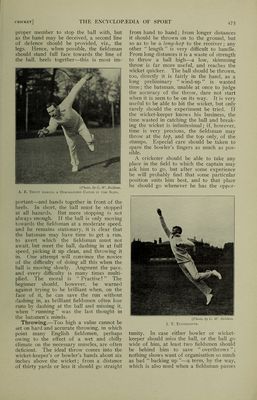
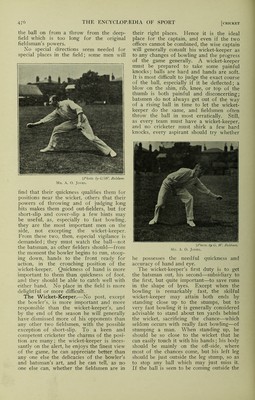
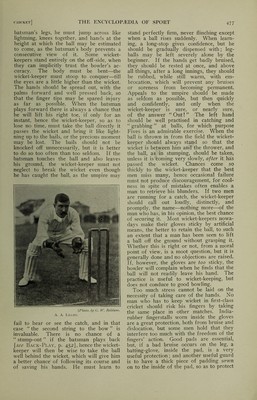
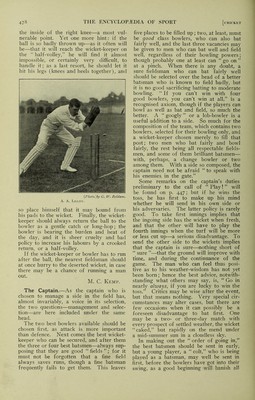
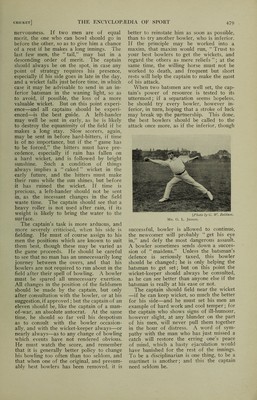
![batsman’s legs, he must jump across like lightning, knees together, and hands at the height at which the ball may be estimated to come, as the batsman’s body prevents a consecutive view of it. Some wicket- keepers stand entirely on the off-side, when they can implicitly trust the bowler’s ac- curacy. The body must be bent—the wicket-keeper must stoop to conquer—till the eyes are a little higher than the wicket. The hands should be spread out, with the palms forward and well pressed back, so that the finger tips may be spared injury as far as possible. When the batsman plays forward there is always a chance that he will lift his right toe, if only for an instant, hence the wicket-keeper, so as to lose no time, must take the ball directly it passes the wicket and bring it like light- ning up to the bails, or the precious moment may be lost. The bails should not be knocked off unnecessarily, but it is better to do so too often than too seldom. If the batsman touches the ball and also leaves his ground, the wicket-keeper must not neglect to break the wicket even though he has caught the ball, as the umpire may [Photo, by G. W. Beldam. A. A. Lili.ey. fail to hear or see the catch, and in that case “ the second string to the bow ” is invaluable. There is no chance of a “ stump-out ” if the batsman plays back [see Back-Play, p. 452], hence the wicket- keeper will then be wise to take the ball well behind the wicket, which will give him a better chance of following its course and of saving his hands. He must learn to stand perfectly firm, never flinching except when a ball rises suddenly. When learn- ing, a long-stop gives confidence, but he should be gradually dispensed with; leg- balls may be left severely alone by the beginner. If the hands get badly bruised, they should be rested at once, and above all things, after a long innings, they should be rubbed, while still warm, with em- brocation, which will prevent any bruises or soreness from becoming permanent. Appeals to the umpire should be made as seldom as possible, but then quickly and confidently, and only when the wicket-keeper is sure, or nearly sure, of the answer “Out!” The left hand should be well practised in catching and “ grabbing ” at balls, for which purpose Fives is an admirable exercise. When the ball is thrown in from the field the wicket- keeper should always stand so that the wicket is between him and the thrower, and the ball, as in stumping, should be taken, unless it is coming very slowly, after it has passed the wicket. Chances come so thickly to the wicket-keeper that the best men miss many, hence occasional failure must not produce discouragement, for cool- ness in spite of mistakes often enables a man to retrieve his blunders. If two men are running for a catch, the wicket-keeper should call out loudly, distinctly, and promptly, the name—nothing more—of the man who has, in his opinion, the best chance of securing it. Most wicket-keepers nowa- days make their gloves sticky by artificial means, the better to retain the ball, to such an extent that a man has been seen to lift a ball off the ground without grasping it. Whether this is right or not, from a moral point of view, is a moot question, but it is generally done and no objections are raised. If, however, the gloves are too sticky, the bowler will complain when he finds that the ball will not readily leave his hand. The practice is useful to wicket-keeping, but does not conduce to good bowling. Too much stress cannot be laid on the necessity of taking care of the hands. No man who has to keep wicket in first-class cricket should risk his fingers by taking the same place in other matches. India- rubber fingerstalls worn inside the gloves are a great protection, both from bruise and dislocation, but some men hold that they interfere too much with the freedom of the fingers’ action. Good pads are essential, but, if a bad bruise occurs on the leg, a batting-glove, inside the pad, is a very useful protection ; and another useful guard is to have a thick piece of padding sewn on to the inside of the pad, so as to protect](https://iiif.wellcomecollection.org/image/b28120681_0001_0509.jp2/full/800%2C/0/default.jpg)