Volume 1
The encyclopaedia of sport and games / edited by the Earl of Suffolk and Berkshire.
- Date:
- 1911
Licence: Attribution-NonCommercial 4.0 International (CC BY-NC 4.0)
Credit: The encyclopaedia of sport and games / edited by the Earl of Suffolk and Berkshire. Source: Wellcome Collection.
514/530 page 484
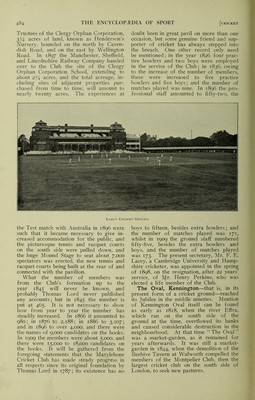
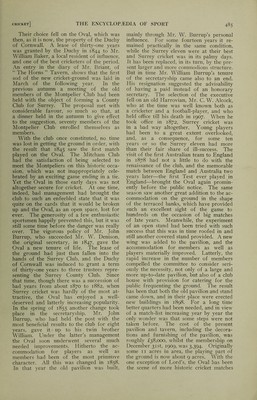
![Trustees of the Clergy Orphan Corporation, 3J4 acres of land, known as Henderson’s Nursery, bounded on the north by Caven- dish Road, and on the east by Wellington Road. In 1897 the Manchester, Sheffield, and Lincolnshire Railway Company handed over to the Club the site of the Clergy Orphan Corporation School, extending to about 2/4 acres, and the total acreage, in- cluding sites of adjacent properties pur- chased from time to time, will amount to nearly twenty acres. The experiences at doubt been in great peril on more than one occasion, but some genuine friend and sup- porter of cricket has always stepped into the breach. One other record only need be mentioned; in the year 1826 four prac- tice bowlers and two boys were employed in the service of the Club; in 1836, owing to the increase of the number of members, these were increased to five practice bowlers and five boys; and the number of matches played was nine. In 1896 the pro- fessional staff amounted to fifty-two, the .i* a. ]Sl2 H ' \ *&illiflii | fSjsssji! • V‘*A A, Lord’s Cricket Ground. the Test match with Australia in 1896 were such that it became necessary to give in- creased accommodation for the public, and the picturesque tennis and racquet courts on the south side were pulled down, and the huge Mound Stage to seat about 7,000 spectators was erected, the new tennis and racquet courts being built at the rear of and connected with the pavilion. What the number of members was from the Club’s formation up to the year 1845 will never be known, and probably Thomas Lord never published any accounts; but in 1845 the number is put at 465. It is not necessary to show how from year to year the number has steadily increased. In 1866 it amounted to 980; in 1876 to 2,188; in 1886 to 3,107; and in 1896 to over 4,000, and there were the names of 9,000 candidates on the books. In 1909 the members were about 5,000. and there were 15,000 to 18,000 candidates on the books. It will be gathered from the foregoing statements that the Marylebone Cricket Club has made steady progress in all respects since its original foundation by Thomas Lord in 1787; its existence has no boys to fifteen, besides extra bowlers; and the number of matches played was 171, whilst in 1909 the ground staff numbered fifty-five, besides the extra bowlers and boys, and the number of matches played was 173. The present secretary, Mr. F. E. Lacey, a Cambridge University and Hamp- shire cricketer, was appointed in the spring of 1898, on the resignation, after 22 years’ service, of Mr. Henry Perkins, who was elected a life member of the Club. The Oval, Kennington—that is, in its present form of a cricket ground—reached its Jubilee in the middle nineties. Mention of Kennington Oval itself can be found as early as 1818, when the river Effra, which ran on the south side of the ground at the time, overflowed its banks and caused considerable destruction in the neighbourhood. At that time “ The Oval ” was a market-garden, as it remained for years afterwards. It was still a market- garden in 1844, when the demolition of the Beehive Tavern at Walworth compelled the members of the Montpelier Club, then the largest cricket club on the south side of London, to seek new pastures.](https://iiif.wellcomecollection.org/image/b28120681_0001_0516.jp2/full/800%2C/0/default.jpg)