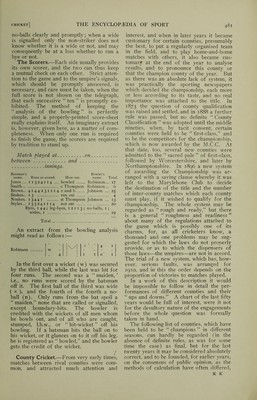
Volume 1
The encyclopaedia of sport and games / edited by the Earl of Suffolk and Berkshire.
- Date:
- 1911
Licence: Attribution-NonCommercial 4.0 International (CC BY-NC 4.0)
Credit: The encyclopaedia of sport and games / edited by the Earl of Suffolk and Berkshire. Source: Wellcome Collection.
516/530 page 486
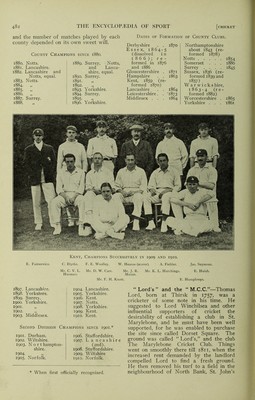
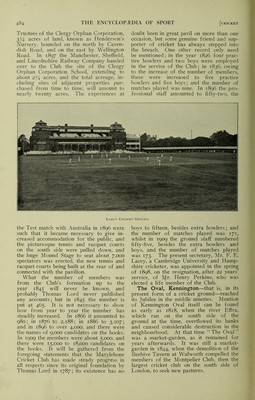
![than any ground in the kingdom, which is as much as to say in the world. The old Oxonian, Mr. W. Findlay, was appointed as Mr. Alcock’s successor. Other Famous Grounds.—Cambridge University.—-For many years the University has played on the ground which was opened by F. P. Fenner in 1846, and which was known as “ Fenner’s ” till in 1875 the C.U.C.C. leased the ground and added a handsome pavilion. In 1892 the club acquired the freehold. The match en- closure, about five acres, is covered with such beautiful turf that high scoring is the rule rather than the exception. The full size of the ground, now known as “ The Cambridge University Cricket Ground,” is about eight acres, and 10,000 persons can witness the game with ease. Derbyshire has its headquarters at Derby, a ground of eleven acres, seven of which are re- served for matches and three for practice. The pavilion and grand stand seat about i,ooo, and there is every convenience for the public. The turf, though a little coarse, is grow* on good clay marl and wears exceedingly well. Some of the home matches are decided at Chesterfield and Glossop. Essex has its ground at Leyton, where on a good gravel soil are eleven and a half acres of capital turf, eight and a half acres being reserved for cricket. There is plenty of accommodation for 12,000 persons, apart from the seats in the stands and pavilion, and a bowling green formed in the winter of 1909. Other improvements would be carried out did funds admit. Gloucestershire.—The County Ground is at Bristol, and comprises fourteen acres and a half of good sound turf, eight of which are reserved for matches. There is a fairly large pavilion and stand. Three county matches are played annually on the Cheltenham College ground, a capital en- closure, these forming the “ Cheltenham Festival.” Matches are also given to Gloucester, and there is a “ Bristol Week.” Hampshire plays several matches annually on the “ Officers’ Recreation Ground, Portsmouth,” a ground famous for good wickets and high scor- ing, but the majority of the matches take place on the county ground at Southampton, where there is plenty of room for cricket, and on the good, sound turf the average scoring is very high. Bournemouth has also of late received a share, and promotes a successful festival. Kent distributes its matches among various towns, but the headquarters of the county are at Canterbury, on the famous St. Lawrence ground, where the famous “ week,” the progenitor of all similar weeks, opens on the August Bank Holi- day. The ground, thirteen acres in area, is well- drained and dries fast; the turf is of the best. It was purchased a few years since by the County Club. The ground can hold 14,000 spectators, in- cluding some 3,300 in the new pavilion (recently added to) and stands. A “week” is also held at Tonbridge, on the Angel ground, a large and commodious enclosure of excellent turf, at Tun- bridge Wells, Dover, and Mote Park, Maidstone, which was made level in 1909, and a handsome pavilion erected. County matches are also played at Blackheath, Catford Bridge, and Gravesend. Lancashire plays all its matches except two on the famous “Old Trafford Ground,” Manchester. The extent of the ground is ten acres, of the match enclosure seven; stands, pavilion, and other buildings occupy the remainder, whilst there are also a practice ground and club match pitch adjoining. The pavilion is a reduced fac- simile of that at “Lord’s.” The turf is admirable, though often very slow, owing to the rainy climate. One of the international matches is always played at Old Trafford. Several county matches are played on the Aigburth Ground, Liverpool, where there is a splendid pavilion and every facility for cricket. About eight acres out of eleven are set apart for matches. Leicestershire.—The county ground is in the Aylestone Road, and all county matches are played there. The ground, eleven acres in extent, is covered with good turf; and half of it forms the match portion. The pavilion and stand seat 1,500 persons, and there is plenty of seating round the ground. Lord’s is the headquarters of English cricket. From the clayey nature of the soil, the ground is as hard as iron after a succession of hot days, but after rain it is probably the most treacherous in England. [See Lord’s and M.C.C.] Middlesex.—All the home matches of this county are played, by special arrangement, at “ Lord’s.” Northamptonshire.—The ground is well situ- ated to the north-east of the county town, North- ampton, and consists of ten acres. The soil is principally sand, and the wickets, which are usually fast, are all improved by the use of marl. The ground has the reputation of drying very quickly, and soon recovers from the effects of the wet. At one corner of the ground is an imposing- looking hotel, under the control of the club, and on the opposite side is the main pavilion, which is confined to the use of the players and male members of the club only. There is also a ladies’ pavilion, a west stand, and a very large stand used in connection with football, as well as cricket. Further extensions of this are contemplated. Nottinghamshire.—The Trent Bridge Ground, Nottingham, is the home of the county’s cricket. It is nine acres in size, six acres forming the match portion, and being covered with excellent turf. The new pavilion, built in 1886, holds some 3,000 spectators, and the ground is surrounded with terraces, provided with seats and roofed. Oxford University.—For many years the O.U.C.C. used a ground known as “ The Magdalen Ground,” and belonging to that college; the present ground was acquired in 1880. The total size of “ The Parks ” is about ten acres, of the match enclosure about five and a half acres; the turf is sound and good under favourable conditions, but is apt to be tricky if the weather is unpropitious. As “ The Parks ” are public property, no admission fee can be charged, and consequently, when gate-money is required, matches are played elsewhere—on the Christ Church Ground, in the Iffley Road. The pavilion accommodates about 600 persons. Somerset possesses an excellent county ground at Taunton, with a fine sward of turf, which dries after rain more quickly than any ground in England. It is six and a half acres in size, accommodates 6,000 spectators in “ the ring,” and 1,000 more in pavilion, grand stand, and ladies’ enclosure. About one-half of the home fixtures are now played at Bath, where better patronage is secured. Surrey.—In “The Oval,” Surrey possesses a ground which in fame stands second only to “ Lord’s,” in excellence second to none, the turf being remarkably fine and good, and recovering very rapidly. The ground belongs to the Duchy of Cornwall, and is situated in Kennington. [5V^ Ante.] Sussex.—The County Ground is at Hove, Brighton, and is famous as being one of the](https://iiif.wellcomecollection.org/image/b28120681_0001_0518.jp2/full/800%2C/0/default.jpg)