Volume 1
The encyclopaedia of sport and games / edited by the Earl of Suffolk and Berkshire.
- Date:
- 1911
Licence: Attribution-NonCommercial 4.0 International (CC BY-NC 4.0)
Credit: The encyclopaedia of sport and games / edited by the Earl of Suffolk and Berkshire. Source: Wellcome Collection.
524/530 page 494
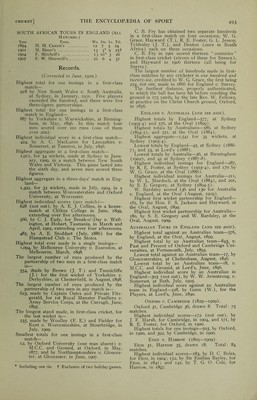
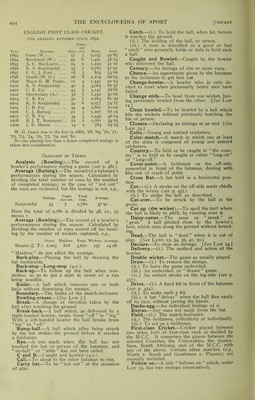
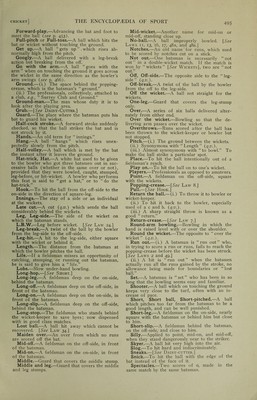
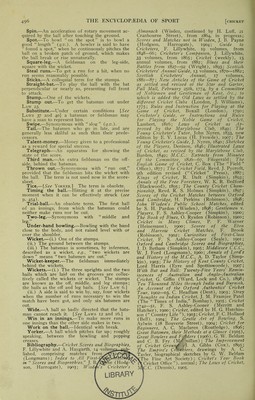
![ENGLISH FIRST CLASS CRICKET. THE LEADING BATSMEN SINCE 1S92. Times not Year. Batsman. Inns. out. Runs. Aver. 1893 Gunn (W.) 51 3 2,057 42-85 1894 Brockwell (W.) 45 6 1,491 3S-23 1895 A. C. MacLaren 24 O 1,229 5'-20 1896 K. S. Ranjitsinhji ... 55 7 2,780 57-9I 1897 F. G. J. Ford 18 3 805 53-66 1898 Quaife (W. G.) 28 8 1,219 60-95 1899 Major R. M. Poore.. 21 4 i,55> 91-23 1900 K. S. Ranjitsinhji ... 40 s 3,065 87-57 1901 G. B. Fry 43 3 3,'47 78-67 1902 Shrewsbury (A.) . ... 32 7 1,250 50-00 1903 C. B. Fry 40 7 2,683 8f30 1904 K. S. Ranjitsinhji ... 34 6 2,077 74-17 1905 C. B. Fry 44 4 2,801 70-02 1906 C. J. Burnup 21 3 1,207 67 05 1907 C. B. Fry 34 3 ',449 46-74 1908 B. J. T. Bosanquet .. 22 2 1,081 54-05 1909 [. R. Mason 14 2 783 65^5 w. G. Grace was to the fore in 1 866, ’68, ’69, ’70, ’7L ’72, ’73. ’74- ’76, ’77, ’79, and ’80. No one playing less than a dozen completed innings is taken into consideration. Glossary of Terms. Analysis (Bowling).—The record of a bowler’s performance during a game (see p. 481). Average (Batting).—The record of a batsman’s performances during the season. Calculated by dividing the total number of runs by the number of completed innings; in the case of “not out the runs are reckoned, but the innings is not, e.g., Inmgs. notout. runs. Average. Ranjitsinhji 55 7 2,780 57'91 Here the total of 2,780 is divided by 48, i.e., 55 minus 7. Average (Bowling).—The record of a bowler’s performances during the season. Calculated by dividing the number of runs scored off his bowl- ing by the number of wickets captured, e.g., Overs. Maidens. Runs. Wickets. Average. Hearne (J. T.) 2,003 818 3,670 257 14-28 “ Maidens ’’ do not affect the average. Back-play.—Playing the ball by drawing the bat backwards. Back-stop—Long-stop (q.v.). Back-up.—To follow up the ball when non- striker, so as to get a start in event of a run being possible. Bailer.—A ball which removes one or both bails without disturbing the stumps. Boundary.—The limits of the match-inclosure. Bowling-crease.— [See Law 7.] Break.—A change of direction taken by the ball after touching the ground. Break-back.—A ball which, as delivered by a right-handed bowler, twists from “ off ” to “ leg.” With a left-handed bowler the ball breaks from “ leg ” to “ off.” Bump-ball.—A ball which after being struck by the bat strikes' the ground before it reaches a fieldsman. Bye.—A run made when the ball has not touched the bat or person of the batsman, and “ no-ball ” or “ wide ” has not been called. C and B.—Caught and bowled (q.v.). Call.—To shout to the other batsman to run. Carry bat.—To be “ not out ” at the cessation of play. Catch.— (i.) To hold the ball, when hit, before it touches the ground. (ii.) The holding of the ball, so struck. (iii.) A man is described as a good or bad “ catch ” who generally holds or fails to hold such a ball. Caught and Bowled.—Caught by the bowler who delivered the ball. Century.—An innings of 100 or more runs. Chance.—An opportunity given by the batsman to the fieldsman to get him out. Change-bowler.—A bowler who is only in- vited to bowl when presumably better men have failed. Change ends.—To bowl from one wicket, hav- ing previously bowled -from the other. [See Law 14.] Clean bowled.—To be bowled by a ball which hits the wickets without previously touching the bat or person. Closure.—Declaring an innings at an end. [See Law 54.] Colts.—Young and untried cricketers. Colts’-match.—A match in which one at least of the sides is composed of young and untried cricketers. Country.—To field or be caught in “ the coun- try ” is to field or be caught at either “ long-on ” or “ long-off.” Cover-point.—A fieldsman on the off-side, somewhat in front of the batsman, dealing with hits out of reach of point. Cross Bat.—A bat held in a horizontal posi- tion. Cut.—(i.) A stroke on the off-side made chiefly with the wrists (see p. 455). (ii.) To strike the ball as described. Cut-over.—To be struck by the ball in the groin. Cut up (the wicket).—To spoil the turf where the ball is likely to pitch, by running over it. Daisy-cutter.—The same as “ sneak ” or “ grub.” A ball pitched close to the bowler’s foot, which runs along the ground without bound- ing. Dead.—The ball is “ dead ” when it is out of play. [See Laws 13, 34, 35, 41, 50.] Declare.—To close an innings. [See Law 54.] Delivery.—(i.) The method and action of the bowler. Double wicket.—The game as usually played. Draw.— (i.) To remove the stumps. (ii.) To leave the game undecided. (iii.) An undecided, or “drawn” game. (iv.) An extinct stroke on the leg-side (see p. 457)- Drive.— (i.) A hard hit in front of the batsman (see p. 454). (ii.) To make such a hit. (iii.) A bat “drives” when the ball flies easily off its face, without jarring the hands. Ducks-egg.—An individual innings of 0. Extras.—Any runs not made from the bat. Field.— (i.) The match-inclosure. (ii.) The fieldsmen, collectively or individually, (iii.) To act as a fieldsman. First-class Cricket.—Cricket played between two sides, both of first-class rank as decided by the M.C.C. It comprises the games between the selected Counties, the Universities, the Austra- lians, South Africans, and of the M.C.C. with any of the above. Certain other matches (e.g., North v. South and Gentlemen v. Players) are annually included. Follow on.—A side “ follows on ” which, under Law 53, has two innings consecutively.](https://iiif.wellcomecollection.org/image/b28120681_0001_0526.jp2/full/800%2C/0/default.jpg)