Volume 1
The encyclopaedia of sport and games / edited by the Earl of Suffolk and Berkshire.
- Date:
- 1911
Licence: Attribution-NonCommercial 4.0 International (CC BY-NC 4.0)
Credit: The encyclopaedia of sport and games / edited by the Earl of Suffolk and Berkshire. Source: Wellcome Collection.
526/530 page 496
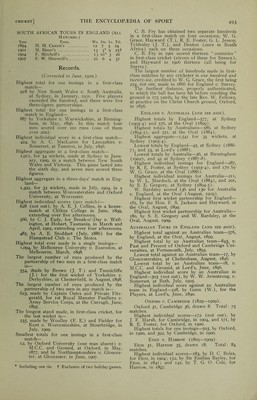
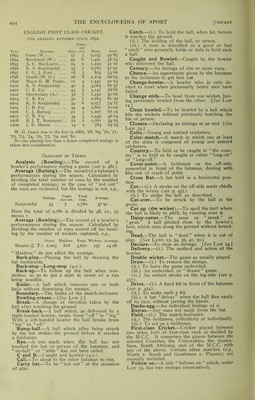
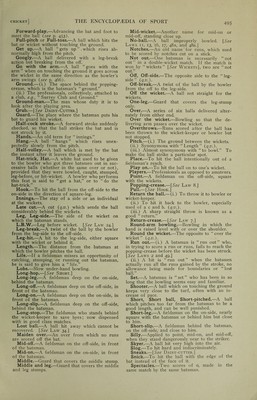
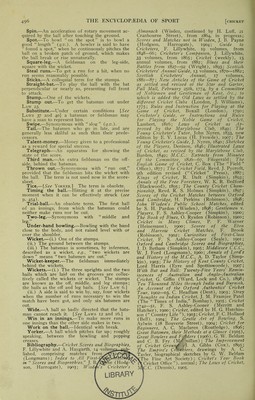
![Spin.—An acceleration of rotary movement ac- quired by the ball after touching the ground. Spot.—To bowl “ on the spot ” is to bowl a good “length” (q.v.). A bowler is said to have “ found a spot,” when he continuously pitches the ball on a broken patch of ground, which makes the ball break or rise unnaturally. Square-leg.—A fieldsman on the leg-side, square with the wicket. Steal runs.—To get a run for a hit, when no run seems reasonably possible. Sticks.—A colloquial term for the stumps. Straight-bat.—To play the ball with the bat perpendicular or nearly so, presenting full front to attack. Stump.—One of the wickets. Stump out.—To get the batsman out under Law 23. Substitute.—Under certain conditions [See Laws 37 and 40] a batsman or fieldsman may have a man to represent him. Swipe.—Synonymous with “slog” (q.v.). Tail.—The batsmen who go in late, and are generally less skilful as such than their prede- cessors. Talent-money.—Money given to a professional as a reward for special success. Telegraph—An apparatus for showing the state of the score. Third man.—An extra fieldsman on the off- side, behind the batsman. Thrown out.—Synonymous with “run out,” provided that the fieldsman hits the wicket with the ball. The term is not used now in the score- sheet. Tice.— [See Yorker.] The term is obsolete. Timing the ball.—Hitting it at the precise moment when it can be effectively struck (see P- 454)- Trial-ball.—An obsolete term. The first ball of an innings, from which the batsman could neither make runs nor be out. Two-leg.—Synonymous with “ middle and leg.” Under-hand bowling.—Bowling with the hand close to the body, and not raised level with or over the shoulder. Wicket.— (i.) One of the stumps. (ii.) The ground between the stumps. (iii.) The batsman is sometimes, by inference, described as a wicket, e.g., “two wickets are down ” means “ two batsmen are out.” Wicket-keeper.—The fieldsman immediately behind the wickets. Wickets.— (i.) The three uprights and the two bails which are laid on the grooves are collec- tively called the wickets or wicket. The stumps are known as the off, middle, and leg stumps; the bails as the off and leg bails. [See Law 6.] (ii.) A side is said to win by, say, four wickets when the number of runs necessary to win the match have been got, and only six batsmen are out. Wide.—A ball so badly directed that the bats- man cannot reach it. [See Laws 12 and 16.] Win in an innings.—To make more runs in one innings than the other side makes in two. Work on the ball.—Identical with break. Yorker.—A ball which pitches far up; roughly speaking, between the bowling and popping creases. Bibliography.—Cricket Scores and Biographies, F. Lillywhite and A. Haygarth, 14 volum£s_jjuh- lished, comprising matches from^^Ta^^ (Longmans); Index to All First-O^^Mcrlc in “Scores and Biographies,” J. B^JjVne (Hodg^ son, Harrogate), 1003; Wisdm’s Cricketer’s Almanack (Wisden, continued by H. Luff, 21 Cranbourne Street), from 1864, in progress; Scores and Matches not in Wisden, J. B. Payne (Hodgson, Harrogate), 1904; Guide to Cricketers, F. Lillywhite, 19 volumes, from 1848—66; Cricketer’s Companion, J. Lillywhite, 33 volumes, from 1865; Cricket (weekly), 15 annual volumes, from 1882; Blues and their Battles from 1827—92 (Wright), 1893; Scottish Cricketers’ Annual Guide, 13 volumes, 1870—1882; Scottish Cricketers’ Annual, 17 volumes, 1881—87; New Articles of the Game of Cricket as settled and revised at the Star and Garter, Pall Mall, February 25th, 1774, by a Committee of Noblemen and Gentlemen of Kent, &c.; to which is added the Old Laws as settled by the different Cricket Clubs (London, J. Williams), 1775; Rules and Instruction for Playing at the Game of Cricket, Boxall (London), 1790; Cricketer’s Guide, or Instructions and Rules for Playing the Noble Game of Cricket, Lambert, 1816; Laws of Cricket as Ap- proved by the Marylebone Club, 1849; The Young Cricketer’s Tutor, John Nyren, 1833, new edition by E. V. Lucas (H. Frowde), 1907; The Young Cricketer’s Guide, J. Nyren, 1840; Sketches of the Players, Denison, 1846; Illustrated Laws of Cricket, as revised by the Marylebone Club, Barden, 1849; M.C.C.: Extracts from Minutes of the Committee, 1826—67, Fitzgerald; The EngLsh Game of Cricket, C. Box (The “ Field ” Office), 1877; The Cricket Field, Revd. J. Pycroft, 9th edition revised (“Cricket” Press), 1887; Kings of Cricket, R. Daft (Simpkin), 1893; Annals of the Free Foresters, W. K. R. Bedford (Blackwood), 1895; The County Cricket Cham- pionship, Revd. R. S. Holmes (Simpkin), 1897; Scores of the Cricket Matches between Oxford and Cambridge, H. Perkins (Robinson), 1898; John Wisden’s Public School Matches, edited by S. H. Pardon (Wisden), 1898; Gentlemen v. Players, F. S. Ashley-Cooper (Simpkin), 1900; The Book of Blues, O. Rysden (Robinson), 1900; Cricket in Many Climes, P. F. Warner (Heinemann), 1900; Scores of the Eton and Harrow Cricket Matches, F. Brook (Robinson), 1902; Curiosities of First-Class Cricket, F. S. Ashley-Cooper (Seale), 1991; Oxford and Cambridge Scores and Biographies, J. D. Betham (Simpkin), 1905; Middlesex C.C.C., W. J. Ford (Longmans), 1900; Annals of Lord’s and History of the M.C.C., A. D. Taylor (Simp- kin), 1903; The History of Kent County Cricket, Lord Harris (Eyre and Spottiswoode), 1907; With Bat and Ball: Twenty-Five Years’ Remin- iscences of Australian and Anglo-Australian Cricket, G. Giffin (Ward, Lock and Co.), 1898; Ten Thousand Miles through India and Burmnh. An Account of the Oxford Autlientics’ Cricket Tour, 1902—03, C. Headlam (Dent), 190.3; Stray Thoughts on Indian Cricket, J. M. Framjee Patel (The “Times of India,” Bombay), 1905; Cricket 1742—51, F. S. Ashley-Cooper (Merritt and Hatcher), 1900; Cricket, edited by H. G. Hutchin- son (“ Country Life ”), 1903; Cricket, F. C. Holland (Bell), 1904; The Gentle Art of Bowling, S. Aylwin (18 Bouverie Street), 1904; Cricket for Beginners, A. C. Maclaren (Routledge), 1896; Great Batsmen, their Methods at a Glance (1905), Great Bowlers and Firfders (1906), G. W. Beldam and C. B. Fry. (Mf Milan) ; The Improvement of Cricket Grouiutt wf. A. Gibbs (Cox), 1895; The Empire’s CrArPcters, drawings by A. C. ^Tavler, biographical sketches by G. W. Beldam ^ [The Fine Art Society) ; Cricket's Year Book .Cricket Office ”), annual; The Laws of Cricket, MlC.C. (Dennis), 1905. LIBRARY](https://iiif.wellcomecollection.org/image/b28120681_0001_0528.jp2/full/800%2C/0/default.jpg)